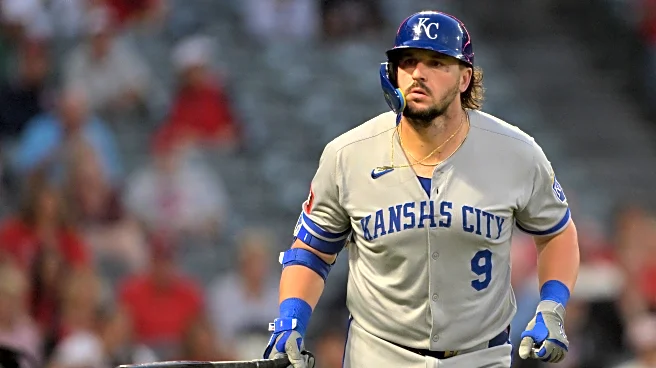



The Royals will have potential arbitration hearings with Kris Bubic and Vinnie Pasquantino in the next few weeks. Neither player came to terms with the team, leading each to file for an arbitration hearing. Bubic filed for $6.15 million, while the Royals countered with $5.15 million. Pasquantino filed for $4.5 million, with the team offering $4 million.
The Royals haven’t gone to an arbitration hearing since 2023, when they won their case over Brady Singer, but they’ve had plenty of experience going
head-to-head with players over the years. Since players won the right to go to arbitration in 1973, the Royals have had 23 arbitration hearings so far, winning 12 of their cases, while players have won 11. The table below shows what each side filed for, and how much larger the player request was than the team offer.

The gap between player requests and team offers has shrunk in recent years. Both sides now have tools to better estimate what a player in that situation will receive through arbitration. The difference between what Vinnie Pasquantino is asking for and what the team has offered is smaller than the difference of any arbitration case the team has ever had.
Players won the right to salary arbitration after a work stoppage in 1973 that canceled part of spring training, although it was a concession owners would soon regret. After the season, any player with at least two years of service time could dispute their salary. That means nearly 500 players could have filed for arbitration, yet just 54 did that first off-season, and 25 settled before going to a hearing.
The first player to go to arbitration was Twins pitcher Dick Woodson, who enjoyed a breakout season that year. He was specifically chosen by the union to highlight the alleged frugality and abusive negotiations against Twins ownership. He won his case and was awarded a $30,000 salary, instead of the $23,000 offer from the Twins. Three months later, he was traded to the Yankees.
The Royals had three players file for arbitration that first off-season – infielders Fred Patek and Cookie Rojas, and pitcher Paul Splittorff. Patek and Split settled before going to a hearing, but the Royals could not come to terms with Rojas. The popular veteran second baseman was coming off his second All-Star season in Kansas City, having hit .276 with six home runs and 18 steals, earning a few MVP votes. But the 34-year-old was also mulling retirement, to be with his wife, who was battling health problems, and his four kids.
Rojas decided to return, but wanted money he felt he was owed after a long career and yearly salary disputes in the days when players had little recourse. He knew his earning days were drawing to an end and wanted to take advantage of the new arbitration system. He asked for a salary of $72,500, with the Royals countering with $60,000. The team claimed they were losing money, despite attendance doubling that summer.
Rojas would lose his case, one of 16 players who lost their arbitration cases, while 13 were awarded their requested salary. The biggest winner was slugger Reggie Jackson, who was awarded a salary of $135,000.

At the time, this was the only recourse for players to appeal their salaries. While players eventually secured free agency in 1976, the union continued to advocate for arbitration as a safeguard for players still years away from reaching the open market. Modern arbitration is available to players with three or more years of service but less than the six years needed for free agency, as well as players with two years that are in the top 22 percent of service time, known as a “Super-Two” designation.
Teams must ‘tender’ a contract to eligible players by a November deadline or ‘non-tender’ them, which immediately makes them free agents. Players tendered a contract can continue to negotiate a salary for the next season, and those that fail to reach agreement can file for arbitration by a January deadline. The player will file their salary request, while the team files their offer. They can, in theory, continue to negotiate up until the hearing decision, but many teams have a policy known as “file-and-trial”, meaning once the two parties file, negotiations are over.
The hearing is before a panel of three arbitrators, where the player makes arguments on why they are deserving of their request, while the team argues why their offer should be chosen. This can create animosity, as the team is essentially arguing the player is worth less than they claim. The collective bargaining agreement spells out what factors can be considered by arbitrators:
The criteria will be the quality of the Player’s contribution to his Club during the past season (including but not limited to his overall performance, special qualities of leadership and public appeal), the length and consistency of his career contribution, the record of the Player’s past compensation, comparative baseball salaries…the existence of any physical or mental defects on the part of the Player, and the recent performance record of the Club including but not limited to its League standing and attendance as an indication of public acceptance…
The panel is directed to give particular attention to comparative salaries for players with similar service time. Inadmissible evidence includes the financial position of the player or club, press comments on the player’s performance, and details of salary negotiations prior to the hearing. Only publicly available data may be used; proprietary team metrics are inadmissible. The panel can choose the player’s request or the team’s offer; they cannot choose a middle ground. According to a 2023 study by Devan Fink, teams have a 57 percent success rate in arbitration hearings.
Teams used to be able to release arbitration-eligible players in spring training for termination pay – obligating them to pay just a fraction of the player’s salary – but that provision was eliminated in the most recent labor deal.
More than 50 years after salary arbitration was introduced, the process has become far more predictable than in its early days, even if it remains inherently adversarial. The gap between the numbers filed by the Royals and their players suggests a resolution could come before a hearing is ever necessary. If not, fans can only hope the process doesn’t leave a lingering strain on the relationships between players and the club.