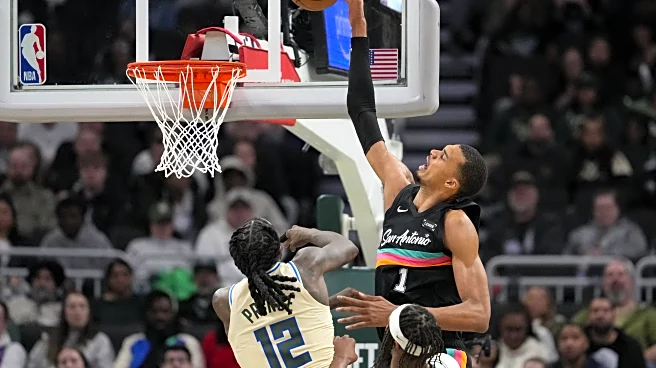



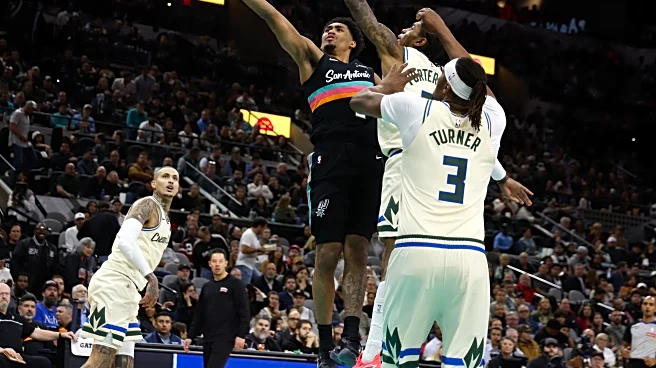
San Antonio is now 25-2 since February 1st, with a good chunk of those wins being blowouts (or at least blowout-adjacent). This latter outcome has been especially common recently, as the Spurs’ schedule has been laden with hapless teams more interested in collecting ping pong balls than wins. The stereotype is that conditions like this breed complacency, often resulting in a disappointing loss to an underqualified opponent.
I never actually thought that Chicago would win last night’s game, but the
first quarter at least raised the specter of this cautionary tale. Outside of some spectacular play by Wemby, the Spurs felt a bit disconnected, inconsistent, and bored (I love puns!) during that period. However, by the start of the second everyone seemed to get on the same page, and San Antonio was off to the races. This game ended up being a pretty vanilla blowout in which the Spurs earned several respectable but unspectacular box score margins. Even so, there were a number of notable highlights:

- This was yet another dominant rebounding performance from the Spurs, with TRB and ORB differentials of +20 and +9, respectively. San Antonio has now had at least 20 more rebounds than its opponent in four of the last five games, and amassed a five-game TRB differential of +97. This is the highest 5-game TRB margin that any team has produced in the regular season dating back to the start of 2012-2013. The previous record was held by the Houston Rockets, who achieved a TRB margin of +96 across five games ending on March 17, 2025.
- Although not as spectacular as their performance against Milwaukee, the Spurs put together another excellent foul differential in this game, with six fewer fouls than Chicago. On average over the last 13 seasons, this would have translated to a FTA margin of about +11; however, the Bulls’ fouls appear to have been pretty well-timed, as San Antonio only had three more free throw attempts. With both teams having essentially the same FT%, the Spurs’ extra volume translated to a FTM differential of +2.
- The Silver and Black finally managed to outscore a team from distance for the first time since their win over the Kings on March 17th, albeit by the narrowest margin possible. As in the Milwaukee game, this happened because the Spurs’ significant edge in 3P% (+11.63 percentage points) was largely negated by the Bulls’ advantage in 3PA (+10).
- Even so, the Spurs did manage to pull away using a solid edge in FG% (+4.81 percentage points), which – together with an advantage in FGA (+3) – helped them log six more made baskets than Chicago.
What are Team Graded Box Scores?
Very briefly, these box scores grade winner-loser differentials for basic box score statistics, with the grade being based on the winning team’s differential relative to other NBA winners during a defined reference period. Think of it like a report card for understanding how a given winner performed relative to other winners. The reference period used runs from the start of the 2012-2013 season to the latest date of play, including only games in the same season category (i.e., regular season and playoff games are not compared to each other).
Data Source: The underlying data used to create these box scores was collected from Basketball Reference. In all cases, the data are collected the morning after the game is played. Although rare, postgame statistical revisions after data collection do occur and may affect the results after the fact.