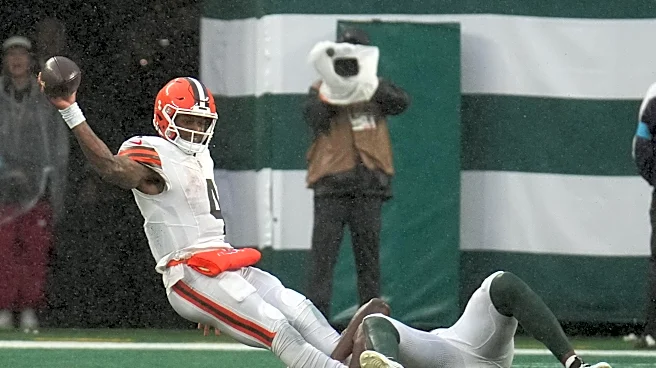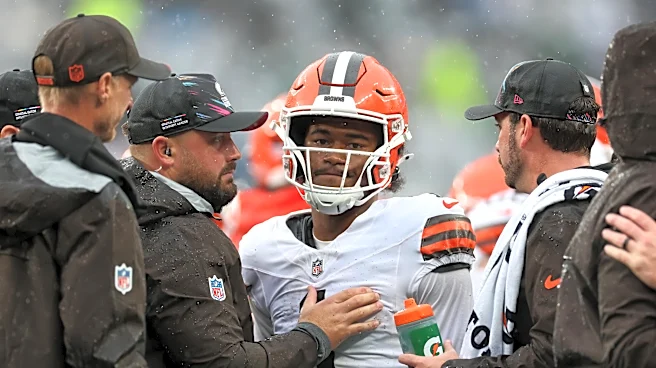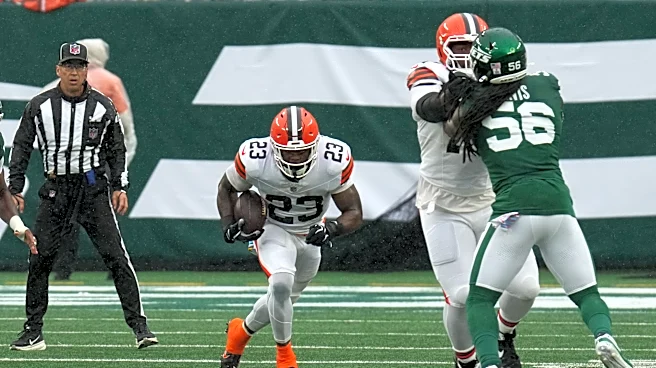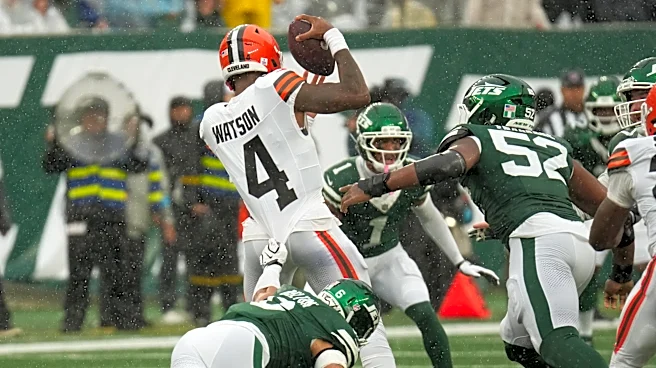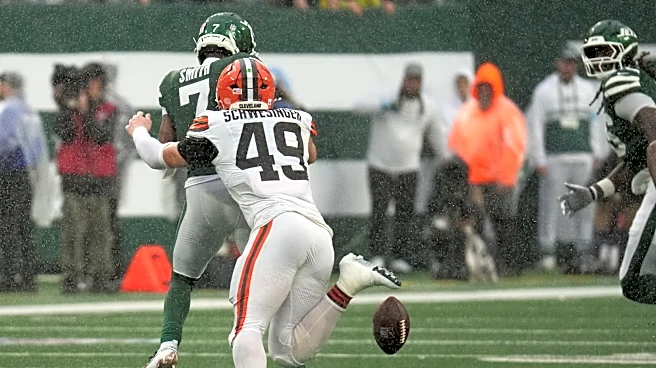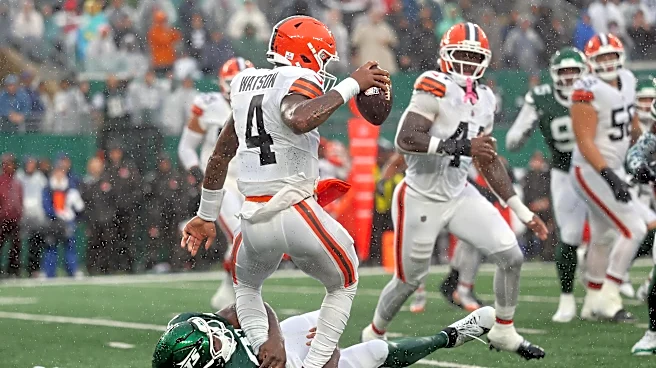


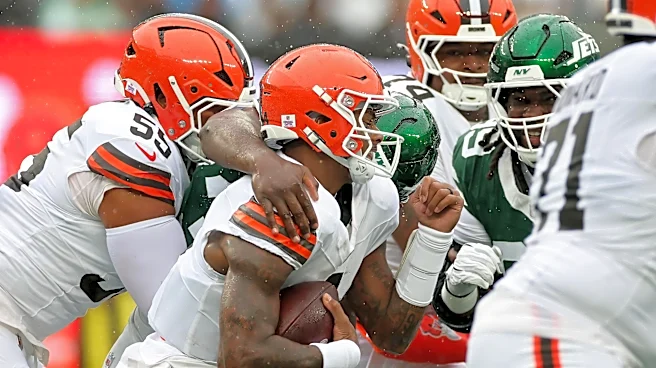
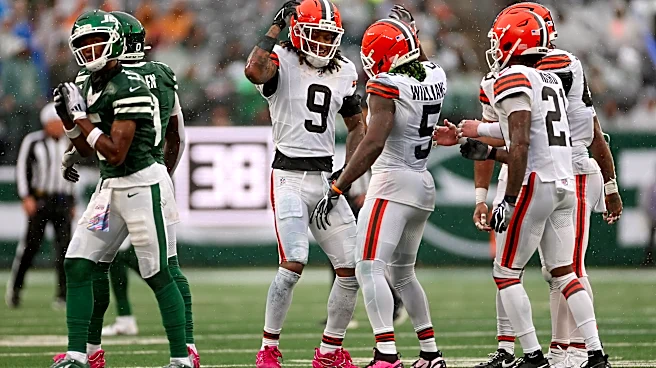
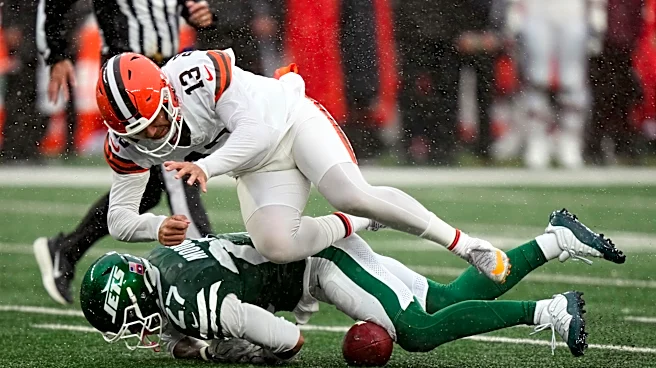

The Cleveland Browns lost to an inferior opponent this past weekend, when mistakes and a huge number of sacks gave the New York Jets a 17-12 victory. This was one team that all Cleveland fans had stuck a “W” on the schedule. The loss put the Browns at 3-2-0 instead of 4-1-0 and a lead in the division.
The Jets had eight sacks. It was a jailbreak on almost every passing down.
RELATED: PLENTY OF BLAME WHEN THE OFFENSE STRUGGLES
Is Cleveland’s offensive line that bad? What happened, and what is the fix?
And not during the offseason, but now.
Is this an offensive line issue, or is Browns QB Deshaun Watson to blame, or does it fall on the scheme, system of Todd Monken?
Cleveland currently starts two rookies along their offensive line: LT Spencer Fano and RG Austin Barber. Barber has been inserted for the injured Tevon Jenkins, who remains out with a back issue. Maybe the inclusion of undeveloped players in the lineup can be the source of the blame for the poor play.
Eight sacks. Obviously, something isn’t gelling. The Jets have had a formidable defense for years, with their problems usually on the offensive side of the ball. And they showed that on Sunday. It seemed like every time Watson dropped back to pass, there was a green jersey or two wrecking the pocket.
According to Pro Football Focus (PFF), the Browns offensive line as a wholeis ranked #28. Ouch.
But hold the phone. By PFF’s data, five of those sacks were credited to the offensive line.
Sack #1
Fano is credited with a sack in the first quarter from LB David Bailey when Watson dropped the snap and the pocket went haywire.
Sack #2
On a first down at New York’s 42-yard line with 12:57 left in the second quarter, Watson was back in shotgun, took the snap, and was almost instantly leveled by former Browns draft pick DE Jowon Briggs. What happened was that right off the snap, center Jenkins squared up but did not have a defender to block. At the same time, Barber took on Briggs while MLB Demario Davis came in without any blocker until he met RB Quinshon Judkins.
Judkins’ block of Davis slammed the Jets defender into Barber, who then lost control of Briggs, and Briggs was now free and able to bear hug Watson for the sack.
Sack #3
The third was also in Quarter 2 with 7:05 before the half.
Bailey lined up at left end. Off the snap with Watson in shotgun, NB Brownlee blitzed, and Howard blocked down to take him. Meanwhile, Bailey was completely unblocked and had a free lane that Watson could do nothing about.
Sack #4
With 13:01 left in the game, Cleveland had a third-and-30 at their own 35-yard line. Bailey came off the snap like a bullet; the new RT, Dawand Jones, could not extend that long paw far enough, and Bailey was all over Watson quickly.
Sack #5
Then, with 2:41 remaining, the Jets rushed six; Jones could not contain Bailey, who had the first shot, and then Watson went down; he had four New York defenders on top of him. Officially, it was Jackson credited with the sack.
One sack was on the tight end.
Early in the fourth quarter, facing a first-and-15 at the midfield stripe, the Jets were up 10-6. Brownlee came off the left side and met TE Harold Fannin. As Brownlee took an inside move, Fannin threw a shoulder at him and then had a straight shot at Watson. The QB tried to throw the ball in the direction of Boston, but the officials had ruled him down.
On this play, the offensive line had provided a beautiful pocket.
The other two sacks were on Watson.

As the second quarter was winding down, Watson took the ball in shotgun, and the pocket stood up as the Jets only rushed four, then brought a fifth on a delay. Sanders stayed in to block and took out LB Jamien Sherwood. Watson had a window, but held it. He pumped, then brought it in. Meanwhile, Barber has lost control of his man, the blitzing safety Dane Belton. As Watson tried to go to his left and leave the pocket, Belton had a clean shot and decked the quarterback.
Take the third-and-five play in the first quarter with the Browns on New York’s seven-yard line. Right off the snap, the Jets rushed six. Rocket Sanders was positioned in the backfield and remained in to block. Fano did not strike his defensive end, Darrell Jackson, but instead jumped outside to take on blitzing LB Will McDonald. Sanders would block Jackson. Johnson and Jenkins took on their defenders as usual. But on the rightside, the defensive end crashed down towards the middle, which left blitzing nickelback Jarvis Brownlee with a straight shot to Watson.
Watson had to get rid of the ball quickly and threw it too high for WR Denzel Boston.
Now, how should this formation be changed? The most obvious is to stick a blocking tight end alongside Howard, hit Brownlee as he approached, and then go out for his route. Boston had a small opening, but he would have been open if Watson had time to get off a good pass instead of forcing the throw.
(Editor’s Note: Does the Cleveland roster have a blocking tight end?)
The end result was a field goal instead of six points.
On the game’s final play, the pocket was there with enough time to survey the field. Bailey eventually got loose from Jones and then chased Watson. Now, if everyone was covered, then they were covered. Watson tried to scramble and look downfield since it was a fourth-and-11 play and there wasn’t a chance that Watson could run for that distance. Bailey caught up with him and the game was essentially over.
Offensive line help
Barber is really struggling. On several plays, he is just being pushed out of the way by much stronger men. On the sack with 2:41 left in the game, it was Bailey who made Watson step up, but Jackson completely pushed Barber out of harm’s way as he then smashed into the Browns signalcaller. His pass-blocking grade is pretty good at 64.0.
Fano is playing very well. His pass-blocking grade is an impressive 77.2 so far. He has allowed just nine pressures in five games and has had one penalty accepted. He is ranked #14 out of 72 qualified offensive tackles.

C Elgton Jenkins is the ace of this group and has been exceptional this year, especially with pass protection. His overall PFF grade is 62.6, but his pass-blocking ability has garnered him an 82.4 grade. That is #1 among 33 centers graded this year.
Johnson also has a good pass protection grade of 76.6, but his run blocking needs work, plus he collects laundry, as he has four accepted penalties. But he has allowed zero sacks so far.
At right tackle, Tytus Howard suffered a knee injury in the first quarter against New York and tried to return. His overall PFF grade is 50.3, but his pass-blocking skills are decent at 64.8. In his place, Jones was beaten badly and often by the Jets. If his man, Bailey, was getting to Watson, his actions were making Watson adjust his pocket presence or simply forcing him to leave the pocket entirely.
The bad offensive line play against the Jets was a fair assessment.
Here are a few facts that affected the outcome of the game:
- Total dropbacks under pressure: 18
- Total sacks allowed: 8
- Watson pressures allowed: 5
- Offensive line pressures allowed: 8
- RB/TE pressures allowed: 5
The eight pressures the offensive line allowed equate to 44.4%, which was the second-lowest rate in the league over the weekend.
Another body in-line
What would help the offensive line is to have a tight end or two who can actually block.
(Editor’s Note: Maybe don’t make the first editor’s note before reading the whole article, yet here we are with editor’s note #2)
Blake Whiteheart looks to be involved in the blocking game, but he does not remain engaged and often loses his defender. Harold Fannin is a talented receiver, which is why he was drafted after leading the nation in receptions and receiving yards his final year at Bowling Green. But his limited play strength impacts his effectiveness as an in-line blocker. When healthy, Carsen Ryan attempts to center his blocks, but he isn’t built to duke it out in-line.

Simply put, Cleveland needs a body or two who can actually hit somebody and remain on their block. This roster is currently devoid of a tight end who can block.
In training camp, that appeared to be Jack Stoll, who was released on August 20 with an injury settlement and is now on the San Francisco 49ers practice squad. He would be a welcome addition. On the Browns’ practice squad is 6’-7” John Fitzpatrick. He will engage, but his lower-body strength is questionable and limits his in-line blocking. Recently signed Devin Culp is an average blocker who is a bit undersized.
Free agent tight ends that are known for their blocking skills include former Brown Pharaoh Brown (6’-5”, 246 pounds), who is a terrific blocker, Will Dissly (6’-4”, 265 pounds), and Tyree Jackson (6’-7”, 249 pounds).
As far as Cleveland’s running backs staying in, Quinshon Judkins, Jaleel McLaughlin, and Raheim Sanders give it all they have when kept in for that extra blocker. They don’t always read the correct defender to take on, but they engage and put their entire body into the block.
Do you think the Browns blocking issues can be solved? Is the problem even on the offensive line at all?
Join the conversation!
Sign up for a user account and get:
- Fewer ads
- Create community posts
- Comment on articles, community posts
- Rec comments, community posts
- New, improved notifications system!
Download the SB Nation app on iOS or Android.