

I am obsessed with the historical occurrence of the fad.
Fad is a word that sounds contemporary but is actually much older, having been coined back in the 1830s as a probable variation of the French word ‘fadaise’ (meaning a trifle and/or nonsense), which was ultimately derived from the Latin ‘fatuus’, which is basically another word for stupid.
And there have been a lot of stupid fads. Some have become lovable and enduring forms of nostalgic lore, like The Macarena, the Hacky Sack, and the Hula Hoop.
Others serve as an external testament to human gullibility and the power of marketing, like the Pet Rock, the Sauna Suit, and vibrating exercise belts.
No longer confined to the “fashion-craze” 1880’s definition of the word, the fad lives on as a societal organism, even in the age of the algorithm. It existed long before the word that we now use for it, and has endured through every phase of recorded history and technological advancement.
We’ve even cycled through a few in the NBA.
‘Positionless’ basketball. The proliferation of small-ball centers. The theoretical softness of European players. The idea that ‘tweeners’ (players who didn’t slot into a traditional 1-5) should be avoided in spite of skill.
There’s even one that’s become an integral part of the modern game: the ABA three-point line.
My favorite fad was introduced to the world in the early 90’s, an epoch rife with Pogs, and Slap Bracelets, with the immortal and quotidian Furby to come, perched upon the sculptured bust above my chamber door.
Magic Eye pictures, also known as autostereograms, were all the rage when I was child.
First published in books in 1991, autostereograms are two-dimensional images that can create the optical illusion of a three-dimensional picture within the 2D image when vision is manipulated in a specific way by the viewer.
One must look past the image in order to see this, to engage Stereopsis (a trick of depth perception caused by the different perspective each eye has of a three-dimensional scene), which is a difficult thing to explain to a 4-year-old.
I wanted to see the pictures so badly. My father did his best to help. He told me to focus on the two dots above the picture, and then relax my eyes until they turned into three, and then look down. No dice.
He told me to touch my nose to the picture, stare into space, and then slowly pull back. No luck there either.
Tantalized by the knowledge of pictures just beyond my sight, I stared at them for hours, patiently (and impatiently) waiting for something, anything, to pop out of the frame in the way that so many had described.
Staring at my television in Game 2, I found myself doing the same thing; trying to will myself into some vision beyond what I was seeing play out on the screen.
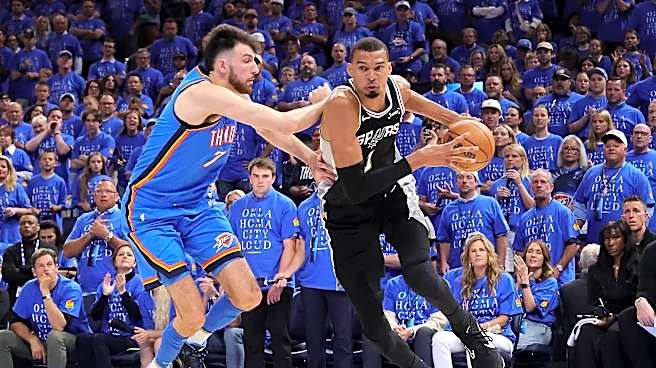
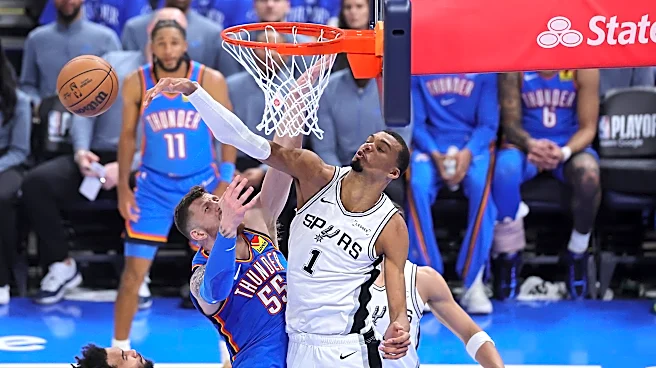
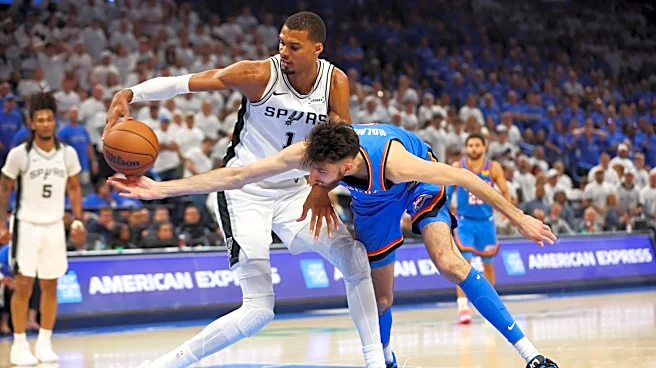
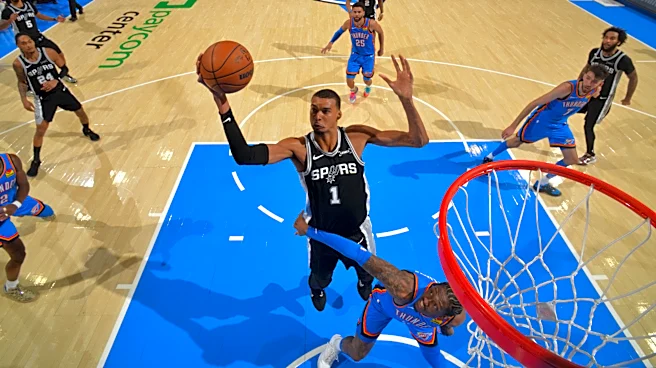
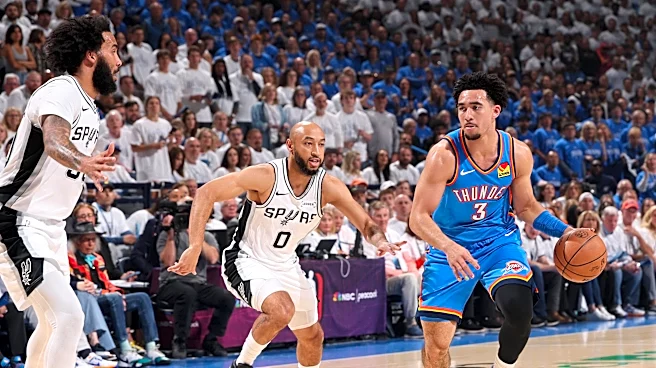
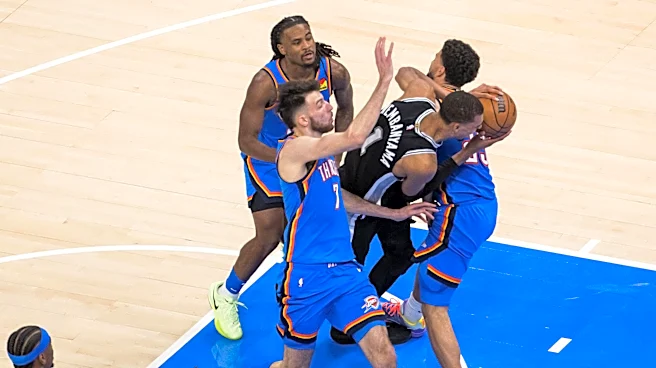
The officiating was jarring. Wemby was being manhandled both inside the paint and outside it by an unleashed and unchecked Isaiah Hartenstein. De’Aaron Fox was out recovering from a re-aggravated injury from the series before. Harper made his way up the tunnel, made a bid to escape Spurs staffers, and then vanished into the locker room yet again, with no one certain of the cause.
Stephon Castle was yanked about by the hair and fired errant passes with an air of increasing desperation and chagrin. And the physicality all but barred Keldon from his usual forays into the paint, as he went 4-12 and found himself being targeted by the swan-diving Thunder.
And it wasn’t that I couldn’t get the picture. I more or less had it by the end of the 3rd quarter. This was a loss.
It was one-sided, and ugly, and exactly the kind of defeat that could send even the most composed Spurs fans into a spiral, and that included me.
I was straining to see what the picture within the picture was.
What were all of these repeating frames and violations composing out of their shape and redundancy? I restarted the game after it was over and continued to stare at it, just as I had the Magic Eye books of my youth.
Everything seemed bad. It just did. There were a lot of things that I could tell myself to feel better, but the more I thought about it, the worse things seemed. The Spurs were down to one of their three all-star caliber guards. Both Game 1 and Game 2 had been called fairly unevenly, even though Game 2 had now glaringly overshadowed it.
Even if one (or both) of said guards returned, there was no guarantee that they wouldn’t be ushered right back off of the court if the same degree of physicality was going to be allowed. And even if it wasn’t, that was no guarantee of effectiveness from players with potentially nagging injuries.
An hour so later, I went back to bed, no clearer on the matter than before.
And it wasn’t until the following afternoon, sitting in my truck, locked out of my home and waiting on a locksmith, that it clicked for me. I was crossing my eyes.
It was something I had figured out after enough time spent gazing at autostereograms with no result. If I crossed my eyes on purpose, instead of waiting for them to adjust, I could make the shapes appear.
Instead of popping out of the frame, they would sink into it, creating the impression of the hidden shape. I was thrilled by this development until I told my father about it.
“You won’t be able to see all of the details that way”, he said to me, frowning slightly. “That’s why I didn’t tell you about it. I wanted you to be able to see the whole picture.”
The whole picture. That’s what I was missing. And the thing is, as I had eventually learned, you kind of have to relax in order to see it. And relaxation isn’t exactly one’s first instinct after a game like that.
So, closing my eyes, I went back over the game in my mind.
I saw Julian Champagnie and Castle going a combined 2-13 from three, a trend likely to reverse itself. I saw Devin Vassell putting in savvy work against Jaylin Williams, Jared McCain, and Isaiah Joe while dropping bombs near max efficiency. I saw Jordan McLaughlin put in quality minutes with little to no preparation, boding well if he has to play more, and becoming positive by default if Harper and/or Fox are able to play.
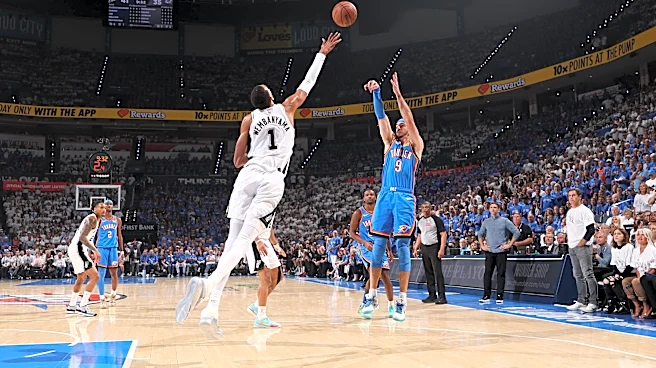
And then I saw the shape pop right out of the background. Long. Rangy. Swatting everything in sight and reach.
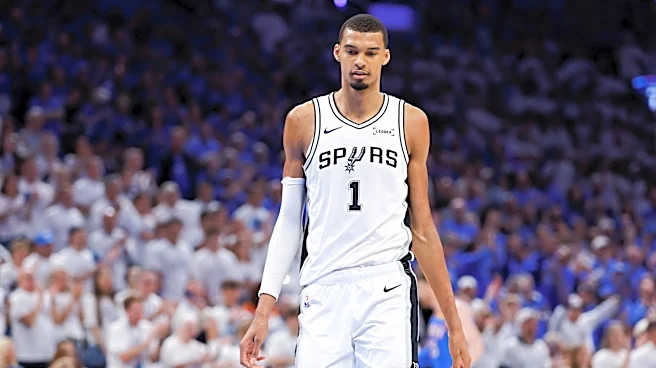
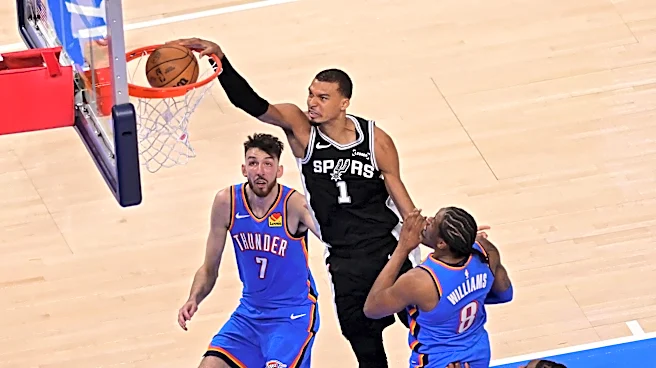
The Spurs have Victor Wembanyama. That’s the big picture. That’s the trump card that they have that the Thunder don’t. Sure, they forestalled him for a game. On their home court. With foul calls going almost entirely in their favor (or largely uncalled). After he bent Game 1 to his will like a raging Kaiju let loose in Oklahoma City.
This strategy of unchecked physicality is just a fad. Teams have been trying it out one after another because that’s the fashion. That’s what coaches, and front offices, and talking heads are thinking will work. They’re clinging to anything that offers some modicum of success. They’re hoping that it’ll stop Wemby.
But it hasn’t for long. It works in fits in starts — in sometimes, and quarters and halves.
It’s not a long-term solution. It hasn’t won a series. It’s not here to stay.
In the context of economic studies, fads are mean-reverting deviations from intrinsic value caused by social or psychological forces. They succeed only as a temporary extension of misguided belief, and then return to the mean.
Like mutton-chops, and hoverboards, and chopines (platform shoes), they exist as residue of human envy and enthusiasm for that which is novel and (often) absurd, and sometimes become a part of the fabric of civilization in enduring ways. Entire eras are colored and defined by them.
It’s possible that they are the debris of humanity itself. That they’ll cease to occur in the same gap of time that we cease to exist. But so long as the Spurs have Wemby, I expect them to keep popping up.
That’s how much players and teams are grasping at straws. The fads are the sign of the times.
And this is the time of the Wemby.
Takeways
- I’ll be the first to admit that I wasn’t big on Stephon Castle out of his draft class, but I knew the Spurs needed guards, and I did think that (if he could improve his shooting) he had a shot at becoming a pretty decent combo-guard. I was resigned to the Spurs drafting Castle, but I was really hoping they’d draft Jared McCain with their other 1st rounder (not being able to imagine a world where they landed Dylan Harper the following year). I say this so that you understand when I say that Castle has completely won me over. After a couple of months, I pronounced him Jrue Holiday 2.0, which I meant/mean as an absolute compliment. Holiday was one of my most desired players coming out of college ever (after LaMarcus Aldridge and Gordon Hayward), and I consider him to be the best two-way guard of the last decade. The thing is, though, that Holiday has historically been at his best running the point in stints, and sharing the back-court with other guards like Derrick White, Dame Lillard, and Steph Curry, and/or heavy assist forwards like Giannis, Middleton, Avdija, and Draymond Green. The same appears to be true of Castle, who creates value in so many ways that it’s really hard to fault him, or even really consider it much of a shortcoming. With Fox and Harper both out, though, it came to the forefront in a historically ugly way, and he and the coaching staff are going to have to figure this out, even in the event of the return of one (or both) of those guards. In fact, I’d like to see them go out of their way to make a point early in the next game that appropriate adjustments have been made and ram the ball down the Thunder’s collective throats. Castle has that kind of work ethic, fire, and grit, and I’m certain that he can do it with a strategy session beforehand.
- I’m starting to think that the Spurs need to kick the tires on French Vanilla if/when the Thunder try to go back to some of their rough-and-tumble paint hijinks. As I understood it, this is exactly the sort of thing that Kornet was brought in for, so it’s odd not to see him used in that way, especially if the Spurs are content to just let Caruso fire away. If you’re gonna give that guy open threes, then who cares if you play two bigs? It just feels like a natural counter that needs to be shown when the Thunder play that hand, as I’m sure they will again.
- After some inconsistent shooting performances, Devin Vassell has improved his shooting with every round. He shot 42 and 44% in the first two rounds, and 35% from three. So far, he’s been absolutely huge in this round, upping his shooting from the field to 46% and his long-distance shooting to 43%, in addition to the largely outstanding defense he’s put on display in the postseason. I know I’ve talked a lot about how insanely good Kornet and Champagnie’s contracts are, but even at 27 million, Vassell is giving them a real run for their money in terms of value, and his salary actually *drops* next year! San Antonio’s front office has to be the envy of just about every owner in the league, be they spend-happy or thrifty beyond belief. And to think they did it without cutting every reasonable expense in the process. I’m guessing that guy in Portland thinks he can outdo them, and boy, would I like to sell him the site of Iowa’s one-and-only shark attack if he thinks he can make that work.
Playing You Out – The Theme Song of the Evening:
Godzilla by Blue Oyster Cult