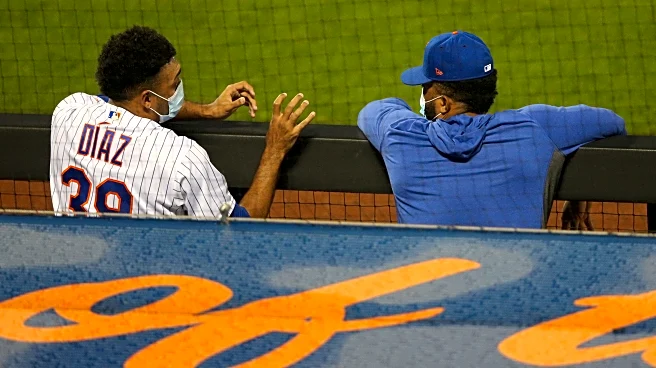




Just over seven years ago, the Mets and the Mariners pulled off a blockbuster trade during the 2018 Winter Meetings. New York sent first-round picks Jarred Kelenic and Justin Dunn, alongside outfielder Jay Bruce, relief pitchers Anthony Swarzak and Gerson Bautista to Seattle in exchange for second baseman Robinson Canó and closer Edwin Díaz. At the time, the Mets, and their new GM Brodie Van Wagenen, were heavily criticized for trading Kelenic, who was seen to be a cornerstone of their system, and for taking
on the contract of Canó, which was already seen to be an albatross.
With Díaz signing with the Dodgers this week, neither team still retains any player swapped in this trade. In fact, with Kelenic currently a free agent, Díaz remains the only player in the bunch to be guaranteed to be playing professional baseball in the United States in 2026. This is the perfect time to look back on the trade and see just how it all shook out.
Note: For simplicity sake, while other statistics may be used to illustrate points, bWAR will be the primary statistic used so that we are comparing apples to apples. If this is not your statistic of choice, apologies.
The Trade:
Mets received Edwin Díaz, Robinson Cano and $20 million
Mariners received Jarred Kelenic, Jay Bruce, Anthony Swarzak, Gerson Bautista, and Justin Dunn.
The Mets’ side:
Edwin Díaz, already a star in Seattle, having saved 57 games in 2018 with a 1.96 ERA and a 208 ERA+, struggled in his first year in New York. Despite saving 26 games, Díaz put up a career high 5.59 ERA and gave up 15 home runs in 58 innings pitched, resulting in the only negative bWAR season of his career with -0.6.
However, for the remainder of his initial contract, Díaz was more or less lights out. With 2021 simple being a ‘very good, not great season,’ 2020 and 2022 saw Díaz as one of the best relievers in baseball. 2022 in particular was phenomenal, with a 1.31 ERA, 118 strikeouts and a 297 ERA+ in 62 innings. It was on the strength of that season that Díaz signed a five year, $102 million contract with the Mets ahead of the 2023 season, the highest for any reliever in history (both in terms of average annual value and total dollars) up to that point. The first year of that contract was lost to a freak injury suffered during a ‘celebration’ at the end of a World Baseball Classic game, but Díaz came back as mostly the same pitcher for 2024 and 2025, albeit with a little less velocity on both of his pitches.
Robinson Canó was a different story. Already in decline when the Mets traded for him, he struggled mightily initially as a Met, with a first half OPS of .646 in 2019. He rebounded a bit, but it was easily Canó’s worst year since 2009, batting .256/.307/.428 with 13 home runs and an OPS+ of 95. However, in 2020, Canó looked like his old self in the shortened COVID-19 season, putting up 1.3 WAR in just 49 games.
However, that offseason Canó popped a positive test for stanozolol and, because it was his second such performance enhancing drug test failure, was suspended for the entirety of the 2021 season. Canó returned in 2022 but began the year incredibly slowly and the Mets decided they saw enough, releasing him on May 8th, thus ending his Mets career. After cups of coffee with both the Padres and Braves, Canó was out of Major League Baseball, though he played both in Dubai and in the Mexican League. In fact, Canó was still playing in the Mexican League as of 2025.
The Mariners’ side:
Over parts of four big league seasons, Justin Dunn made 32 starts for the Mariners and Reds and, as recently as last year, was still trying to make a comeback to the majors, having stints in the White Sox and Royals organizations, but a number of injuries, almost all of them shoulder-related, kept him limited in his innings and his effectiveness. However, he was part of a trade which we will discuss a little later that had more impact on the M’s than any other part of this deal.
Gerson Bautista made his MLB debut with the Mets in 2018 before being traded, and would pitch in eight games for the Mariners in 2019 before being released at the end of the season. After a season in Mexico, Bautista attempted a comeback with the Giants, but never got higher than Triple-A. After that, he pitched in the Mexican League until the end of the 2024 season.
Anthony Swarzak, whom the Mets had signed to a two-year, $14 million contract ahead of the 2018 season, missed all of spring training in 2019 and started the year on the Injured List. After just 15 appearances, Swarzak was traded to the Braves for Arodys Vizcaíno and Jesse Biddle. Swarzak did not pitch in the 2020 season, and finished his career splitting the 2021 season between the Diamondbacks and the Royals.
Jay Bruce, a former All-Star who the Mets acquired twice between 2016-2018, played just two months for the Mariners before being traded, along with $18.5 million to the Phillies, for whom Bruce played through the end of the 2020 season. After spending the first few weeks of the next season in the Bronx as a Yankee, Bruce retired on April 18th, 2021.
But the real prize of the Mariners’ haul at the time of the trade was Jarred Kelenic, who the Mets drafted sixth overall in the 2018 draft, just six months earlier. Kelenic was the prize of the Mets’ system at the time of the trade, and many had high hopes for him. While Kelenic showed some promise in his first two seasons for the Mariners, he was mostly a disappointment for Seattle. His third year was the first where he looked anything remotely close to what the Mets had drafted him to be, despite kicking a cooler and thus losing two months for breaking his foot against said cooler. On that success of that shorted season, he was traded to the Braves ahead of the 2024 season alongside Marco Gonzales and Evan White for Jackson Kowar and Cole Phillips. 2024 was a disaster for Kelenic and, after another disappointing season in 2025, Kelenic was outrighted to Triple-A and elected free agency.
The aftermath:
In a continued attempt to compare apples to apples, we are only going to use Díaz’s initial Mariners contract when talking about the trade since, hypothetically, the Mets could’ve signed him to his free agent deal whether or not he was traded to them in 2018. Also, in the interest of simplicity, while we will look at trade returns after the initial deal, it doesn’t make sense to try to itemize how much each former Met was worth in a trade versus the other players in each trade. This is obviously not scientific nor perfect, but simply a way to look at the trade with some reasonable distance and perspective.
On the Mets side, it’s fairly simple: Canó put up 1.4 bWAR as a Met, and between 2019 and 2022, Díaz was worth 5.1 bWAR. Because Cano was released and not traded and Díaz re-signed, the Mets acquired no additional players down the road; the trade ended when both players signed elsewhere.
The only variable in this side of the discussion is the money. The Mets received $20 million in the swap which, hypothetically, they used in the 2019 offseason to bring in players like Jed Lowrie, Wilson Ramos, Justin Wilson, and re-signing Jeurys Familia.
Lowrie, signed for two years and $20 million, is widely regarded as one of the worst signings in franchise history, as Lowrie made just eight plate appearances as a Met and fought various bizarre injuries on his way to -0.2 bWAR. Ramos signed a two year, $19 million contract and put up 2.4 bWAR in his two seasons as a Met. Familia came back to the Mets on a three-year, $30 million deal, and pitched in 156 games, good for 0.1 bWAR. Wilson joined the Mets on a two-year, $10 million deal and he appeared in 68 games with a 2.91 ERA, good for 1.4 bWAR.
The $20 million clearly helped the Mets to sign these players, whose contracts worth approximately $35 million in 2019 payroll obligations. And so, for this exercise, we will attribute 57.1% of the bWAR from these players to this trade, even though the money only contributed to the first year. Again, this is sloppy math, but is merely to illustrate a point.
The Mariners’ piece of this is a little more complicated. While Dunn was worth 1.5 bWAR over his three seasons with Seattle, he was traded alongside Brandon Williamson and Jake Fraley ahead of the 2022 season to the Reds for Eugenio Suárez and future old friend Jesse Winker. Over two seasons in Seattle in his initial stay, Suárez was worth 6.5 bWAR. Winker was less valuable, with -0.1 bWAR.
Bautista put up -0.3 bWAR in his one season with Seattle before being released. Swarzak (-0.3 bWAR) was traded for Jesse Bidde (-0.6 bWAR) and Arodys Vizcaíno (who never played for the big league club and, coincidentally, was in the Mets’ system in 2020). Bruce (0.2 bWAR) was traded with cash for minor leaguer Jake Scheiner, who never played for the Mariners either.
Kelenic’s first two seasons in Seattle were rough, but he had a nice 2023 season, which is what allowed him to be traded to the Braves (alongside Marco Gaonzales and Evan White) for Cole Phillips and Jackson Kowar. Cumulatively, Kelenic put up 0.2 bWAR for the M’s, and Kowar this season put up 0.1 bWAR in 15 appearances for Seattle (Phillips never made the majors). Kowar remains the only player associated with any of these trades in any capacity to still be on an initial contract with the Mariners (Suárez was re-acquired last season, but that’s contractually unrelated).
The tally:
Robinson Canó and Edwin Díaz’s bWAR as Mets between 2019 and 2022: 6.5
Ancillary bWAR (57.1% of Jed Lowrie, Wilson Ramos, Justin Wilson, and Jeurys Familia’s 2019-2021 contracts): 2.1
Total Mets’ bWAR: 8.6
Dunn, Bautista, Swarzack, Bruce, and Keleic’s bWAR as Mariners between 2019 and 2023: 1.3
Ancillary bWAR from acquired players: 5.9
Total Mariners’ bWAR: 7.2
When considered just the players in the initial trade, the Mets really won this one. However, with everything considered, it’s a more fair trade than it looked at the time, or really at any point in the process. After the rough 2019 for both Met additions and Kelenic playing in three levels of the Seattle minors system, it looked like the Mets had overpaid for damaged goods. But Díaz established himself as a top-three all-time Met reliever and revolutionized closer entrances and how they’re broadcast, while having maybe the best closer entrance song since “Enter Sandman,” with all due respect to “Danza Kurudo.”
The only unchecked box here is the rest of Kowar’s career as a Mariner. He’s under contract through 2030, so there’s every chance that he could emerge as a key part of the Mariners’ success down the road.
Another piece to consider is the knowledge that, just two years later, Steve Cohen bought the Mets. This allowed them to cut ties with Canó, something that would’ve been unthinkable under the Wilpon ownership group. Cohen paid almost $50 million for 43 plate appearances in 2022 and zero in 2023, simply because it made the team better on paper. If the Wilpons still owned the team in 2023, they would’ve kept playing a clearly broken Canó or planted more PEDs on him to get out of the contract (joking, ha ha, satire).
The trade signified the real start of the Mets’ post-2015/2016 team. 2018 was a start, with Brandon Nimmo and Jeff McNeil becoming everyday players and Jacob deGrom winning his first of two consecutive Cy Youngs. 2019 saw Pete Alonso break camp with the club and a the team racking up 86 wins in a very fun back end of the season. While the Mets wouldn’t have another winning season until 2021, Díaz’s arrival signaled a major piece arriving and helping establish what would be the core of the team for their next two playoff berths.