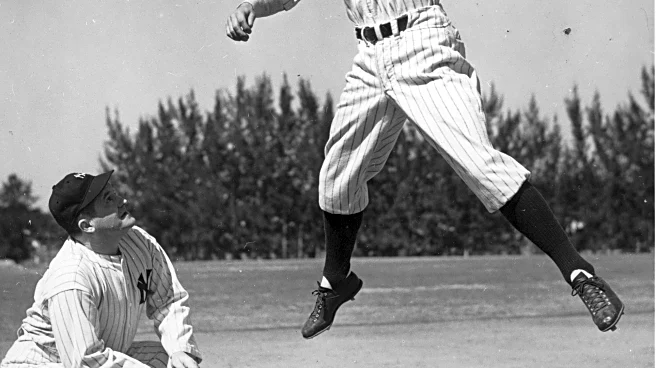

There are so many legends across the history of the New York Yankees that it feels like some members of their teams who were also excellent don’t get the recognition they deserve. Players enshrined in Cooperstown with a certain team’s logo almost always seem to be especially honored by the related club — perhaps a retired number or maybe even a statue.
Alas, though Joe Gordon is a Hall of Famer and was a slam-dunk entry on our Top 100 Yankees series (all the way up at No. 34), you won’t find a trace
of him in Monument Park. That’s honestly a shame because the man could really play and was one of the best second basemen in franchise history, winning an MVP and four World Series titles.
Joseph Lowell “Flash” Gordon
Born: February 18, 1915 (Los Angeles, CA)
Died: April 14, 1978 (Sacramento, CA)
Yankees Tenure: 1938-46
Joe Gordon was born in Los Angeles, but he and his family moved to Oregon, where he spent most of his time growing up. He attended the University of Oregon and was a multi-sport athlete, competing in football as a halfback, gymnastics, soccer, and the long jump, while also developing his violin skills in the college orchestra. Gordon joined the Ducks baseball team for the 1934 and 1935 seasons and hit .358 while at Oregon, which ranks him tied for fourth in team history. The team also won the Pacific Coast Conference’s North Division in both seasons he wore the Ducks uniform.
Gordon began his MLB career after signing with the Yankees in 1936, and he immediately began proving his worth at the second base position through the minor leagues. He was initially assigned to the Oakland Oaks in the Pacific Coast League before being moved to the Newark Bears’ Double-A team in 1937. And in 1938 — after one of the best minor-league seasons ever, with the Bears winning 110 of 158 possible games — he was called up to the Yankees to make his debut on April 18, 1938, against the Boston Red Sox.
In his first season, Gordon slashed .255/.340/.502 for an OPS of .843 and an OPS+ of 109 in 127 games. The biggest feat of his rookie season, though, was his 25 home runs, which put Gordon as the American League record holder for home runs by a second baseman 64 years before being surpassed by Bret Boone’s 36 home runs in 2001. In his rookie season, the Yankees also won their third of what would be four consecutive titles.
Gordon’s years up through 1943 were simply fantastic. He collected a total of 31.7 BWAR, slashed .282/.368/.478 for an OPS of .846 and a 128 OPS+ with 117 home runs, good for 23.4 per season. And not only were his numbers good enough to garner attention within the organization as the team’s starting second baseman, but they were good enough to garner national recognition as well.
Through those 1939-1943 seasons, Gordon was a six-time All-Star and the winner of the AL MVP award in 1942, beating out a name every baseball fan will recognize — Ted Williams — for the award. It’s true that Williams almost certainly deserved it since he won the Triple Crown and had a staggering 10.5 WAR season by Baseball Reference, but, well, he and the writers were not very fond of each other, so to Gordon went the spoils! It was still a terrific campaign. In that time as well, Gordon gathered another three championships to his resume.
Outside of baseball, there was, of course, the war going on. World War II required most men to enlist in the military, and as a result, Gordon missed both the 1944 and 1945 seasons. In 1946, though, Gordon was able to make his return to the Yankees lineup, but it was a major struggle. Gordon dealt with tons of injuries that either kept him out of the lineup entirely or made it extremely hard to play at a high level. His numbers dipped to .210/.308/.338 with an OPS of .645 and the first below-average OPS+ of his career at 79.
After some internal discussions within the organization, they decided it would make sense to move Gordon, and they did in October to Cleveland for pitcher Allie Reynolds, which helped both clubs in the end. New York won a slew of championships with Reynolds leading their staff, and Gordon found new life. The second baseman’s numbers returned, playing four years with Cleveland and not seeing a below-average OPS+ for the rest of that time. He was an All-Star three of the four years as well, along with finishing seventh and sixth in the 1947 and ’48 MVP race, respectively. Gordon also won his final World Series (and the last one in Cleveland’s history to this point) in that ’48 campaign, with the six-game win coming against the Boston Braves. Although Gordon was held to four hits, he did put Cleveland up for good in the decisive Game 6 with a solo shot off righty Bill Voiselle.
At the age of 35, Gordon played his final MLB game against the Detroit Tigers, posting just one at-bat. And after his major league career, Gordon became a player-manager with the Pacific Coast League’s Sacramento Solons. After a brief scouting career, he managed four major league teams — Cleveland, Detroit, the Kansas City Athletics, and their successor in KC, the Royals. But all were relatively short stays before he moved into real estate following his resignation from the Royals after their inaugural season in 1969.
Gordon passed away in Sacramento, California, on April 14, 1978, at age 63, due to suffering multiple heart seizures. He wasn’t a Hall of Famer at the time, but the Veterans Committee did grant him posthumous honors in 2009. That July, his daughter Judy accepted his plaque and spoke on his behalf in Cooperstown. We hope that somewhere out there, the Gordon family is toasting Joe’s eleventy-first birthday!
See more of the “Yankees Birthday of the Day” series here.