
So far this year the Rays as a team have produced just a 91 wRC+ against left-handed pitching heading into Wednesday’s game – ranking just 22nd in the league. After watching Martin Perez throw seven shutout innings against the Rays last week in Atlanta, I began wondering whether their struggles against left-handed pitching could become a problem in October. The short answer is no, and the current iteration of the roster suggests they should be better against lefties going forward.
First, that overall
team wRC+ is skewed a bit. The problem is concentrated among the team’s left-handed hitters. They have combined for a 72 wRC+ against southpaws, while the team’s right-handed hitters have posted a 101 wRC+. Some left-handed hitters will still have to appear in a postseason lineup, but the Rays have enough alternatives that the weakest platoon bats do not all need to play.
Chandler Simpson should be in the lineup against lefty starters. He has transformed himself into an impact defender, and his skillset is platoon-neutral so there’s no reason his performance data should be as low as it has been against lefties. His contact rates are still near elite against them, but he does chase quite a bit more versus left-handed pitchers. Simpson’s underlying contact ability suggests there is room for improvement in his production against lefties, particularly if he can reduce the additional chase that has limited his results. It wasn’t an issue for Simpson in his minor league career as he maintained nearly identical chase rates against both righties and lefties, so I expect that to take shape in the majors with more time.
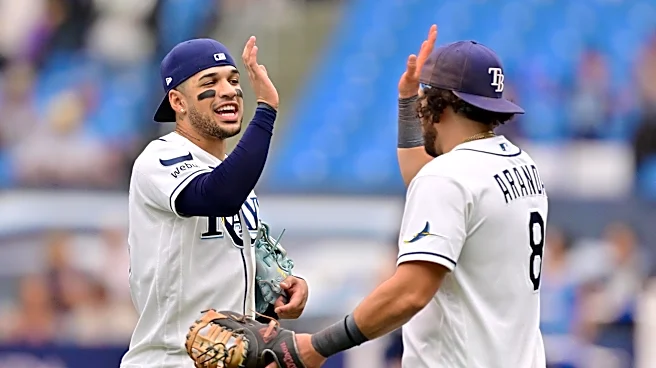
Jonathan Aranda is another player who could be in a lineup against left-handers. His approach is more passive against them; he gets his A-swing off about half the time compared to when he faces right-handers, but Aranda maintains similar contact rates against lefties. His results against southpaws have been roughly league average, and his batted-ball profile suggests he has leaned into contact toward left field and up-the-middle rather than trying to pull the ball. Here’s his spray heatmap against righties this year:

And then we can see how he’s going less pull-heavy when he faces a lefty:

That may not be enough to keep him in the lineup if Victor Mesa Jr. establishes himself as a viable everyday option.
Mesa looks like a potential everyday option for the Rays when healthy. He has similar contact and chase rates against both righties and lefties for his brief major-league career so far, and that trend extends back to his time in AAA since 2024. Mesa even gets to his best bat speeds when facing lefties, so he doesn’t appear to be overmatched by same-side matchups. I’m cautiously optimistic he could start and hold his own against lefties in a larger sample in the majors because of his underlying data. He plays near-elite defense in right field, so a configuration of Vilade at first base and Mesa in right field against lefties offers more impact on both sides of the ball compared to Aranda at first base and Vilade in right field.
Here’s how each position player on the current roster stacks up in the majors against righties and lefties from the start of 2024 through September 15th, 2026:
Simpson’s underlying contact profile is nearly identical against both handedness groups, while Mesa’s contact and batted-ball data provide reason to believe he may be able to handle left-handed pitching better than his limited major-league results suggest. His Triple-A EV90 against lefties was 102.8 mph, suggesting the major-league split may have room to stabilize. Also, it’s likely that Mateo and Madrigal won’t be on the roster when Walls and Williamson get healthy. The left-handed hitters whose overall offensive production is weakest against southpaws are Aranda, Hicks, Mullins, Palacios, and Fraley.
With their current roster, the Rays have to use at least two left-handed hitters in a lineup against a left-handed starter. Here’s how I’d lineup against a left-handed starter with the current roster:
- Yandy Diaz DH
- Ryan Vilade 1B
- Junior Caminero 3B
- Jonny DeLuca CF
- Chandler Simpson LF
- Nick Madrigal 2B (or Ben Williamson when healthy)
- Victor Mesa RF
- Nick Fortes C
- Jorge Mateo SS (or Taylor Walls when healthy)
This alignment prioritizes right-handed bats and defensive range while keeping the weakest left-handed platoon options on the bench. Cash could still use Aranda aggressively as a pinch hitter. Even if an opposing manager responds with a left-handed reliever, Aranda’s ability to shoot a single into left-center may be more valuable in a late-game matchup than in several early at-bats against a left-handed starter due to the difference in leverage.
While the lineup they can run against right-handed starters is more impactful, the drop-off against left-handed starters is not as severe as the Rays’ overall numbers might suggest. The combination of right-handed power, platoon-neutral contact skills, and strong defense gives them enough flexibility to build a competitive lineup against southpaws. If Mesa can establish himself as an everyday option, the Rays may have enough depth to handle left-handed starters without compromising their defensive identity.