



When the 2026 NFL schedule was revealed in May, two things were apparent for the Cleveland Browns: There weren’t any prime-time games, and with the nine contests planned for the league’s international series, the Browns were omitted, despite rumors of a game in Paris. Every other AFC North Division club is included in this year’s offering.
Then Vegas came out with their preseason odds. The Browns are +2100 to win the AFC North Division (last place), and +25,000 to capture the Super Bowl (#29).
RELATED:
MAKE YOUR PLANS AS THE 2026 SCHEDULE IS HERE
In the 1970s, the “World Football League” was invented with the idea of bringing the sport of American Football to a global scale. That was the grand plan. In the first year, the new entity established a club in Toronto, which was later relocated to Memphis. As a league that touted a global blueprint, all of the clubs were based in the United States, and there weren’t any actual international teams whatsoever.

The selling point with this new league was that it would gradually place teams in other countries. London versus Los Angeles. Tokyo against New York. Berlin takes on Birmingham. What occurred instead was that every franchise was located in the United States, and the league folded midway into its second year of existence.
The “National Football League” (NFL) had played some exhibition contests with Canadian Football League clubs in the 1950s and 1960s in both the United States and in Canada. Its first international game played outside the confines of North America happened in 1976 when the San Diego Chargers played the St. Louis Cardinals in Japan in a game labeled “The Mainichi Star Bowl.”This year, the leagueis playing nine regular-season games in other countries, including the first held in Australia and France.
Now, the NFL is admitting that one day it will plant a team in another country.
NFL commissioner Roger Goodell said in an interview with former NFL defensive player and German-born Markus Kuhn on German media outlet RTL/ntv, he stated that the league has full plans to eventually place a team permanently based outside the confines of the United States. Goodell said:
“At some point, there will be NFL teams outside the USA. I have no doubt that this will happen one day.”
The big questions are which nation, and whether that would be an expansion team or an existing franchise that will relocate. Notice that Goodell used the word “teams” instead of just one franchise. Also note that Goodell used the words “will be” and not “might be.”
Mike Florio of Pro Football Talk had this take regarding the commissioner’s statement:
“That is the most unequivocal, unconditional, clear statement I’ve seen of indication and confidence that the NFL is going to have teams in other countries. I think we kinda know it’s going to happen, but to hear the commissioner say it that clearly, that’s significant.”
On the surface, the most feasible locations would be either in Mexico or Canada. Both would satisfy his clarifications of “outside the USA.”
Mexico City has long been a probable location to place a franchise since it is close to the mainland and would be in the same time zone as other NFL cities, being a central standard time zone city. Travel would not be an issue as well. Estadio Azteca Stadium is an excellent venue that holds 87,500 patrons and has hosted several World Cup finals.
Canadian cities would be another matter. The NFL has had a gentlemen’s agreement with the “Canadian Football League” (CFL) for decades, just like it has had with college football and high school football programs. The NFL isn’t looking to quash or interfere with the lesser league and levels.
The Buffalo Bills at one time had plans to expand the team’s fan base in Southern Ontario. They had been playing a preseason game in Toronto for years and were set to schedule one home game a year, but eventually, that thought was abandoned. The CFL cried foul and didn’t want any new team to affect the fanbase of their CFL affiliate, the Toronto Argonauts.
Then there is Bill C-22: the Canadian Football Act. Introduced in 1974, its purpose was to give the CFL a government-protected monopoly over professional football in Canada. There have been many NFL preseason games held in various Canadian cities over the decades, but the NFL has a friendly relationship with the league and has no interest in maneuvering into its territory.
The NFL has zero financial interest in the CFL, whether that be ownership stakes or operational partnerships. In 1997, the NFL loaned the CFL a $3 million interest-free loan in order to stabilize the league. As far as players, the NFL is allowed to sign CFL players who have reached the option year of their contract, but that’s it.

While Mexico is a large possibility, going into Canada is a dead issue.
In the past, the NFL has always dodged the question of international expansion. They have used descriptions such as “trying to expand the sport” and “our hope one day.” To date, it’s always been blanket statements that have never nailed down what the league’s future stance actually is.
There is a strong possibility that the league will want to create new teams in Europe.
Germany and England are the most logical locations. Both countries draw very well with the NFL International Series and had large crowds back in the 1990s when the NFL established “NFL Europe,” an NFL farm-system league.
A franchise in either London or Munich/Berlin/Frankfurt, Germany would draw extremely well and become successful from minute one. Both countries have embraced the game of American Football, and the NFL as a viable entertainment option.
This year alone, three games are scheduled in London while one will be played in Munich. The Jacksonville Jaguars annually play one home game in London and consider that city their second home. Their fan base is called the “Union Jax,” which has a membership that exceeds 40,000. At one time, it was rumored that the Jags would eventually relocate to London.

However, placing any team in any European country creates a huge problem: time zones. Travel is already an issue with NFL teams during the regular season. Players and coaches love going over to other countries as long as their bye week is the following weekend. This allows everyone to spend some time in a foreign country, go sightseeing, and explore the local food.
But if any team has a game in Europe and then a game the following week, for one, the travel is long and tedious, with numerous airports to visit. The flights are long, to the tune of 15 hours, and each player’s body has instant fatigue, which means they must arrive earlier than for any normal scheduled game.
Florio explained:
“The travel is an issue. There are advances in the return of supersonic travel. The Concorde is long gone, but there are different planes. Then there are the tax rates in the other countries and the exchange rate. The league is going to have guys who will say, ‘I don’t want to play in London. I don’t want to live in Germany. I didn’t sign up to play pro football and get shipped off to Australia.’ London’s going to be the first candidate.”
The NFL has been monitoring the developments of supersonic travel. But each of these planes that would qualify is not very big. It might require an entire fleet in order to get all of the players, coaches, cheerleaders, front office, trainers, and medical personnel, not to mention all the equipment.
By installing a franchise in another country, does this mean that at some point a Super Bowl could be hosted on foreign soil? Say it ain’t so.
Goodell addressed that:
“There are definitely international cities that could host something like that. But we would like to see an NFL team in such a city first.”
Which all means that the league is serious about placing a franchise located outside of North America.

This year during the owners’ meetings, it was voted on that as many as 10 international games would be played annually beginning in 2027. Also passed with a motion was to strip away a team’s ability to protect any home games from international play, thus making any regular-season game available, including key divisional contests.
Originally, the NFL offered only preseason games to foreign venues. But on October 27, 2007, the Miami Dolphins and New York Football Giants played a regular-season game at Wembley Stadium in London. The first 40,000 tickets were sold within an hour of being offered. This contest was the first of what the league entitled “The International Series.”
Countries that have hosted an NFL game in the series include England, Germany, Spain, Mexico, Japan, Brazil, Ireland, and Argentina. The most games played have been in England with 42 contests, followed by Germany (5) and Mexico (4). Along with Australia and France hosting their first games this year, the league has already announced intentions to have games played in Scotland, China, and Wales.
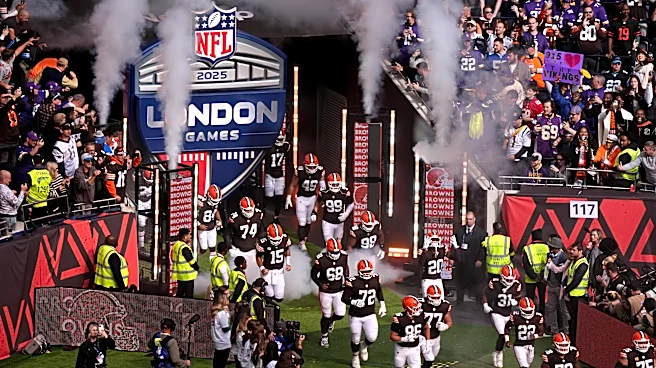
Cleveland has played in two series games and is 0-2-0. Both games were against the Minnesota Vikings. Last year, they lost 21-17 in Week 5 at Tottenham Hotspur Stadium in London with an announced attendance of 61,082. The capacity is 62,850. In the winless season of 2017, the Browns lost 33-16 in Week 8 at London’s Twickenham Stadium, with a capacity of 75,000. The game was attended by 74,237.
The Browns have also played two preseason games in Canada. They lost 11-7 in Montreal at Olympic Stadium in 1988 and then were beaten 12-9 at the SkyDome in Toronto in 1993.
Yahoo! Sports has suggested the NFL keep the Browns out of any international gamein the future to “keep them quarantined for everyone’s safety.”
In 2021, the league embraced its worldwide footprint by forming the International Home Marketing Areas (HMA) initiative. Basically, NFL clubs could “claim” foreign countries and hold exclusive marketing rights in that nation for a period of five years. Eventually, the Browns selected Nigeria, which the club had a natural tie to through tight end David Njoku, who had been anointed a Nigerian chief. Every NFL team has a country registered.
What this idea of placing teams in other countries does has a ripple effect. Suddenly, the league will want to shift to Madrid, Spain, and Tokyo, Japan, and Rio De Janeiro, Brazil. This would kill the hopes of American cities that have been dangling the carrot that one day, they would receive an expansion team in their city.
Cities such as San Antonio, Portland, Oklahoma City, and Orlando, and perhaps the return to San Diego and St. Louis. All of a sudden, each of these would be placed on the back burner while international sites are being evaluated and scouted instead.
Florio surmised:
“I think the ultimate, perfect end configuration of the NFL would be a division with four European teams and a division with four Pacific teams. The NFC gets one of them, and the AFC gets the other. That’s five divisions with four teams each, which gets to 40. They would need to do this incrementally. They have gone in baby steps. But this is the longest the NFL has gone without adding another team. When this happens, it’s going to be historic.”
The last time the NFL expanded was in 1999 with the new Browns, and in 2002 bringing in the Houston Texans.
Right now, things are aligned perfectly with 32 clubs. Each team plays two games a year with every squad in their own division, then every four years it rotates so that each ballclub has a match against every other team. There’s great symmetry there.
And as far as a Super Bowl being played overseas? Floria explained:
“You’re not going to have a Super Bowl in a city that doesn’t have a team. You get the team there first, and then it becomes a potential Super Bowl host city. But the Super Bowl is on the table, too. Once you put a team in another country, the Super Bowl is going to follow.”
The recent World Cup here in the United States opened a lot of eyes to what the NFL could become on a global scale.
Now we know. An NFL franchise in another country is inevitable, with more behind that.