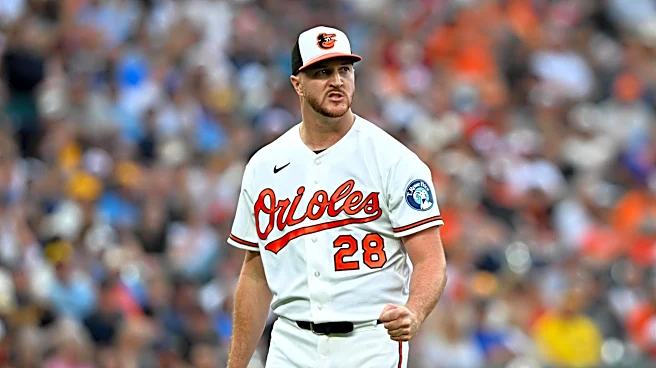



Despite all of the things that have gone wrong for the Orioles these last two seasons, one player stands out as a resounding success. Trevor Rogers came to Baltimore in a 2024 trade with the Marlins that, at the time, left many fans scratching their heads. Now, as he is on the precipice of free agency, most would give anything to keep him around a while longer.
Rogers’ brilliance in 2025 is well documented at this point. By the time he stood on a big league mound for the first time that season, the Orioles
campaign had already gone sideways. The team had tumbled down the standings, and their manager had been canned. But that didn’t stop him from being, arguably, the best pitcher in the league from late May through the end of the year. Across 18 starts he compiled 1.81 ERA over 109.2 innings, even earning some down-ballot Cy Young consideration.
That performance earned Rogers the designation of Orioles Opening Day starter and de facto “staff ace” going into the 2026 season, ahead of a healthy Kyle Bradish and the recently acquired and extended Shane Baz. The hope was that this trio would lead the O’s back to the postseason, where they would be a tough matchup for any offense.
Obviously, the postseason part of the outlook never materialized. And there was certainly room for improvement from Rogers, which will be discussed. But in general, the big, lanky lefty was pretty darn good again for this Orioles team.
Rogers’ top line numbers for the season are pedestrian. Over 169.2 innings he had a 4.03 ERA, 101 ERA+ and went 10-11 across 30 starts. His bWAR for the year sat at just 2.2. Not bad. Not great.
But digging deeper reveals that Rogers’ struggles were almost entirely confined to a six-week span of the season. From April 14 through May 29, he had a 10.01 ERA over 29.2 innings and seven starts. In that span he struck out 14 while walking 13 and allowing eight home runs. He also had an IL stint in that time that ran from April 26 through May 11 for the flu. It’s reasonable to wonder how that sickness had been impacting him in the starts leading up to the IL stay, and then how long it took for him to truly feel like he was 100%.
His first three starts of the year were impressive. He tossed seven shutout innings on Opening Day against the Twins, and then allowed four runs total over his next two outings, which spanned 12 innings. Then came the aforementioned slump. The month of May saw his walk rate spike to 9.2%, his strikeout rate fall to 12.6%, and just about every other metrics you could imagine trended in the wrong direction.
Starting in June through the end of the season, however, Rogers was back to being nearly as good as he was for all of 2025. He tossed 121 innings and made 20 starts in the final four months of the season, pitching to a 2.90 ERA/2.89 FIP over that time with 119 strikeouts, 21 walks, and 11 home runs allowed. He saw batters swing and miss more often month to month, peaking at 28.2% in the month of September. He walked fewer and fewer, giving up free passes just 1.7% of the time in the season’s final month. And gave up weaker and weaker contact, once again reaching his best mark right at the end of the season.
So, what happened? Most noticeable was a change in velocity. Rogers added three ticks to his fastball as the season wore on, from an average of 90.5 mph in April to 93.4 mph in September. Much of that improvement was seen early on, from April to May, but he even added one mph from May through the end of the season.
Other characteristics of his pitches saw improvement throughout the year as well. That includes spin rate. Each of his offerings added spin from the April/May timeframe through the end of the season.
Perhaps because of the added velocity and spin, Rogers felt more confident and got more aggressive throughout the season. In April, just 44.2% of his pitches were in the strike zone. That number crept up throughout the year, peaking at 56.4% in July but staying right about there and finishing at 55.3% in September.
It’s a formula that seems simple on paper. Throw harder. Be more deceptive. Pound the strike zone. But it only works if the pitcher has the right kind of “stuff” to keep opposing hitters off balance. Rogers, when he is on his game, is capable of doing just that.
That is why back in early August, it seemed like Rogers would be one of the most logical Orioles players to get traded at the deadline. The team had failed to live up to expectations again, and had admitted as much when they moved on from Adley Rutschman and Tyler Wells, two players under team control for 2027. They also dealt Taylor Ward, a pending free agent. So it stood to reason that Rogers, a left-handed starter worthy of pitching postseason innings and out of contract in just a few months, would be an easy one to move, and it’s possible that the Orioles would have gotten a decent haul in return.
But the hours ticked away. Rumors connecting him to other teams were almost non-existent. And when the deadline passed, he remained in Baltimore. Rogers himself was surprised, saying at the time “Honestly, I was waiting for the call.” Yeah, join the club, Trevor.
Why exactly the Orioles made that decision remains unclear. Mike Elias has said several times, including at his season-ending press conference, that the team “would love for [Rogers] to stay,” which is the same thing he said about Rutschman just weeks before sending him to a division rival.
Now, it should be said that holding onto Rogers did help the Orioles stay in mathematical contention for a playoff spot right up until the final week of the season. Without him, the final few weeks of the season would have been less interesting. But it would have been more consistent with the team’s overall approach to the deadline to trade Rogers for prospects and then seek him back out in free agency if they love him so much. Instead, they likely have to settle for draft pick compensation if/when he signs elsewhere.
Rogers has been reciprocal in his appreciation of the franchise. He said in late September that he “would love to be back here.” Back in July he said that “[The Orioles] are going to be number one on my list. Whether they’ve heard it or not heard it, they know how much I like it here.”
That is all very nice to hear, and it seems genuine. But what most often happens in these situations is that the player signs with the team that offers the most money. The Orioles were aggressive last offseason, signing Pete Alonso to a big contract and reportedly pushing the Phillies to best their offer to Kyle Schwarber before that. Starting pitching has been something that Elias has preferred to trade for, while free agent arms tend to settle for one-year deals in Baltimore. Pushing to re-sign Rogers would be a deviation of their norms, though it is easy enough to argue that the front office is due for a different approach anyway. And it does seem as though the Orioles were serious about re-signing Corbin Burnes ahead of the 2025 season, though they were never particularly close to a reunion there.
Speculation about what sort of deal Rogers can expect this offseason is difficult at this point. Some of the biggest spenders are still playing games right now, and the ongoing labor discussions add an opacity to what is possible. Last offseason saw 30-year-old Ranger Suárez ink a five-year, $130 million deal with Boston while 32-year-old Framber Valdez got three years, $115 million from the Tigers. Rogers, who will play the entire 2027 season as a 29-year-old, lacks the track record of those two, but is younger and has been great lately, so it is possible ends up in that same neighborhood.
This was an important season for Rogers. Hitting the open market after one solid season is nice, but it looks even better as a follow-up to his 2025 campaign. On top of that, the 169.2 innings he threw were a career high, and it seemed like he was getting stronger as the year went on. The offseason ahead is an uncertain one for everyone associated with Major League Baseball, but regardless Rogers has set himself up to get a nice deal heading into the 2027 campaign, and if he does it will mean the Orioles have a massive void to fill.