


The Cincinnati Bengals’ 2026 roster is officially set, and while there were plenty of predictable decisions, there were also some genuinely difficult cuts.
Cincinnati finished the preseason 3-0, capped by a 30-13 demolition of the Philadelphia Eagles, and that created something of a problem for Zac Taylor and Duke Tobin. Several players who performed well throughout training camp and the preseason simply couldn’t fit into a 53-man roster that has considerably more depth than some recent Bengals teams.
The Bengals ultimately kept all seven of their 2026 draft picks, five tight ends, six wide receivers, and 11 defensive linemen. That meant some talented players were inevitably going to be left out.
Here are some of the best players who didn’t make Cincinnati’s initial 53-man roster but could be candidates for the 16-man practice squad.
1. Isaiah Foskey, DE
This one hurts. Foskey wasn’t merely decent during the preseason. He was good. Really good at times.
The former Notre Dame standout had a strong training camp and finished the preseason with 11 pressures and three sacks.
In the preseason finale against Philadelphia, Foskey recorded 1.5 sacks in the first half and was one of the players Zac Taylor specifically mentioned when discussing the group that played virtually every defensive snap up front.
And yet he didn’t make the roster. That’s the ultimate example of a “numbers game” cut.
The Bengals had Boye Mafe, Myles Murphy, Cashius Howell and Shemar Stewart, among others, competing for edge snaps. Stewart’s knee situation ultimately helped Cincinnati keep him on the 53-man roster while he continues his rehabilitation.
Foskey’s performance may also make him one of the more attractive players available on the waiver wire.
2. Charlie Jones, WR/returner
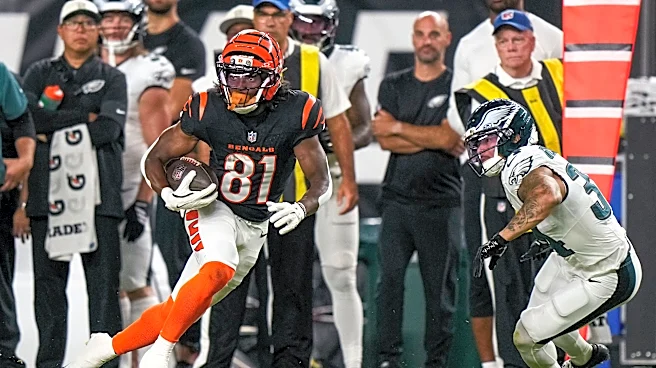
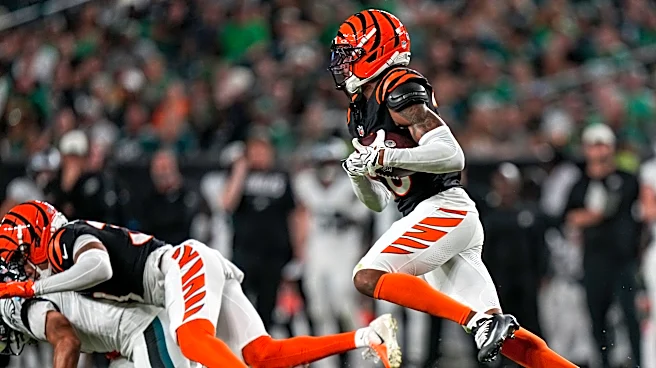
Jones may be the most surprising offensive cut. For the past two seasons, he has been one of Cincinnati’s primary return specialists, and he entered the preseason with a legitimate argument to retain that role.
He also played well in the preseason finale.
Against Philadelphia, Jones returned three punts for 44 yards, including a 31-yard return, while catching two passes for 36 yards.
But the Bengals ultimately decided that Ke’Shawn Williams could provide enough value as a returner while giving them a different skill set at receiver. Cincinnati’s official roster announcement confirmed that Williams would take over the return duties, while Jones was waived.
That’s a significant decision because Jones wasn’t simply a fringe receiver.
He had been Cincinnati’s primary kickoff returner and had established himself as one of the team’s more reliable special teams weapons. The Bengals clearly decided that the roster spot was better spent elsewhere.
They could still attempt to bring Jones back if he clears waivers.
3. Josh Johnson, QB
It’s hard to imagine Josh Johnson’s preseason going much better. Zac Taylor certainly thought so.
After Cincinnati’s preseason finale, Taylor said:
“Josh Johnson had a superb preseason. I really don’t know that he could have played much better.”
That’s a pretty strong endorsement from the head coach.
Johnson completed 12 of 19 passes for 156 yards against Philadelphia and helped Cincinnati move the ball consistently in his first-half appearance. He had already thrown for 156 yards and two touchdowns against Chicago.
The problem was that Cincinnati simply didn’t have room for him.
Joe Burrow and Joe Flacco occupy the first two spots, and the Bengals decided that a third quarterback wasn’t worth using a 53-man roster spot on. Johnson was released as a vested veteran rather than waived, meaning he is free to sign with another team.
There’s a decent chance Cincinnati could revisit the idea later, particularly if it wants a veteran quarterback in reserve.
4. Mitchell Tinsley, WR
Tinsley’s story is particularly interesting because of how quickly things changed. A year ago, Tinsley was the Bengals’ preseason darling.
His performance earned him a spot on the 53-man roster in 2025, and he remained in the conversation entering this year’s camp. But then Dohnte Meyers happened. And Colbie Young happened.
Tinsley wasn’t necessarily bad this summer. He simply wasn’t as impressive as the players competing against him. Cincinnati’s final receiver group became Chase, Higgins, Iosivas, Young, Meyers and Williams.
Tinsley could still be back in Cincinnati if he clears waivers, but other teams may have noticed what he did last year.
5. McKinnley Jackson, DT
Jackson was a former third-round pick and had shown enough flashes during his first two seasons to make his release a tough pill to swallow for the front office. The ridiculous depth Cincinnati assembled along the defensive line helped lead to his release.
The Bengals added Dexter Lawrence and Jonathan Allen during the offseason, retained B.J. Hill and T.J. Slaton, continued developing Kris Jenkins, and then watched seventh-round rookie Landon Robinson emerge as one of the biggest surprises of training camp.
Jackson became the odd man out.
Cincinnati reportedly received trade interest in Jackson before ultimately waiving him, but no deal materialized. He now gets an opportunity to find a new home.
Jackson’s best NFL season came as a rookie in 2024, when he appeared in 13 games and recorded 15 tackles and a sack. His development was slowed by injuries and inconsistency, but he’s still only entering his third NFL season.
The fact that a former third-round pick with legitimate NFL experience couldn’t crack this defensive line says more about Cincinnati’s depth than it does about Jackson.
6. Shaka Heyward, LB
Heyward is another player who appeared to have a legitimate argument for the 53. He had a strong preseason and was part of a linebacker competition that remained unsettled almost until the deadline.
Ultimately, Cincinnati chose to carry four linebackers behind Barrett Carter and Demetrius Knight Jr., with Oren Burks and Swayze Bozeman rounding out the group. That decision squeezed Heyward out.
Cincy Jungle’s roster tracker specifically identified Heyward as a surprise cut, noting that his performance had warranted consideration for a roster spot.
The emergence of Bozeman appears to have been a major factor. Heyward could be an interesting practice-squad candidate if he clears waivers.
7. Antwaun Powell-Ryland, DE
Powell-Ryland is another cut that demonstrates just how deep Cincinnati’s defensive front became. He made plays throughout the preseason and finished the Philadelphia game with a sack alongside Foskey.
More importantly, Taylor specifically mentioned Powell-Ryland as one of the six defensive linemen who essentially had to play the entire game against Philadelphia because of Cincinnati’s limited numbers. The Bengals were comfortable enough with their other edge options that Powell-Ryland ultimately didn’t make the 53.
That doesn’t mean he failed. It means Cincinnati had more players deserving of defensive-line jobs than it could accommodate.
8. Daijahn Anthony, S
Anthony’s release is another interesting one because Cincinnati had previously invested in him as a developmental safety. The Bengals drafted Anthony in the seventh round in 2024, and he saw meaningful playing time as a rookie.
But the safety room changed this offseason. Bryan Cook, Jordan Battle, and Kyle Dugger are established pieces, while P.J. Jules emerged strongly enough during camp to beat Anthony out for the final safety spot.
The Bengals ultimately went with four safeties, leaving Anthony outside the 53. This is another case where the player wasn’t necessarily bad.
Someone simply won the competition.
9. Cam Grandy, TE
Grandy is perhaps less surprising than the players above, but his release is notable because Cincinnati ultimately chose to keep five tight ends. That makes it particularly interesting that Grandy wasn’t one of them.
The Bengals kept Mike Gesicki, Drew Sample, Tanner Hudson, Erick All, and seventh-round rookie Jack Endries. Endries’ emergence essentially squeezed Grandy out.
And that was another theme of this preseason: Cincinnati wasn’t simply cutting players because they didn’t perform. In several cases, the Bengals were choosing between players who had demonstrated legitimate value.
Other notable cuts: LB Joe Giles-Harris, DT Howard Cross III, WR Noah Thomas, RB Jamal Haynes, CB Bralyn Lux, WR Kendric Pryor, LB Liam Anderson, QB Sean Clifford, RB Kendall Milton
The biggest takeaway: Cincinnati has created some tough cuts
The Bengals’ initial 53-man roster isn’t perfect.
Questions remain about offensive-line depth, and the team will have an opportunity to add players through the waiver wire and practice squad.
But it’s difficult to look at this list and conclude that Cincinnati simply cut a bunch of players who weren’t good enough.
That’s not what happened.
The Bengals cut:
- A former third-round defensive tackle in McKinnley Jackson.
- A former second-round pick in Isaiah Foskey.
- A veteran return specialist and former fourth-round pick in Charlie Jones.
- A 40-year-old quarterback who Zac Taylor said had a “superb preseason.”
- A linebacker who’s been on the 53-man roster in Shaka Heyward.
- A former seventh-round safety in Daijahn Anthony.
- Last year’s preseason breakout receiver in Mitchell Tinsley.
And that’s before mentioning players such as Andrew Coker, Josh Kattus, Kendall Milton, and others who also didn’t make the cut. The Bengals’ official transaction list included 34 players who were either released, waived or placed on injured reserve as they got down to 53.
Perhaps the most telling part is that Cincinnati’s coaching staff didn’t seem particularly unhappy with the players who were leaving.
After the Eagles game, Taylor specifically praised the defensive group that included Jackson, Foskey, Powell-Ryland, Howard Cross III, Landon Robinson and Jordan Jefferson for holding up despite playing essentially the entire game in Philadelphia’s heat.
He also said both Johnson and Sean Clifford were “nails” and praised Johnson for a “superb preseason.” Yet Johnson, Foskey, Jackson, and Powell-Ryland are all gone.
That’s the reality of the NFL’s 53-man roster.
And perhaps the best sign for the Bengals heading into 2026 is that their biggest problem isn’t finding enough talented players to fill out the roster. It’s figuring out what to do with all of them. Now comes the waiver wire.
And don’t be surprised if at least a few of the players on this list find themselves back in Cincinnati on the practice squad — or become contributors somewhere else in the NFL.