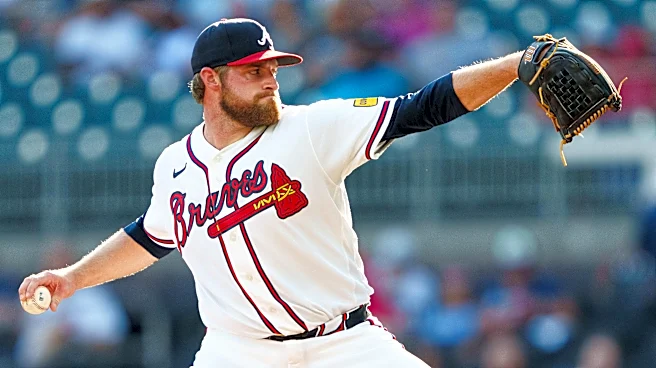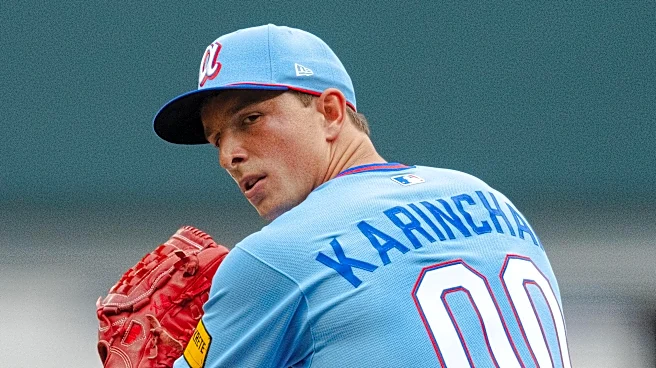

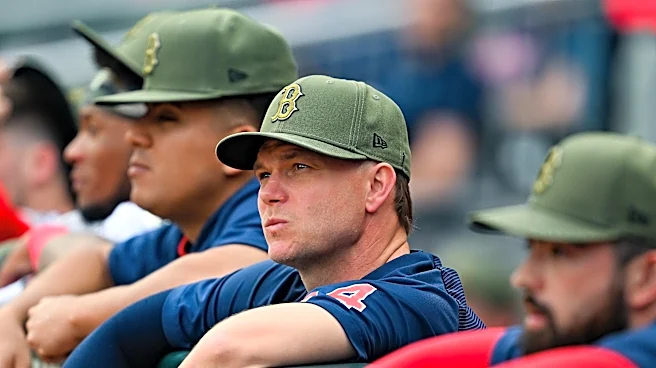
James Karinchak has big opinions on stuff, like get yourself placed on the restricted list kinds of opinions. His impact on the Braves’ season was not big. When given the opportunity, Karinchak presided over some games where the Braves experienced good results while he was on the mound. But, his peripherals were not great, and limited his chances. Still, those good results led to a high WPA, and he was not a distraction.
How Acquired
The Atlanta Braves signed Karinchak to a minor league deal in December.
What were the expectations?
A ninth-round
pick by Cleveland in 2017, Karinchak was sent packing in 2024 after a string of injuries. A two-month stint in the minors with the White Sox didn’t go well at all, which led to the Braves deciding to take a peek at what was left.
Karinchak had great runs in partial/shortened seasons in 2020 and 2022, got stung by the longball in 2021, and saw a huge, likely injury-related dropoff in 2023, which was his last major league exposure before 2026. His combined line was a 74 ERA-, 82 FIP-, and 85 xFIP- over 165 2/3 career innings — but the big caveat was that all of this was compiled in 2019-2023. Given that, he had the following projections for 2026:

As a result, I’m not sure the Braves had any expectations for him. The likely plan was for him to wait in Gwinnett for an opportunity. Steamer had him with a 4.42/4.39/4.47 line. Most models had him on the edge of replacement level with a walk rate approaching 5.00. 9 to 12 innings was the range of his expected usage, with the caveat that projection systems don’t really forecast playing time the way they do performance, so this was more of a vote in the “he’s just gonna be around to fill in a bit camp”
As noted, Karinchak had big strikeout potential with 245 strikeouts in 160 1/3 innings from 2020-2023. So he was definitely worth a flyer. The Braves could do a lot worse in a marginal player. This one, if he could put it back together, could be a force in an already strong bullpen. But, that wasn’t the expectation
2026 Results

Well, did the models nail it or did the models nail it? Steamer had the FIP within 5 hundredths of a run. He was in that 9 to 12 inning range. Walk rate approaching five per nine, that’s a bingo. Karinchak was exactly what they thought he was over a tiny sample.

What the above doesn’t show is how effective the four-seam fastball was. Hitters collected only a .290 xwOBA versus the fastball, which is pretty outstanding. Batters tagged him for just one homer in his 9 2/3 innings of work. The walk rate was, well, the high walk rate. That was pretty much his season in a limited role: hitters didn’t make great contact, but the strikeout rate was unimpressive and the walk rate was gruesome.
Karinchak’s stints were limited to three stints. Or, really, two stints:
- June 10 to July 3: eight appearances
- July 7 to 11: one appearance
- August 1 to 3: no appearances
The last two appearances of the first run saw James allow a single run in each, despite some earlier appearances where he walked as many as he struck out but didn’t get any runs charged to him. First, he ended up being a charged with a run despite no one collecting a hit in the inning. Then, he got popped for a homer. That was about all the Braves wanted to see. Life’s tough when you’re a fringy reliever: a team may be content to carry you so long as the dam doesn’t burst, but as soon as it shows a leak, see ya.
What went right?
First of all, let’s talk this number choice. After wearing number 70 and then 99, James pushed it right off the scale.

James Karinchak became the first Braves player to wear double zero. What else did Koko do well? Throw a fit his fastball, of course.
Karinchak’s highest-WPA outing actually gave him a lot of WPA, and was emblematic of his short season in the majors, such as it was. He came in to protect a one-run lead in the eighth against the Pirates. He immediately issued a leadoff walk. Then a wild pitch moved the tying run to second. A strikeout helped, a groundout moved the runner to third. Jared Triolo then hit an opposite field 99 mph liner that ends up a hit about 60 percent of the time, but the Braves had Matt Olson playing way over given the batter’s handedness and the situation, and he escaped the jam. The Braves then hit a grand slam in the top of the ninth to make the close shave irrelevant, but the point is that Karinchak earned a shutdown despite a 1/1 K/BB ratio, and, amusingly, his worst contact management game of the season.
If you’re only going to be up for a few games, it’s probably better that your appearances feature fewer runs instead of more runs, even if you don’t pitch all that well. That’s what happened for Karinchak.
What went wrong?
As solid as the fastball was after missing all of 2024, the curveball felt lacking. It’s not that it was outright bad, given the .217 xwOBA-against. But its shape made it more like a gyroslider with a curveball grip, and the real issue was that it was basically thrown down the middle over and over as a change-of-pace. Alec Burleson had particular thoughts about it on July 2nd during this beatdown by the St. Louis Cardinals.
You’d think, from seeing that video, “Boy, he hung that curveball,” but he really did hang a lot of his curves: about 20 percent of the 64 he threw were in the heart of the zone, which feels suboptimal. It’s kind of amazing he had a whiff rate over 30 percent on it, and just a .217 xwOBA-against.
Fundamentally, the issue with his 2026 was largely already described above: he simply didn’t do enough on the strikeout end to compensate for his walks. The league strikeout rate was 22.1 percent, rising a bit with relievers pitching. Karinchak was at 21.6 percent. Meanwhile, his walk rate was considerably worse than league average.
At the same time, Karinchak’s laboring at Gwinnett didn’t exactly give the team reasons to promote him and keep him up, hence his stints all coming in the summer and only one giving him any extended play. A bunch of mid-3.00s ERA estimators (78 FIP-, 75 xFIP-) in Triple-A would be okay for a prospect, but this was his seventh stint at that level. It certainly didn’t force the Braves’ hand or anything.
And, of course, there was the aforementioned outing where somehow a run scored while Karinchak pitched without any hits. A walk, a steal, a strikeout, a wild pitch, and a sac fly was how it happened. It didn’t really matter, just turning a three-run deficit into a four-run deficit, so Karinchak didn’t take a big WPA hit or anything. But, it was pretty much the only time that Karinchak presided over an inning where the team’s win expectancy went down while he was in the game. Considering that he had five outings with an xFIP- above 135 and only four with an xFIP- below 100, maybe this should’ve been in the “What went right?” section.
2027 Outlook
The outlook going into 2027 for James Karinchak looks very similar to the outlook for 2026. He will likely be looking for a minor league contract and an invitation to Spring Training. The Braves apparently preferred an open 40-man roster spot and the lack of a commitment to paying him anything to his continued presence, and non-tendered him earlier this week.
Still, I don’t think that means the last of ol’ Double Zero in a Braves uniform. The bottom on the 40-man roster typically remains pretty fluid over the course of the offseason. The lack of contract now means anything going forward. He will have to pitch his way onto any roster.
Steamer basically has him repeating his 2026 FIP (remember that his 2026 FIP was also very close to his projected 2025 Steamer FIP), which comes with a lot more strikeouts than he managed in 2026, and a lower but still bad walk rate. That adds up to a barely above replacement reliever. That means he’ll probably get a shot somewhere, and it’ll be up to him to actually improve on his 2026 in order to deliver it.