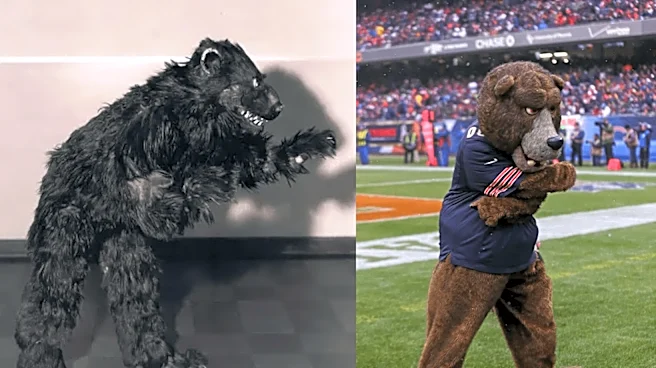



The 2026 NFL season marks the 24th year Staley Da Bear will patrol the sidelines. The name Staley drew inspiration from the original moniker of the Chicago Bears. The first iteration of George Halas’s football club started in 1920 as the Decatur Staleys, followed by a single season in 1921 as the Chicago Staleys, before Halas changed the name for the 1922 season to the Chicago Bears. Staley Da Bear harkens back to the start of the Bears— but wait, if Staley arrived on the scene the same year as Charles
Tillman and Lance Briggs, what happened in the 80+ years before that?
This is the true story of the men dressed in bear mascots with never-before-published photos to give you a glimpse into the distant past.
A Real Bearskin Suit
In 1935, Frank Conan Dain approached George Halas with an idea. Dain, a former clown in the Ringling Brothers Circus, wanted to roam the sidelines in a bear costume during games to help work the crowd up in support of the team. The former Pittsburgh resident, inspired by the University of Pittsburgh’s Panther, Dain thought a bear would fit right in with the professional circuit. It would mark the first human in a mascot outfit in the pro game.
Halas went for it and “Mr. Bear” was born.
According to a 1936 article in the Green Bay Press-Gazette, Dain wore a real bearskin suit that ran him $350, about $8,500 in today’s dollars. The suit “hooks up the front and the animal’s chin is strapped to Dain’s own chin so that by opening his mouth Dain can open the bear’s mouth.”
According to Don Pierson of the Chicago Tribune, the bear suit “looked fierce. Smelled fierce, too.”
Dain enjoyed an incredible run as the Bears mascot, witnessing the NFL’s first dynasty as the team won four championships in seven years in the 1940s. The last of those championships was a 24-14 win over the New York Giants in the Polo Grounds. Dain was there on the sidelines, as captured by this awesome video (you’ll note WGN giving a shout to friend and colleague Jack Silverstein). He was a hit with politicians and celebrities, meeting President Truman in 1953 when he attended a Bears game and singer Patti Page at an armed services event.
The final piece of information on Dain’s tenure as Bears mascot appears in a 1954 article by Rocky Wolf in the game program against the Rams on November 28th. Wolf’s short profile of Dain includes a headshot and another photo of Dain in full mascot uniform with a brief bio. The story mentions that Dain, 62 at the time, recently retired from General Motors. That was likely the last season for Dain as the Bears mascot. He would move to Albuquerque for his final eight years, dying at the age of 72.
Liz Dain Karzag, granddaughter of Frank, remembers a sweet, kind man who loved to entertain. “His life was like a thick frosting on a cake: full, luscious and messy, but he was as sweet as the frosting and meant good wishing to entertain others and to make them laugh, and he enjoyed that connection with people,” she explained to Windy City Gridiron.
He could juggle, walk on his hands, and impersonate famous people of the day. In fact, he won a Charlie Chaplin impersonation contest that took him to Europe to perform. Despite the performance resume and added value Dain delivered on the sidelines Dain Karzag marveled, “You’ll never believe this – George Halas never paid him a single penny.” (Ma’am, that’s the most believable part of the whole story.)
Dain performed for the love of the game and the spirit of performance.
Exclusive for this story, Liz Dain Karzag shared her personal archives, revealing gem upon gem of Chicago Bears history. Published here for the first time ever are pictures of Dain from the personal archives, including meeting President Truman and singer Patti Page, a famous photo of the 1946 NFL championship game celebration, images from the 1954 program, and so much more.


The First Transition, Mic’d Up (For Cryin’ Out Loud!)
The second human to roam the Bears sidelines as the mascot was George Motyka, made famous by a memorable NFL Films clip from 1970 and a wonderful behind the scenes feature put out decades later.
The first video contains game footage from a 20-16 victory over the Eagles. If it looks like a weird stadium setup, that’s because it is. The Bears played their home opener at Dyche Stadium, the only NFL game ever played there. 1970 was the last year the Bears called Wrigley Field home, and with the NFL season overlapping with the MLB season in September, the Bears needed a local stadium to host the early-season tilt. The second video is a “behind the scenes” that aired in 2000 from NFL Films.
Motyka recounts the story of talking to the Bears team doctor at the hospital he was working at around that time, asking what happened to the bear (Dain) on the sideline. The doctor didn’t know and apparently suggested Motyka step in. Motyka, a lifelong Bears fan, grew up with Mugs Halas (Motyka was about three years his junior) and his appeal to replace Dain fell on receptive ears despite not bringing any notable performance experience to the job. His costume was approved by Mugs Halas and moved away from the real bearskin Dain favored in the direction of a modern mascot outfit. Just like that, the window washer from O’Hare airport became the second Bears mascot.
Motyka’s start date may vary depending on the source (see sidebar), but his end date is well established. In 1984, when the Bears traveled to San Francisco to take on the 49ers in the NFC Championship game, they left Motyka off the manifest. Word leaked, and the papers picked up the plight of Motyka, causing a bit of a stir.
Cook County Board commissioner Charles Bowen spearheaded a fundraising campaign ($25 each from the 17 County Board members) to cover Motyka’s hotel room and meals, while American Airlines offered Motyka a free flight to the City by the Bay. But Motyka stayed home. He wasn’t sure the Bears would let him on the field, and it didn’t seem right to sit in the stands. Motyka said he received supportive calls from everyone with the exception of two people: the President of the United States and Michael McCaskey, Chairman of the Board of the Bears. Without a call from McCaskey, Motyka wouldn’t (and didn’t) go to San Francisco.
Motyka, much like his predecessor, was never officially a Bears employee as he wasn’t paid for his services. He enjoyed season tickets with an enviable view and a parking spot right next to George Halas’s for 30 “happy years like part of the family.” With Motyka’s connection to Mugs Halas and, one can imagine, a familial relationship after decades on the sidelines with George Halas, he must have felt like part of the Bears family. By 1984, those relationships may not have been as strong with Mugs dying of a heart attack in 1979 and Papa Bear passing in 1983.
Motyka added years later in a 1992 interview with the Chicago Tribune, “I was just shoved out in the cold. I don’t go to the games anymore. I know if I put my name on the waiting list for tickets I’d never get them. It hurts to this day.”
Despite how it all ended, thirty years on the sidelines and a parking spot next to George Halas is a pretty good way to spend your Sundays.


Big Bear vs Mysterious Brown Bear
Late in Motyka’s tenure as Mr. Bear, another mascot found its way to the sidelines. John Bittner donned the suit of “Big Bear” to accompany the Honey Bears – Chicago’s short-lived cheerleading troupe. The “dancing girls,” as Halas called them, were an attempt to bring some additional energy to game days. The Honey Bears started in the late 1970’s with Bittner playing the role of Big Bear from the 1978 season until the famed 1985 season.
According to former Honey Bear Renee Halverson Wright, co-author of the 2018 book Missing from the Sidelines, Motyka’s Mr. Bear was referred to as “Mysterious Brown Bear” to the cheer squad. Motyka seemed to show no interest in interacting with Bittner’s new, cartoon-like mascot that may or may not be encroaching on his turf.
Having two Bears in costume on the sidelines at the same time may have caused some confusion with fans. Don Pierson fielded a question in 1983 from one such fan, upset that the Bears had a “mama bear wearing a skirt” on the sidelines instead of a “real-looking bear mascot.” Pierson fired back, “The official Bear mascot doesn’t wear a skirt.” This multi-pronged Bears mascot approach sprouted organically and out of necessity to serve the cheerleading troupe, but having multiple Bears mascots on the field at the same time may have informed the team’s approach in the future with Staley.
Bittner’s Big Bear was attached to the cheerleading squad and proved incredibly popular with cheerleaders and fans alike. Big Bear was true to the name as the costume boasted a comically large head and fun, fanciful outfits to accent the Honey Bears.
With Motyka’s run ending in 1984, Bittner’s Big Bear was the only mascot left in 1985. It would also be the last for Bittner and the dancing girls as the Honey Bears contract ended in ’85 and the new owner, Virginia McCaskey, wasn’t interested in keeping her father’s cheer squad around.


Curse of the Honey Bears (or Big Bear?) and Bear Man
Chicago is no stranger to sports curses, and one popular theory among many Bears fans of a certain age is that the Bears’ decision to remove cheerleaders from the sidelines caused the championship drought since. Whether it’s causation, correlation, or mere coincidence, the math lines up that since Virginia McCaskey’s decision to not renew the Honey Bears contract after the 1985 season, the Chicago Bears trophy case has failed to add a companion to their lone Lombardi.
But nature abhors a vacuum, and in place of the dancing girls and men dressed in bear-like costumes, a parade of “super-fans” stepped in to fill the void. The most famous fan, known as “Bear Man,” is a season ticket holder since 1985 named Don Wachter. Don’s getup has evolved over the years to the now-famous shoulder-padded 46 jersey, Zubaz pants, topped with a taxidermized bear head. He zeroed in on the look for the 1996 season, the birth of “Bear Man” for all intents and purposes.
Bear Man was an instant hit, earning a Miller Lite commercial in 1997. In 1998, Wachter met with the Bears Director of Communications at the first fan convention to discuss possible collaborations. That meeting resulted in Wachter running on the field with the flag. He was stationed on the sidelines in the north end zone, complete with Bear Man outfit, serving for many as the “unofficial mascot” for the Bears. That relationship lasted from 1998 through the 2004 season. Until 2002, Wachter wore the Bear Man outfit, but in 2003, with the birth of Staley, the Bears wanted no confusion as to the official Bears mascot. In 2003 and 2004, Wachter remained a flag bearer (Grrrr!), but returned to the stands – in full Bear Man gear – starting in the 2005 season. Wachter’s dedication to the persona led to induction into the “Hall of Fans” in the inaugural class of 2019 – one of three people from around the league, complete with a plaque in the Pro Football Hall of Fame.
In the image gallery below, take a look at Bear Man’s evolution in more never-before-published photos. The first two pictures show Wachter on the field in the familiar Bear Man get up. Starting with the third picture, you’re transported back to the beginning where Wachter started with just an airhorn and none of the familiar elements, slowly building to a look perfected by 1996.


The Birth of Staley
In 2003, the Bears let Wachter know of the official marketing decision to bring a mascot back to the sidelines and encouraged him to apply (Wachter opted against applying for the role). According to Wachter, the first hire as Staley’s handler was short-lived, but the early replacement proved a hit, bringing the desired energy the marketing team coveted in a mascot. That individual eventually quit the Bears to run a mascot school, helping the burgeoning business of mascots to help advance the field.
Staley’s current “coordinator,” Scott Adams, first suited up in 2006, making this upcoming season his 21st in uniform. It hasn’t always been easy for the man inside the suit. COVID forced even Staley to isolate, which made for an uncomfortable interaction between Staley and Adams’s young daughter.
There’s a kind of perfect happy medium to Staley, a just-right Goldilocks mascot built to be memorable but not nightmare fuel. He looks somewhat “realistic” – not too cartoonish like Bittner’s Big Bear but not like Dain’s hyper-realistic real bear suit. Staley may give a memorable visual reaction to an event (trigger warning), but he’s not going to be mic’d up for an NFL Films clip or run to a paper if he gets left off a flight manifest.
Staley Da Bear serves the greater good of the Chicago Bears organization as an ideal public relations ambassador. He performs at local events, performs outreach, and helps at charity fundraisers. He serves a purpose for the Bears organization far more than just on-field antics. However, his crowd work and on-field performance represents an extension and evolution of the circus performance roots of Dain, the passionate football-obsessed Motyka and Wachter, and the playful whimsey of Bittner.
As Adams embarks on his third decade in the suit, let’s all hope he finds some of the magic left behind from the previous mascots, who all witnessed at least one championship from the inside of a bear head.


The author would like to thank Jack Dain, Liz Dain Karzag, Renee Halverson Wright, and Don Wachter for sharing images and background stories to help bring this story to life.