


Perfect Game grades amateur players on a 10-point scale. A 10, its top grade, marks a potential very high draft pick “and/or” an elite college prospect.
That “and/or” is the right way to look at the burgeoning 2028 baseball recruiting class for the Texas Longhorns — at least four of the Longhorns’ 11 commitments already carry a 10 from Perfect Game, including shortstop Theo Swafford, No. 1 in its 2028 national rankings. Three sit in the top five of Baseball America’s 2028 high school rankings.
Jim
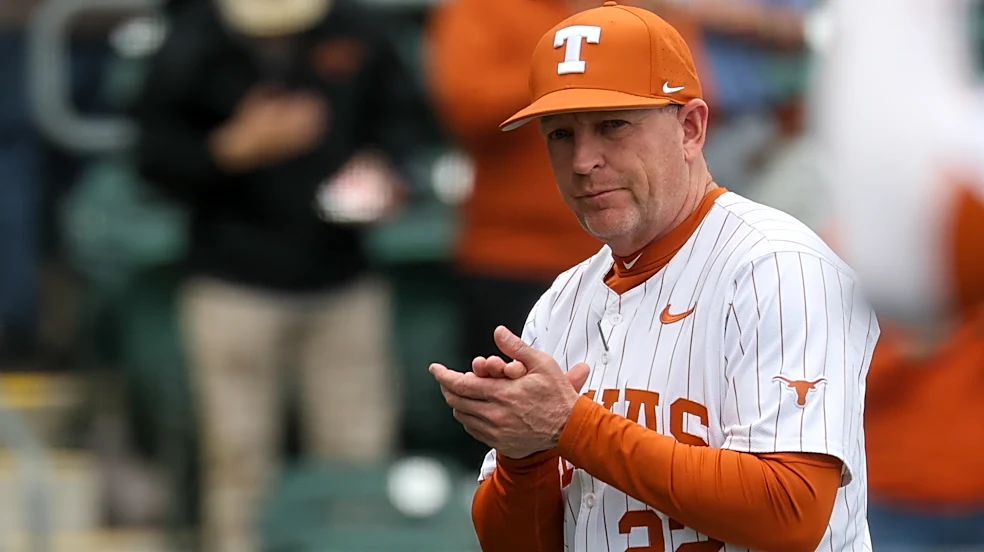
Schlossnagle’s staff has the talent part handled. Whether that talent ever plays at UFCU Disch-Falk Field depends on two things Texas doesn’t control — how these players develop between now and the 2028 draft, and what Major League Baseball and its players’ union agree to before then.
The class
All 11 appear on Perfect Game’s list of Texas’ 2028 commitments:
- SS Theo Swafford, Sierra Canyon (Calif.)
- SS Jake Welch, Lehi (Utah)
- OF Mikey Batiste, Port Credit (Mississauga, Ontario)
- OF Rylan Jenkins, Washington County (Ga.)
- OF Trendyn Motley, Pro5 Baseball Academy (N.C.)
- RHP Tommy Driver, Ballston Spa (N.Y.)
- RHP Jack Postma, Barrington (Ill.)
- RHP Parker Klug, Delbarton (N.J.)
- RHP Chase Cotton, Whitney (Calif.)
- LHP Colton Small, Forest Hills Eastern (Mich.)
- LHP Jude Huff, Magnolia West (Texas)
Baseball America’s July 31 rankings put Welch third, Swafford fourth and Batiste fifth among 2028 high school players, with Driver (19), Jenkins (20), Postma (33), Motley (38) and Klug (54) among the other Texas commits on the list. Perfect Game’s rankings, last updated August 21, have Swafford first.
The class came together fast. In late September, BA’s Ben Badler named Texas one of three SEC programs off to a hot start in the 2028 cycle. Batiste and Jenkins committed October 19, and Badler posted that day that “Texas now has three of the top five players in the 2028 class.” Magnolia West left-hander Jude Huff announced his commitment the next day.
What usually happens at the top
Under current rules, a high school player is draft eligible when he graduates. If he enrolls at a four-year school, he generally can’t be drafted again until after his junior season or until he turns 21. For this class, the first fork comes at the 2028 draft.
At the very top of a class, that fork usually leads to pro ball. In its post-draft 2026 recruiting rankings, Baseball America noted that Stanford’s Archer Horn, No. 16 in its 2026 high school rankings, was the second-highest-ranked player from that class headed to college. Duke’s James Clark, No. 17, was the third. That means only three of BA’s top 17 high school players were headed to campus.
Texas felt it, too. Shortstop Grady Emerson, one of four five-star recruits the Longhorns lost to the 2026 draft, went second overall to Tampa Bay in July. Texas still finished with the No. 4 class in BA’s post-draft rankings. A year earlier, two members of Texas’ 2025 class, Gavin Fien and Kayson Cunningham, went in the first round.
That’s the price of recruiting at the top of the market, and Texas has shown it’s willing to pay it. It also points to the right way to judge the 2028 group — by its depth as much as its headliners.
The proposal aimed at this class
In June, MLB proposed that players be at least 20 years old by September 1 of their draft year and at least two years removed from high school graduation, beginning with the 2028 draft. High school players would no longer be eligible, MLB.com’s Mark Feinsand reported, and junior college players would have to meet the same thresholds. Players could still skip college and be drafted after playing in the MLB Draft League or an independent league. The proposed domestic draft would cover players from the U.S., Canada and Puerto Rico, so the change would reach Batiste in Ontario, too. MLB argued that college programs offer better preparation for pro careers and proposed cutting the draft to 12 rounds in 2027, according to The Associated Press.
The players’ union rejected it. Its July 21 counterproposal would keep high school and junior college players eligible, keep the draft at 20 rounds, move it back to June, and add college sophomores to the pool. The union said its framework would maintain the draft’s economic structure and give lower-revenue clubs better access to amateur talent.
Neither plan is in effect. The collective bargaining agreement expires December 1, and the AP described the sport as heading toward a labor confrontation this offseason. This month, MLB Deputy Commissioner Dan Halem sent clubs a 34-page memo on lockout procedures, according to The Athletic, warning that if no deal is reached, clubs could be left with “no realistic alternative but to implement a lockout of major-league players.” Until a new agreement says otherwise, today’s rules are the only ones anyone can plan around.
There’s one overlap, though the two sides define it differently. MLB’s plan would make most college players draft-eligible a year earlier than they are now, which in practice means after their sophomore seasons. By MLB.com’s count, 86 percent of the top-40 college players drafted in 2025 would have qualified a year sooner. The union’s plan names sophomores outright. If some version of it survives, landing a draft-worthy recruit would usually buy Texas two college seasons before the draft calls again, not three.
Set side by side, the proposals point to three paths for this class. If MLB gets its way on high school eligibility, the 2028 draft stops being a fork, and a class this deep could arrive close to intact, as long as the commitments hold. If the union’s position holds, or today’s rules survive in some form, 2026 shows what Texas could be up against — the draft took four of its five-star recruits. And if bargaining runs long, a lockout could leave the rules unsettled into 2027, with these players’ senior seasons approaching.
Who is most likely to get to Austin
There’s no honest way to put a percentage on any of this, and nobody outside these families knows what bonus would change a decision. What the public scouting supports is a rough order of draft exposure under today’s rules. The groups below are analysis of rankings and scouting reports, not reporting on anyone’s plans.
The headliners — Swafford, Welch, and Batiste
These three look the most like the 2026 prospects who never reached campus.
“Swafford is an easy player to like because everything he does on the field looks like it comes easy for him,” Badler wrote in BA’s Area Code Games report in August. BA noted that the left-handed hitter doesn’t have the huge power or speed of some players, but called him well-rounded, with a short, direct swing, pitch recognition and strike-zone judgment. Perfect Game’s Junior National report credited fast barrel turns, projectable power, and hit ability, and shortstop actions that should let him stay at the position. Polished bats who can stay at shortstop are what scouting departments pay for.
Welch, Swafford’s teammate on the USA Prime National travel team, hits right-handed and may have a little more raw tool to him. Badler wrote in September that Welch has a tick more arm strength, speed, and bat speed, and BA’s August report called him “a smart, instinctive player, but he’s much more than a scrappy, gamer type.” Perfect Game’s scouting blurb notes a 50-to-9 walk-to-strikeout ratio from 2023 to 2025, and Prep Baseball Report has clocked him at 6.65 seconds in the 60 and 94 mph across the infield.
Batiste is the power bet. “Batiste is an immense human being with the power to match,” Badler wrote after the Area Code Games, where the switch-hitter won the home run derby. Perfect Game lists him at 6’4 and 235 pounds with a 93 mph throw from the outfield. BA saw a corner outfielder with patience to go with the power and “the look of a potential 30-plus home run slugger.”
If 2026 is any guide, Texas shouldn’t count on seeing any of those three players in Austin.
The next wave — Driver, Postma, Klug, Jenkins, Motley, and Cotton
Each has a national ranking or a top Perfect Game grade, and each has a tool that could push his stock higher before the 2028 draft.
Driver is a 6’5 right-hander whom Perfect Game describes as very young for the class. At the Area Code Games, he threw two perfect innings, striking out four of the six hitters he faced, and touching 95 with a low-80s slider that spun above 2,600 rpm. Badler sees three potential above-average or better pitches, including a changeup with impressive depth and fade.
Postma is another 6’5 right-hander. He was up to 92 at the Area Codes and struck out five of the eight hitters he faced without allowing a walk, hit, or run. BA liked his mechanics, extension, and low release height. Its read on him doubles as the thesis of this story: “the MLB teams with the best pitching programs will try to make sure he never gets to college.”
Klug “has some of the best stuff in the 2028 class,” according to BA. He has touched 96, according to Perfect Game, and his slider spun above 2,700 rpm at the Area Codes. He also walked four in two innings there, even while striking out five of 11 hitters without allowing a hit, and BA’s September report said he still needs to improve his control. Strike throwing will decide which way his stock moves.
Jenkins is the reminder that small doesn’t mean safe. Perfect Game lists the left-handed hitter at 5’9 and 175 pounds. At the Area Codes, BA wrote, he “showed off his plus-plus speed and instincts by scoring from second base on a wild pitch.” Perfect Game also timed him at 6.52 seconds in the 60 at its 2026 Junior National Showcase, just off his career best of 6.46, and praised his routes in center field and his barrel control. Speed, contact, and a real center field can carry a pro profile on their own.
Motley was uncommitted this summer when Prep Baseball Report’s Brandon Hall previewed North Carolina’s roster for the Future Games and called him “one of the most physical and exciting left-handed bats in the 2028 class.” Perfect Game, which gives him a 10, lists him at 6’5 and 210 pounds and credits him with big left-handed bat speed and a very patient approach. If that power plays against better pitching, his stock could climb fast.
Cotton’s case is about health as much as stuff. Prep Baseball Report wrote in July that he was finally back and fully healthy after more than a year of rehab from an arm injury he suffered as a freshman. In August, Badler wrote that Cotton “was a big name in the 2028 class early on” before surgery cost him a year. BA had him unranked then. Cotton touched 95 at the Area Codes, and Perfect Game, which also gives him a 10, says he’s been up to 94 all year with a power breaking ball and “lots of strikes.” A healthy spring could put him back near the top of the class.
The projection bets — Small and Huff
On today’s evidence, the two left-handers have the least draft exposure in the class, which makes them the likeliest to reach campus for now. Recent scouting reports have them topping out in the low 90s, short of the 95-96 mph Driver, Klug and Cotton have reached, and both are being recruited for what they could become.
Small is 6’10. In September, Badler had him up to 91 with heavy life and arm-side run and noted his obvious physical upside.
Huff ranked sixth in Prep Baseball Report’s August update of its Texas 2028 rankings. The Magnolia West lefty sits 87 to 91 mph and has touched 92, with a sweeping slider, a changeup that tunnels off his fastball and some crossfire in his delivery that adds deception. In May, after 3 1/3 scoreless innings in a high-leverage playoff relief appearance, Perfect Game’s Texas notebook called him “one of the biggest breakout arms in the class.”
Postma is the reason to hold that order loosely. BA calls him “extremely projectable.” His fastball was up to 92 at the Area Codes, and BA still expects the best pitching programs in pro ball to come after him. Small and Huff are projectable, too, and velocity jumps could move either into the group above.
Verbal commitments can also change for reasons that have nothing to do with the draft, and players sometimes switch graduating classes. Texas saw that this week, when Grant Sperandio, a right-hander in the 2027 class, reclassified to enroll in January. Perfect Game lists all 11 as 2028 graduates. That line matters more than usual this cycle, because MLB’s proposed high school cutoff would start with the 2028 draft, not the 2027 one.
The bottom line
The commitment list is the easy part to celebrate. The fight for this class happens in two places Schlossnagle can’t control — on summer fields where these players will climb or level off and at a bargaining table in New York. Under today’s rules, Texas has built a class deep enough to lose a few headliners and still be one of the country’s best. Under MLB’s plan, it could arrive close to whole.
For decades, the best high school players have gotten to choose which half of Perfect Game’s “and/or” applies to them. For Texas’ 2028 class, the first one MLB’s proposal would reach, that choice might be made at the bargaining table instead.