




Charlie Caldwell lived a remarkable athletic life. He was a center, a fullback, a pitcher, and a guard. He was a varsity athlete and a Coach of the Year, a Hall of Famer and a big leaguer. He was a Tiger and an Eph. And, for a couple of weeks in the summer of 1925, he was a New York Yankee.
Charles William Caldwell
Born: August 2, 1901 (Bristol, VA)
Died: November 1, 1957 (Princeton, NJ)
Yankees Tenure: 1925
Charlie Caldwell was born in Bristol, VA and grew up in Yonkers, NY. He was an athletic standout
early on, playing football, baseball, and basketball. He put those skills to use at Princeton University, where he starred as a three-sport athlete, earning seven varsity letters. Most notably, he played on Princeton’s 1922 national champion football team at center and fullback, a squad dubbed the “Team of Destiny” by legendary sportswriter Grantland Rice during the first national radio broadcast of a college football game.
Upon Caldwell’s graduation in 1925, with the NFL still nascent, it was Major League Baseball that came calling. He joined a struggling Yankees squad in the midst of what would be its sole losing season between 1919 and 1964. The 24-year-old made his first appearance on July 7th in a low-leverage spot, with the Yankees down 11 runs to the Browns in the seventh. The very first batter he faced was none other than George Sisler, the future Hall of Famer who hit over .400 twice in his distinguished career. Caldwell retired Sisler and got through 1.1 innings unscathed, an encouraging debut.
That performance would be the peak of Caldwell’s Yankees tenure. His next time out, once again in the midst of a blowout loss at the hands of the Browns, he got lit up for four runs in a single inning of work. He would make just one more appearance, entering with the Yankees down 14-5 against Cleveland and getting tagged for two runs (one earned) while recording only one out. Caldwell left Major League Baseball the way he entered it, facing an iconic future Hall of Famer. This time it was Tris Speaker, who singled to right field to chase Caldwell for good.
During his brief time with the Yankees, Caldwell garnered a connection to one of the club’s most iconic moments. Wally Pipp, the veteran first baseman who’d received MVP votes as recently as the year prior, was replaced by Lou Gehrig after a slow start to the ‘25 season. The Iron Horse would famously cling to the starting job for the next 2,130 games. Pipp’s fate became a cautionary tale for the danger of sitting out, with the common legend that he asked a teammate for an aspirin, prompting manager Miller Huggins to give him a day off and opening the door for Gehrig to usurp him. Decades later, Pipp told a different story.
I was taking batting practice that day and the guy who was pitching that day was a big, strong kid from Princeton, Charlie Caldwell. Charlie whistled one in, and somehow or other, I just couldn’t duck. The ball hit me right there on the temple. Down I went and I was much too far gone to bother reaching for any aspirin bottles.
I was in the hospital for two solid weeks. By the time I returned to the Yankees, Gehrig was hitting the ball like crazy, and Huggins would have been a complete dope to give me my job back.
Alas, this story does not appear to be true, either. The incident Pipp describes did happen, but not until July 2nd, a month after Gehrig’s streak began. The simplest (and least sensational) explanation seems to be the correct one here. At the time of Pipp’s benching, he was slashing .244/.292/.372, well below his career norms, and Huggins chose to pull him of his own accord.
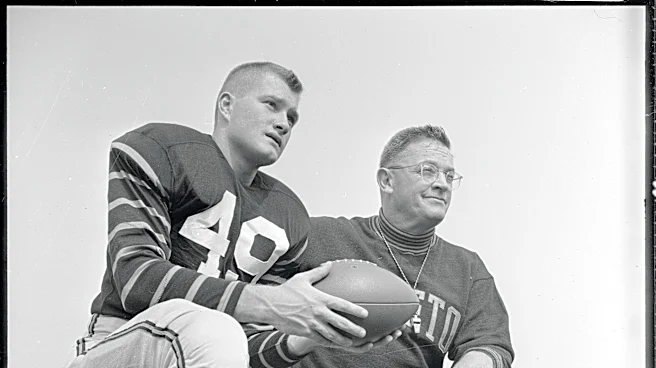
After his short time with the Yankees, the real work of Caldwell’s life began. He entered coaching, starting back with his alma mater as an assistant before serving as head football coach at at Williams College in Williamstown, MA from 1928–1944, where he also spent time as both basketball and baseball coach concurrently. His football teams won seven Little Three championships during this time (in competition with Amherst and Wesleyan). That success garnered him his most high-profile opportunity as head football coach at Princeton, which he held from 1945–1956.
The Tigers went undefeated in 1950 and ‘51, earning him the 1950 American Football Coaches Association Coach of the Year Award. During his time at Princeton, he became known as a standard-bearer of the single-wing offense, the formation created by Pop Warner that revolutionized the passing game.
Coach Caldwell died of cancer in 1957 at the age of 56. It was an immense loss for Princeton, as the university’s president articulated after his passing. “Mr. Caldwell’s death has come as a blow to the entire Princeton community,” Dr. Robert F. Goheen said. “I have known him for many years and have long admired him as a person and as an inspiring teacher. He devoted his life to the education of young men. It is impossible to say how much he will be missed by all Princetonians.”
Caldwell was posthumously inducted into the College Football Hall of Fame in 1961. His legacy as a leader, mentor, and strategist in the world of college football remains strong. And, for a brief window at the age of 24, he was a New York Yankee.
See more of the “Yankees Birthday of the Day” series here.