

With the Cleveland Browns finishing up their bye week with practice on Tuesday for Week 12’s matchup, we have a little more time to look back at the team’s history, as we did with the Thom Darden interview last week.
During World War II, numerous “National Football League” (NFL) veterans, coaches, and owners joined the fight. Many college football players left school early and joined the military, leaving behind years of eligibility. When they came back, they wanted to play football again. But now,
with their age, that meant professional football.1
Meanwhile, several rich men wanted to purchase a pro football team. Upon inquiring with the NFL owners, they were rebuffed and told the league was not going to expand. So, several of these gentlemen decided to start their own league, and found other wealthy men who had approached the NFL as well. For 1946, the “All-America Football Conference” (AAFC) began with eight franchises.
One of these teams was the New York Yankees, who defected from the NFL and joined the newly-formed AAFC because of a territorial rights dispute with the New York Football Giants. Every league needed a team located in New York City 2 to be considered a major league, so the AAFC welcomed the Yankees.

RELATED: PAUL BROWN – THE BUILDING OF THE CLEVELAND BROWNS
One of these men was Cleveland’s Mickey McBride, who loved Notre Dame football. He was very rich and owned two local taxi companies plus dabbled in real estate and had a horse racing news wire. He wanted his own team and tried to purchase the Cleveland Rams 3 but owner Dan Reeves rejected the offer. When the AAFC contingency came around, McBride jumped at the chance to own a franchise and situated the team in Cleveland despite the Rams already set up.

McBride hired one of the most famous sports persons in the State of Ohio, Paul Brown 4, who had won a National Championship with Ohio State plus captured six high school state titles. The Rams then relocated to Los Angeles, which opened up the City of Cleveland for McBride’s new team, which eventually was named the Browns.
Cleveland dominated the AAFC, winning the league title all four years of existence. They went 15-0-0 5 in 1948, becoming just the second pro football entity to go undefeated and untied in a single season. The 1972 Miami Dolphins became the third club to accomplish this, although that distinction was in the NFL. At one stretch, the Browns had a 29-game unbeaten streak, going 27-0-2 over three seasons.
Back in 1950, the NFL was divided into two conferences: American and National. These were basically laid out into eastern teams (American) and western clubs (National). Back then, there weren’t any playoffs. Each team played each club in their conference twice, and after the regular season, the winner of each conference met in the “NFL Championship Game” and claimed the league title.
The NFL had just 10 teams, primarily located in the Midwest and Eastern Seaboard. Only the Los Angeles Rams were beyond these parameters. 6 The NFL owners despised the AAFC for raising player salaries and raiding their veteran talent, as well as several coaches. They considered the AAFC a minor league and in no way on the same level as their established league. And because Cleveland won all four years of the AAFC’s existence, their hatred was heaped upon the Browns more so than any other AAFC club.
After the 1949 season, the NFL merged three AAFC clubs merged into the NFL for 1950: the Baltimore Colts, San Francisco 49ers, and the Browns. This made the league comprise 13 teams. The balance of the players in the AAFC went through a dispersal draft.
At every angle, the NFL attempted to thwart the Browns when they entered the NFL. To the NFL owners, Cleveland represented all of what they hated about the AAFC: wealthier owners, signing the majority of the incoming college talent, and the big kicker – larger player contracts which could never be reduced. What the NFL owners wanted more than anything else for the 1950 season was for the Cleveland Browns to completely crumble and fall apart and expose that they were indeed an oddity playing in a bush league entity, which would prove the owners right about the AAFC’s status as a worthless pro football league.
Here is the NFL owner’s blueprint to make the 1950 NFL maiden season for the Browns as difficult as possible, and, quite possibly, 10 things you probably didn’t know about the 1950 Cleveland Browns.
1. The Browns did not begin in the NFL

Today, the Browns are a participant in the “National Football League” (NFL), a 32-team sports league. Cleveland is housed in the American Football Conference and inserted into the AFC North Division. But the franchise did not begin in the NFL.
The AAFC began in 1946 and was comprised of eight teams when the NFL only had 10 clubs. The reason the AAFC began is that several wealthy men wanted to purchase an NFL expansion team and were turned away. So, they started their own league. The origins of the Browns are in the AAFC, and they captured this league’s championship all four years of that league’s existence. 7
2. The NFL’s stance was their worst team could beat the AAFC’s best club

The NFL owners hated the AAFC because the majority of these teams paid bigger contracts to players. This league was able to sign a high percentage of the blue-chip college players because of the better contract offers. In the 1946 season alone, the AAFC signed 40 of the 66 college players drafted. 8 The AAFC did not steal NFL players who were under contract, but offered larger deals when an NFL veteran’s contract was up and he hadn’t re-signed yet.
Because the AAFC teams offered more money, they signed quite a few NFL veterans. 9 The NFL’s stance on the AAFC was that it was nothing more than a minor-league entity, a bush league, and the game on the field and rosters were far more inferior. The owner of the Washington Redskins, George Preston Marshall, stated to beat writers 10 that “the worst team in our league could beat the best team in theirs” when dismissing the rival league.
3. The NFL placed the Browns in the most difficult division
By 1949, the NFL had grown tired of escalating player salaries. They offered an olive branch to the AAFC with a merger. It was estimated that between the two leagues, accumulated losses reached around $2 million. 11 The NFL only wanted two teams, Cleveland and San Francisco, while the others would fold. The AAFC was willing to merge, but countered with four clubs: Cleveland, San Francisco, New York Yankees, and the Buffalo Bills. These four were the league’s best teams and highest draws.
The deal was sealed with three AAFC teams 11 merging into the NFL for the 1950 season: Cleveland, San Francisco 49ers, and the Baltimore Colts. The NFL owners squashed the Yankees because of the territorial rights the Giants held. They also didn’t want Buffalo, which was then a small market, plus playing outdoor games in December was brutally frigid. The two leagues settled on three teams, with the Colts the third franchise.

The NFL owners despised the Browns most of all because they were considered the AAFC’s best team every season for four years. Now, since the Browns were beginning play in the big boy league, the NFL attempted to give Cleveland the hardest road possible.
The first act was the Browns were placed in the most difficult conference. At the time, the NFL was split into two divisions they called conferences: American (East) and National (West). Obviously, San Francisco was placed in the National Conference, which were western clubs. But Baltimore was placed in this conference as well. Cleveland was placed in the American Conference, which were all eastern teams.
Why would the Browns be placed in an eastern division instead of Baltimore? Three of the league’s best teams resided in this conference. The NFL wanted Cleveland to struggle to win their conference by having to play six games against some of their best clubs.
4. The NFL made certain that the Browns were slotted in a poor position for the first common draft
In today’s NFL, any new expansion team receives the NFL Draft’s top spot in each round. If it is two expansion clubs in the same year, those two would alternate each round. Then, last season’s worst team would be picking third in each round instead of first overall. Back then, the NFL held a bonus lottery pick for the four worst teams that would get the first overall selection, plus keep their own draft position.

The NFL owners had to decide where to place the three new AAFC teams. The 1950 NFL draft was held January 20-21 in Philadelphia after the 1949 NFL and 1949 AAFC seasons had concluded and the merger was complete. Cleveland finished the 1949 season 9-1-2, San Fran 9-3-0, and the Colts 1-11-0. The Browns had beaten the 49ers 21-7 in the final “AAFC Championship Game.”
Since Cleveland, San Francisco, and Baltimore were new NFL teams, it seems likely they would be placed at the top of the 1950 draft process as expansion clubs. Instead, the Browns picked #13 out of 14 picks (because of the bonus pick). The NFL champs, the Philadelphia Eagles, selected last in each round.
It is assumed that because Cleveland was the reigning AAFC champion, that is why they were slotted second to last in each round. However, the NFL considered the Browns to be a minor league outfit. By placing them second-to-last in front of their league title holder, this was done to not give the Browns any of the best college players.
5. The Browns had to make helmet alterations
All four years while playing in the AAFC, Cleveland wore solid white blank leather helmets. As soon as the Browns entered the NFL, they were informed that their white helmets wouldn’t work for night games. They were instructed to change.

The NFL played its night games with a white football, and had a rule that prohibited teams from playing in white or light-colored helmets. 12 Browns head coach Paul Brown chose orange as the color for night games. Why orange instead of brown? Anyone who has the answer to that question is no longer with us.
The Browns switched back to white for day games and orange for night games for their first two seasons in the NFL. Their equipment manager, Leo Murphy, had to paint every helmet, then repaint them back again. In 1952, better plastic helmets became available, and the Browns ditched the leather hats for solid orange plastic helmets. 13 It does explain why the Browns have always donned orange lids.
6. The Browns 1950 preseason had just one home game (out of five contests)
During this time span, each NFL team played five preseason games. Back then, coaches and players viewed every game as a must-win situation. Today, starters rarely play, whereas in 1950 the games were viewed as tune-ups and the starters were seen almost every game for the first half. Nobody wanted to lose any game – period, regardless of exhibition or not.
The Browns won all five preseason games.14 But what the league didn’t do was give Cleveland more than one home preseason game, forcing them to travel. A crowd of 51,076 showed up at Cleveland Municipal Stadium for that one. Almost every team in the league had a 3-2 or 2-3 split for home and away with the preseason schedule. But not the Browns.
7. The NFL scheduled the Browns first-ever league game against their reigning champion
The league was certain that the Browns would have fallen apart a little after playing five preseason games and headed into their first-ever NFL contest. The 5-0 preseason record wasn’t expected. But now, it was time for big-boy football without second-teamers clogging the field.

Week 1, Saturday, September 16, 1950: Cleveland Browns at Philadelphia Eagles. 15 The Eagles had won both the 1948 and 1949 NFL titles, which made Cleveland’s opening opponent even scarier. The Eagles had finished 11-1-0 the year before and then defeated the Rams 14-0 in the “1949 NFL Championship Game.” Reigning NFL champs. Make that two-time reigning NFL champs.
Eagles head coach Greasy Neale told reporters that his current roster was, “the best team ever put together.” Somebody asked Neale, “What about Cleveland?” Neale then stated, “Why, all they do is throw the ball.” 16
The NFL schedule makers wanted to make certain that when the wins and losses were tallied, the highway the Browns would be traveling would be bumpy as hell.
The league billed the contest as “The World Series of Pro Football,” pitting two league champions against each other. That game title was designed to put more pressure on the Browns. Another twist: The game was scheduled on the Saturday before opening day. The NFL rarely played games on Saturdays, except when the college football season breaks for Christmas. But this was a special occurrence. The NFL wanted all eyes on the butt-whooping the Eagles were about to bestow 17 upon the Browns.
8. How did the Browns’ very first NFL game that counted go?
Cleveland was set to compete in their very first NFL game that counted. Everyone knows that Philly fans are some of the worst as far as hospitality. And Philadelphia Municipal Stadium was not a happy place for visiting teams centered in downtown Philadelphia. The paid attendance for this game was 71,237.

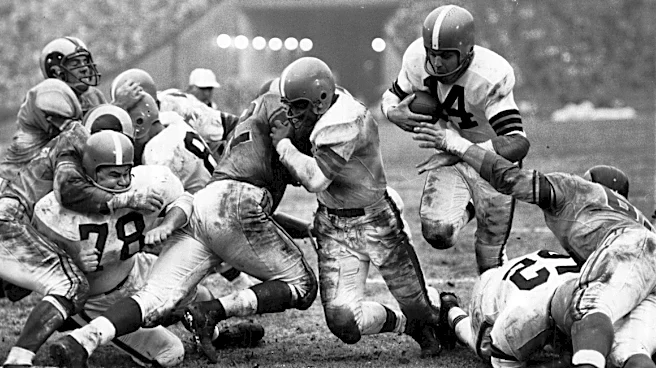
The Eagles jumped out to a 3-0 lead before Browns QB Otto Graham found WR Dub Jones for a 59-yard touchdown catch-and-run that silenced the crowd. In the second quarter, Graham tossed a 26-yard TD pass to WR Dante Lavelli for a 14-3 halftime score. The only points scored in Quarter 3 was a 13-yard pass from Graham to WR Mac Speedie. Then early in the fourth quarter, Graham took it in from one yard out as the Browns were now up 28-3. Both teams added a touchdown for the final score of Cleveland 35, Philadelphia 10. 18
To this point, the NFL had done everything in its power to make the Browns’ transition as difficult as possible. But the whole thing was that the Browns were an exceptional ballclub who were well-coached with plenty of talent. This one game, the NFL owners were certain would shut up Cleveland about their claim of being a four-time league title holder.
The Browns had not only beaten the NFL’s two-time reigning champions; they had destroyed them. Philly gave up five turnovers as the Browns had 448 yards of total offense compared to just 248 for the Eagles. Just one game into the 1950 season, and the owner’s plan had backfired. They had provided as many obstacles as they could to face the Browns, now it was out of their hands as the season would be decided solely on the field. Time Magazine did an article on the Browns.
9. The American Conference title

The New York Football Giants were one of the three really good clubs that were located in the same conference as the Browns. Cleveland finished the 1950 season 10-2-0 as both losses were to the Giants. For the next 20 years, , the Giants were Cleveland’s annual rivalry until the merger with the “American Football League” in 1970. And this new rivalry began with this season.
At season’s end, both the Browns and Giants had identical records. 19 Today, the Giants would have advanced based on head-to-head, but back then the league scheduled a one-game playoff with the winner going to the “1950 NFL Championship Game.” In the other conference, the Rams and Chicago Bears had identical 9-3-0 records, so they went to a winner-take-all situation as well.
Cleveland beat the Giants 8-3 while Los Angeles defeated the Bears 24-14. In the Browns very first year in the NFL, they had captured their division, um, conference over every other NFL club.
10. Browns play in the 1950 NFL Championship Game

Finally, Cleveland had beaten the Giants in a rough and tough match. The win placed the Browns in the “1950 NFL Championship Game.” 20 It was the fifth consecutive season that Cleveland was playing in a league title game. The NFL rotated home field advantage for the title game between the two conferences. This year, it swung to the American Conference with the Browns having a home game. The owners missed this opportunity to thwart Cleveland, but it was what it was. So, the Browns had its first NFL championship home battle since the 1945 Cleveland Rams defeated the Redskins 15-14 in a blizzard. 21
The temperature at kickoff for the 1950 title game was 27 degrees, with a wind chill of near zero, played on Christmas Eve. The Browns largest crowd during the season was 40,714, so they drew well. But only 29,751 brave souls took on the bitter environment while the rest of Ohio listened on the radio.
The Rams started off 7-0 on the very first play of the game, but at the half held a slim 14-13 lead. In the third quarter, Cleveland struck first for a 20-14 lead, but that ended shortly as the Rams scored twice and led 28-20 going into the final quarter.

Graham hit RB Rex Bumgardner with a 14-yard TD pass to cut the lead down to 28-27. Then K Lou Groza nailed a 16-yard field goal with 20 seconds remaining 22 as the Browns won 30-28.
In their first year in the NFL, the Cleveland Browns were now NFL Champions. 23 Five championship games in five years that became five championships. Still a record in pro football. Everyone discusses a three-peat in the Super Bowl, but winning multiple consecutive title games has already been done. The league owners had placed so many obstacles in the Browns’ way, but instead Cleveland went over, under, around, and through every impediment.
After Cleveland’s historic victory, NFL commissioner Bert Bell called the 1950 Browns “the greatest team ever to play football.” 24
The 1950 Browns ranked #25 on the 100 greatest teams of all time presented by the NFL on its 100th Anniversary. 25
Barry Shuck is a pro football historical writer and a member of the Professional Football Researchers’ Association
Notes:
1. Craig R. Coenen, “Pro Football’s Long Road to Stability and Prominence,” From Sandlots to the Super Bowl, 2005, The University of Tennessee Press
2. John Eisenberg, “Two Wars,” The League, 2018, Basic Books
3. Greater Cleveland Sports Hall of Fame, “Arthur B. (Mickey) McBride,” clevelandsportshall.com/mcbride-arthur-b-mickey/
4. Jonathan Knight, “Beginnings and Endings,” Paul Brown’s Ghost, 2018, Sports Publishing
5. Gary Webster, “No Stranger to Championships,” Just Too Good: The Undefeated 1948 Cleveland Browns, 2015, McFarland
6. Pro Football Hall of Fame, “History of the Los Angeles Rams,” profootballhof.com/teams/los-angeles-rams/team-history
7. Anthony Poisal, “Top Moments: Browns win all four AAFC championships from 1946-1949,” clevelandbrowns.com, 2021
8. Richard A. Macales, “Review of the All-America Football Conference,” Sport in American History, 2019
9. Richard A. Macales, “Review of the All-America Football Conference,” Sport in American History, 2019
10. Michael MacCambridge, “Going Deep,” America’s Game, 2004, Random House
11. Andrew O’Toole, “World’s Greatest Football Team,” Paul Brown: The Rise and Fall and Rise Again of Football’s Most Innovative Coach, 2008, Clerisy Books
12. Jeff Darcy, “White footballs used at night,” Browns new/old white helmets, 2024, cleveland.com
13. Andrew Gribble, “Browns uniforms through the years,” Timeline: Documenting the changes Browns have made to their uniforms since 1946, 2020, clevelandbrowns.com
14. The Gridiron Uniform Database, “1950 Cleveland Browns preseason games,” 1950 Cleveland Browns
15. 1950 NFL schedule, “Week-by-week games,” pro-football-reference.com/years/1950/games.htm
16. Andrew O’Toole, “World’s Greatest Football Team,” Paul Brown: The Rise and Fall and Rise Again of Football’s Most Innovative Coach, 2008, Clerisy Books
17. Andy Piascik, “The 1946–1955 Cleveland Browns”, The Best Show in Football, 2007, Taylor Trade Publishing
18. 1950 NFL schedule, “Week 1: Cleveland at Philadelphia box score,” pro-football-reference.com/boxscores/195009160phi.htm
19. 1950 NFL season, “Final standings,” nfl.com/standings/league/1950/reg, nfl.com
20. 1950 playoffs, “1950 NFL Championship Game,” pro-football-reference.com/boxscores/195012240cle.htm
21. John Eisenberg, “The Right Guy in Charge,” The League, 2018, Basic Books
22. New York Times, “Browns Win Pro Football Title on Groza’s Field Goal,” 1950
23. Vince Guerrieri, “1950: Browns Win First NFL Championship,” 2025, Cleveland Magazine
24. Michael MacCambridge, “Going Deep,” America’s Game, 2004, Random House
25. National Football League, “#25: 1950 Cleveland Browns,” NFL 100 Greatest Teams, nfl.com/videos/nfl-100-greatest-teams-no-25-1950-cleveland-browns