



Welcome to the 2026 NBA Playoffs.
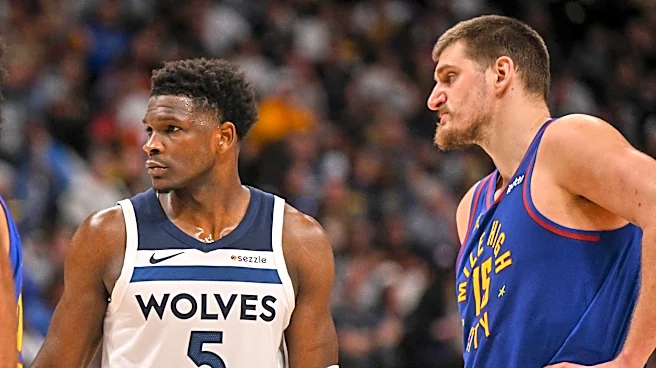
For the third time in four years, the Minnesota Timberwolves will take on the Denver Nuggets in the playoffs. The two teams have become incredibly familiar with each other as they have played a total of 28 times over the past four seasons.
Three years ago, fresh off a trade for Rudy Gobert, the eighth-seeded Wolves lost to the eventual champion Nuggets in five games, a series that Nuggets players called the toughest of their playoff run. The next season, in possibly
the greatest game in Timberwolves history, Minnesota came back from 20 points down in the second half of Game 7 in Denver to reach the Western Conference Finals for the first time in 20 years.
For the two fanbases, the history goes back even further than that. In 2004, the Wolves’ first-ever playoff series victory as a franchise came against Carmelo Anthony and the Nuggets. In 2018, Jimmy Butler and the Wolves beat the Nuggets, eliminating them on the final day of the regular season while clinching the franchise’s first playoff berth in 14 years.
“I don’t think there’s anything else to call it but a rivalry.” -Anthony Edwards on the Timberwolves-Nuggets matchup.
A new chapter in this rivalry is set to begin Saturday afternoon in Denver, and it’s sure to be electric. It always is with these two teams.

Playoff Anthony Edwards
Any discussion of the Timberwolves in the playoffs, but especially against the Nuggets, has to begin with the team’s superstar, Anthony Edwards.
Edwards comes into the playoffs as the biggest health question mark for Minnesota. Ant played in a career-low 61 games, 18 fewer than the past three seasons. Since mid-March, Edwards has only played in a total of three games, averaging just 25.3 minutes per game.
The most recent issue has been what is colloquially known as “runner’s knee.” It’s an injury that is unlikely to lead to further issues, but also one that can flare up seemingly out of nowhere and cause pain. The best thing an athlete can do to treat the injury is rest, something Edwards has gotten plenty of the past month.
Edwards was a full-go at practice this week, but his ability to play at 100 percent in this series likely won’t be known until the two teams step on the floor for Game 1. If Ant is limited physically in this series, the Wolves’ path to winning this series becomes a lot more clouded.
If Edwards is healthy, this Denver matchup should be an advantageous one for him. The Nuggets’ defense ranked 21st during the regular season, and they do not have a traditional rim protector or an All-NBA caliber wing defender, two archetypes that have given Edwards issues in the past.
Given Denver’s lack of point-of-attack defenders or an ideal matchup for Ant, the Nuggets will likely throw multiple defenders at Edwards as many as possible. That is what happened during the Wolves’ lone win over the Nuggets on March 1. The Nuggets consistently sent two defenders at Edwards in an attempt to get him off the ball, and by the end of the game were picking him up the moment he crossed the mid-court line.
“My 4 is better than they 3,” Edwards said following that game. “We’re playing 4 on 3. So, I hit Rudy, and he makes a play, and I feel like we’re gonna win if they keep making us play like that.”
A month and a half later, Ant still feels the same way. “I’ve seen everything now. So nothing they’re going to throw at me that’s unexpected. I know they’re going to put two or three on the ball. I’ve just got to be willing to make the right play and take my shots and live with it.”
“Ant sees a ton of different types of coverages,” Timberwolves head coach Chris Finch explained. “We review them as the season goes along. This week gives us a chance to put him through a lot of live reps where he’s gotta make reads against what we think might be coming or just anything that’s out there.”
Speaking specifically about Denver picking up Edwards at halfcourt, Finch said, “If they’re going to pick him up and pressure, we just need him to make the easy play to the right guy and trust the open man to make the same decision.”
Ant’s ability to pick apart the Denver defense and dominate the series offensively is the Wolves’ most straightforward path to beating the Nuggets. If Edwards is merely good instead of sensational, that will likely not be good enough against a Nuggets team looking for revenge from what happened two seasons ago.
Game 1 should be an interesting litmus test for this. The Wolves’ margin of error in this series is already slim, so if Edwards is slow to find his legs or a rhythm in the game, that might be a bad sign for the Wolves in this series. Minnesota will need Edwards to step up his game right from the opening moments or potentially dig themselves into a hole.
Let’s see if Ant can rise to the occasion yet again.

The Tradeoff of Offense vs Defense
The Timberwolves’ largest challenge in this series will be containing the Nuggets on offense. During the regular season, Denver sported the league’s best offensive rating of 121.2, a full point better than second place.
Unsurprisingly, the two main drivers for Denver’s incredible offense this season were Nikola Jokić and Jamal Murray. This season, the pairing of Jokić and Murray led the NBA in scoring efficiency among qualified pairings with an offensive rating of 128.7. For comparison, the Wolves’ best offensive two-man pairing was Edwards and Donte DiVincenzo with a 120.8, which ranked 102nd.
If Minnesota has any chance of slowing down the league-best Denver offense with possibly the best two-man game of the past half-decade, they are likely going to need to utilize Rudy Gobert in this series, both on offense and on defense.
While Gobert has been the foundation of a Timberwolves defense that has been one of the best units in the league since he arrived in Minnesota in the summer of 2022, the Wolves have struggled to maximize his impact on the offensive end. This season has possibly been the most extreme differential between the two sides of the court with Gobert.
With Gobert on the court this season, the Timberwolves have a defensive rating of 109.8, which would rank 3rd in the NBA as a team. The offense on the other end had a 114.8 rating, which would rank 16th. While the +5.4 net rating Gobert generated while on the court speaks positively of his impact, it also begs the question: Can the Timberwolves outperform their mediocre offensive numbers with Gobert on the court?
At many points this season, when the Wolves have been down in games, the first lever Finch has pulled is to take Gobert off the floor to generate more offense. While that move may make sense in the regular season or in a different
In the minutes with Gobert on the bench this season, the Wolves had a defensive rating of 118.8, a number worse than the 26th-ranked Memphis Grizzlies’ defense. While the offense often made up for that and more in those minutes, the Wolves’ inability to defend without Gobert on the floor would likely mean disaster if Minnesota decided to increase the minutes of the Julius Randle-Naz Reid frontcourt.
With Edwards set to receive an outsized portion of the attention from the Nuggets’ defense, the ball is more likely to end up in Gobert’s hands as it did down the stretch of the Wolves’ win over the Nuggets on March 1. Gobert was successful in that game in receiving the ball from Edwards and making the right play against the shifted defense, often finding open teammates either under the basket or on the perimeter.
“Just being poised,” Gobert said about the potential of increased offensive touches against Denver. “Take whatever the defense gives us. I’m going to have a lot of opportunities to find my teammates. I’m going to have a lot of opportunities to be aggressive. It’s the beauty of our team. Taking what the defenders give us and doing that as a team, and if we do that, we will have some success.”
“I feel like every series that we’ve been in when I play with Rudy, they’re like daring us to throw it to him,” Edwards explained about Gobert. “Just getting comfortable with throwing that lob, with getting downhill, with him getting to the dunker more instead of pick-and-roll, just getting to the dunker and allowing me to go by my man and them helping uphill, just throwing that lob, learning how to throw it, how much touch to put on the pass.”
To keep Gobert on the floor in this series, the Timberwolves will need to keep him involved in the offense, at least on a level that prevents Denver from completely ignoring him on that side of the court. Minnesota has not done well in that area this season, or really at any time during Gobert’s time with the Wolves. They have often been hesitant to throw him the ball with worries that he will either fumble the pass or be unable to finish near the rim.
To upset a dangerous Nuggets team, though, what the Wolves did during the regular season is not going to be good enough. They will need to either trust their franchise center on offense or look to find any defense with their other lineups.

What Version of Julius Randle Shows Up?
The Timberwolves have seen two different forms of Julius Randle this season.
The one from the first half of the season gave the Wolves exactly what they needed. Randle scored at a solid clip, defended his matchup well, and dished out assists whenever a second defender came to help. For most of the first couple of months of the season, it appeared Julius was on track to make the All-Star Game.
In the second half, all of that completely flipped for Randle. The scoring dipped, his defensive focus fell off a cliff, and the turnovers went up while the ball movement stopped.
The statistical splits from before and after the All-Star Break tell the story of Radle’s Jekyll and Hyde season. Before the All-Star Break, Rande averaged 22.3 points and 5.4 assists on 49.2/32.5/82.3 shooting splits with a net rating of +5.7 while he was on the court.
In the second half, all of those numbers went down. Randle had just 18.1 points and 4.2 assists per game while putting up rough shooting splits of 44.9/28.2/75.3.
A large x-factor in this Timberwolves-Nuggets series is whether or not Randle can return to his first-half form. One possible reason for optimism in that area is that Julius was outstanding in the first two rounds of the playoffs last season.
“First and foremost, health,” Randle explained as the reason for his success in the playoffs last season. “
Going into the playoffs healthy was big. Just a competitive nature. It’s the basketball you live for throughout the year. Just having that certain level of focus and sharpness and attention to detail and all that different type of stuff. I felt good. Coaches had a great game plan for us and myself. It’s really about trusting that and trusting your work. It’s no different than any other game.”
A positive sign for Randle is that he appears to be entering the playoffs healthy again. Julius played in the Wolves’ first 79 games before sitting out the last three once the Wolves’ seed was more or less solidified.
If the Wolves can get the first-half version of Randle, the Wolves will have a much easier time attacking the Denver defense, which is likely to focus a majority of their attention on Edwards. If the second half of the season is more indicative of what to expect from Julius, it might spell the end of the power forward’s time in Minnesota.

Can the Wolves Flip the Switch?
For the second straight season, the Timberwolves finished the regular season with 49 wins and in sixth place in the Western Conference. Unlike last season, though, there was not a big trade that was made right before training camp; instead, they returned all but Nickeil Alexander-Walker from their “seven starters” rotation.
There have been some solid stretches of play and wins against the Oklahoma City Thunder and San Antonio Spurs. There have also been mind-numbingly poor stretches, including a five-game losing streak in January and a three-game losing streak by a combined 66 points in March.
There has been a sense all season that the Timberwolves have just been waiting for the playoffs to begin, and that when they do, they will be able to flip a switch and transform into a capable of beating anyone in any given series. In their minds, it seemed they had proven all they needed to by making the past two Western Conference Finals, the second of which as the lower seed following a lackluster regular season.
Edwards was asked if the team had been just waiting for the playoffs to begin: “It felt like that at times, like we was just trying to get through the season to get to the playoffs, but we’re here now, and all the other excuses are out the window. So it’s time.”
Ant is right about one thing: nothing from earlier in the season matters now. While there will be plenty of time in the offseason to debate the success or failure of the regular season, the entire context of the season changes if the Wolves can play as they have in the past two postseasons.
To do that, though, they are going to need to play with a level of intensity and consistency on the defensive end of the floor that was severely lacking during the regular season.
“We don’t have a choice,” Gobert said about the defense needing to find another gear. “When our group doesn’t have a choice, usually it shows up, and so once again it’s all in our hands. It’s all in our power. We’re facing a great opponent, and we know that if we don’t come out hungry, we don’t have a chance.“
Naz Reid echoed Gobert’s points, saying, “It has to. We have no choice. Defense wins games. They say that in football, and I think it translates to basketball, as well. You can score, but who’s going to get the stops? We have no choice.”
Whether or not the Wolves can pull it all together will be tested right out of the gates against the Nuggets. “It’s really on us to do it,” Randle posited. ”We gotta come in with that focus from Game 1. We can’t ease our way into the series.”
The Timberwolves have said all the right things. They’ve acknowledged their shortcomings, identified what needs to change, and spent the week at practice and in film sessions implementing their new game plan. Everything gets put to the test Saturday afternoon in Denver for Game 1. The Wolves can either back up their words and lock in for the next weeks and possibly months, or continue down the path of a disappointing season.
When asked if Finch believes the Wolves have a flip to switch, the Wolves coach stated through a chuckle, “We’ll see.”