

Mizzou took a unique approach on a 4th and 1 with several potential ball carriers against Arkansas’ defense.
Austin Simmons lined up in the gun, with Jamal Roberts aligned to his left. Simmons simply could’ve just handed it off to Roberts. But with the play clock going under 15 seconds, Simmons sprinted under center, with Roberts aligned off the left tackle. DeMarion Fowlkes finished his motion by aligning the offset of Jordon Harris.
A quarterback sneak with a 6-foot-4 Simmons is another option, but
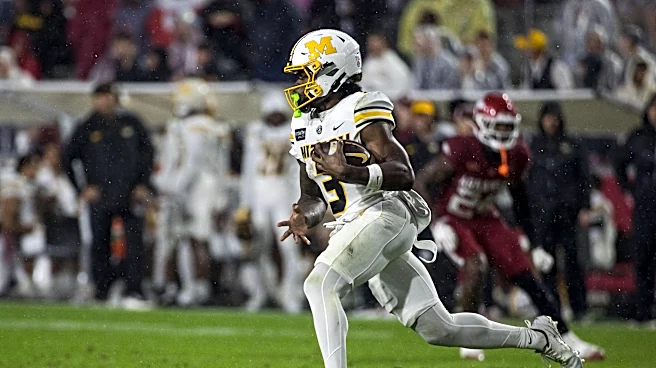
instead, it’s Fowlkes taking the ball on a jet sweep. The 5-foot-9 wide receiver made one cut before muscling his way for a six-yard gain.
Seven plays later, Blake Craig nailed a 53-yard field goal, extending the Tigers’ lead to 13-0, on their way to a 34-10 win.
Going back to the jet sweep to Fowlkes, it’s something that we haven’t seen from the Tigers’ offense much this season. But it was frequent on Saturday as it gave gave Arkansas more rushing threats to defend on top of playing against one of the best running backs in the SEC.
At that point in the second quarter, that was Fowlkes’ third designed rushing attempt of the night. He was the only wide receiver to have a rush attempt this season prior to Saturday with one. But Cole Cubelic noted on the broadcast how Chip Lindsey was using the east-west game a lot to generate quick touches for Mizzou’s playmakers.
The offense ran a handful of screens, while Fowlkes produced in the rushing attack.
On his first attempt, off Trajen Greco’s interception, Fowlkes picked up eight yards on a jet sweep. The second, Mizzou lined up under center, Fowlkes went in motion and followed the blocks of Harris and Jude James for a four-yard gain.
In the postgame, when describing an improvement in the red zone, Drinkwitz highlighted how staying ahead of the chains leads to better play calls. Applying that same principle, Fowlkes’ carries created more manageable situations for Mizzou, producing a 2nd and 2 and 3rd and 5.
The following plays from both rushes were a six-yard gain by Roberts and a Simmons completion to Olugbode for a first down.
Jet sweeps aren’t the only thing that’s been developing in within MU’s offense. Over the past three games in SEC play, the Tigers have leaned a bit into Simmons’ potential as a running threat. Mizzou has called three quarterback draws over the past three games, two to end the half against Texas A&M, and another at Ole Miss.
Against Arkansas, it was called once again. On a 2nd and 1, Mizzou lined up four receiving options near the hash marks or wider, with Olugbode lined up by himself near the numbers, creating a five-wide set. It creates a lighter box for Arkansas, as it has to allocate resources out wide.

The favorable matchup up front with just five in the box allows Simmons to run a quarterback draw up the middle for three yards and a first down.
Mizzou’s playcalling in the red zone has often been described as predictable. Two plays after Simmons’ draw, Cubelic described how, in the red zone, formations and personnel groupings are just as important as the play calls, which is something you saw on the draw by Simmons.
Simmons also picked up a couple of yards on a read option where he kept it to the outside in the red zone.
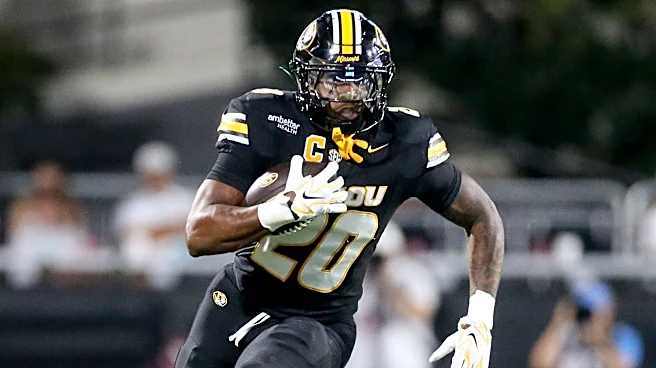
Designed runs to players like Fowlkes or Simmons supplement the Tigers’ traditional running game. Mizzou ran for 211 yards in the afternoon, behind Roberts 138 yards to help him go over 1,000 for the season.
This included an awesome run by Roberts in one of Mizzou’s traditional concepts. Mizzou’s bread and butter, the outside zone, worked to perfection as blocks by Harris and Lee opened the floodgates for a 43-yard run. Harris engages with the defender, while Lee prevents his guy from getting inside of him. It opens a massive hole for Roberts. Further downfield, Donovan Olgubode makes a nice block, allowing Roberts to get to the sideline.
A play later, Mizzou lined up in I-formation and Roberts plowed over the defensive end to get into the end zone for a one-yard score.
But while the Tigers found success on the ground, there were still plenty of elements that left a lot of meat on the bone for the team. Roberts had a 16-yard gain wiped out by a holding penalty by Caleb Goodie Sr., and as a team, was penalized nine times for 80 yards.
“Offensively, we were just continually stubbing our toes with penalties,” Drinkwitz said. “We’ve got to get that cleaned up. In the second half, we were much better.”
In the fourth quarter on a 1st and 10, the Tigers went back to a design they found success with in the first half. Under center, they motioned Fowlkes to what appeared to be a jet sweep with Harris and James blocking on the perimeter. It froze four Arkansas defenders. Meanwhile, the original play designed appeared to be a zone on the opposite side to Roberts.
But a miscommunication caused Roberts to go to the opposite side. Simmons kept the ball, which resulted in a loss of two. But, the way the play was blocked up, a potential sizable gain for MU was available.
While that play failed, it demonstrates how the use of motion causes stress on an entire defense. It creates beautiful results and showed once again in the fourth quarter.
On Mizzou’s final score, on a 4th and 2, the Tigers sold an end-around with Fowlkes. The hesitation it creates with linebackers allows Roberts to get free in the flats. The pitch and catch to Roberts is easy, and it’s a 10-yard score to put the game on ice, 34-10.
That was Mizzou’s third touchdown in the red zone, showing improvement after struggling at Mississippi. Creativity and evolution sometimes come in small numbers, but it helped Mizzou’s offense generate an efficient night offensively. In the first half, Lindsey used misdirection, and it later helped create a touchdown through the air. In this case, defenses have more possibilities to defend.
Whether its penalties, or miscommunication, execution still needs improvement. But, this past Saturday showed how adding a few additional things can help make Mizzou’s offense more versatile.