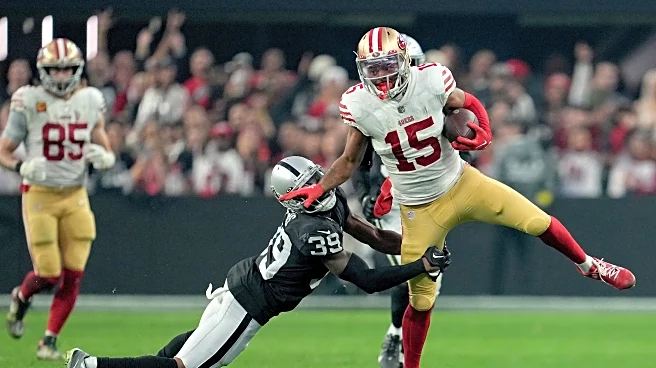



After a one-year hiatus, the San Francisco 49ers return to the playoffs. The regular season has been full of rollercoaster moments. The highs include thrilling victories over the Rams and Bears, while the lows feature losing two of the best players in the league at their respective positions.
We’ve learned a lot about Kyle Shanahan this year. Despite all the injuries the offense endured throughout the season, his scheme proved it can transcend the absence of star players. The 49ers were once again
prolific offensively, finishing second in schedule-adjusted efficiency and third in success rate.
If the 49ers are going to make a playoff run, it’ll need to be on the backs of their offense. The defense showed some fight in Week 18, but the depth is depleted, and the margin for error no longer exists. Any drive that doesn’t result in points is a win for Robert Saleh.
Expectations reset in the playoffs. What you did for 17 games doesn’t matter. It’s about which team executes for 50 minutes. With that in mind, let’s discuss five unanswered questions about the 49ers as they enter the playoffs.
Can the offense generate enough big plays?
Looking at various numbers daily, the ones that show the most correlation with winning are passing success rate and generating explosive plays through the air. For the season, the 49ers finished third in passing success rate, at 53.1 percent. Since Week 11, the offense remained consistent, sitting third once more at 52.8 percent.
The 49ers’ offense was below league average this season in explosive play rate through the air, ranking 20th. They were much better in the final three games, ranking third, which is encouraging coming out of the bye week. Still, over the final 10 games, on a larger sample, the Niners were 20th.
Week 18 was a prime example of how difficult offense can be when you don’t generate explosives. The 49ers did it on one drive, and they quickly marched down the field and into the red zone. Outside of that drive, it was tough sledding for the offense.
I’d expect Kyle Shanahan and his coaching staff to review the Week 13 matchup between the Eagles and the Chicago Bears and watch it closely, perhaps stealing some of the concepts involving motion.. Ben Johnson windrow dressed his way up and down the field, had Philadelphia’s second-level defenders confused, and found a way to control the game, despite only one explosive passing play. It’s possible, but it won’t be easy.
How aggressive will Kyle Shanahan be on 4th downs?
There are a couple of trains of thought when it comes to fourth-down decision-making. Before we share those, there is nothing more valuable in football than possessing the ball. The best chance you have to win in this league is when you have the ball.
Knowing that, teams are either uber-aggressive on fourth down because they know their offense is potent and can pick up whatever yardage they need. Then there are the coaches with elite defenses. If you know your defense is stingy, then you can afford to go for it on fourth down because you understand there is a high probability that you get the ball back.
In Week 18, Shanahan punted the ball on 4th & 2 from San Francisco’s 43-yard line. In a game like that, where every possession is so valuable, the probability of you gaining two yards, retaining the ball, and going down to score was well worth being wrong about.
There was zero indication that your defense could get a stop up to that point. The Seahawks scored on their previous drive and reached 1st & goal at the 1-yard line on their first drive. The odds that you were going to prevent Seattle from getting to the 43 were slim. Sure enough, Shanahan punted.
The result worked out, as the Seahawks missed the field goal. However, that doesn’t feel like the right way to look at it. You still didn’t score, nor did the defense stop Seattle from getting to the yard where you punted.
Shanahan went for it on the next fourth down. The offense needed one yard. They didn’t convert. That doesn’t mean the decision to go was incorrect. On the ensuing drive, the defense had a free run at Sam Darnold. They should have ended the possession scoreless had Dee Winters sacked Darnold. They allowed a field goal, which works.
How aggressive will Shanahan be on fourth downs in the postseason? The strength of this team is on offense. Shanahan was correct more often than not during the regular season when it came time to go for it.
The 49ers are at their best when the offense is on the field. Even against a top defense like the Eagles, keeping the offense out there on fourth downs will give them the best chance to win.
Can the defense cut down on the mistakes it can control?
Saleh will put you in a position to make a play. The 49ers are short on talent defensively, but that doesn’t excuse the mental mistakes or missed tackles. The Niners had 23 missed tackles in Week 18, leading to 272 yards after contact.
A.J. Brown and DeVonta Smith aren’t known for being YAC merchants, but they’re not easy to get on the ground. Neither is Dallas Goedert. Saquon Barkley had 759 yards after contact this season. The Eagles have playmakers who can make you look silly.
The 49ers’ secondary will be put in a position, time after time, in the playoffs to make a 1-on-1 tackle. Malik Mustapha has a broken+missed tackle percentage of 26 percent, which is the 18th-highest among all defensive backs in the NFL. Deommodore Lenoir sits at 22.8, and Ji’Ayir Brown is 22.2 percent.
It’s problematic when both of your safeties and the corner that you put in cloud coverage as the primary force defender are consistently missing tackles. That’s not on Saleh when his players are whiffing. He can’t tackle for them.
You can control tackling. It wouldn’t be surprising if the Niners started Eric Kendricks and Kyzir White this Sunday. Since Fred Warner went down, missed tackles at linebacker have been problematic. The Eagles’ offense has been bogged down all year. The last thing Saleh’s unit can afford to do is give them extra chances and free yards because of missed tackles.
Can the defense stand tall on third downs and in the red zone?
Seattle went 6-for-13 on third down, but went 0-for-3 in the red zone in Week 18. The Bears went 6-for-12 on third down, but were 1-for-3 in the red zone. The Colts were 5-for-10 on third downs and scored a touchdown on both of their red zone trips.
Teams have no issues moving the ball on the 49ers’ defense. That’s been a given all season. The postseason success will come down to whether Saleh’s unit can get off the field on third downs or force field goals in the red zone.
For the season, the 49ers were 10th in opponent red zone touchdown scoring percentage at 53.7 percent and 50 percent during the final ten games. They were 21st in opponent third-down conversion rate, one spot behind the Eagles.
It comes back to possessing the ball. Your offense needs to be on the field. One way the 49ers’ defense can keep the offense in the game is by holding their opponent to three points or forcing a third-down stop before they reach field-goal range. It doesn’t have to be the majority of the time, either. A 40 percent third-down rate allowed should be plenty good.
Can the 49ers’ special teams win them a game?
In Week 18, Jake Moody missed a 24-yard field goal after doinking a kick off the upright. Eddy Pineiro’s one miss came at the end of the half from nearly 60 yards. Pineiro’s near-perfection will come in handy this postseason.
The 49ers’ opponent’s kicking percentage should also benefit them. Last year, teams kicking against the 49ers made 96 percent of their kicks. This season, it’s been a league-low 66.6 percent — nearly six percentage points better than the team in second place.
The 49ers finished the season ranked 13th in special teams DVOA. The Eagles were 24th. Thanks to Skyy Moore and Brian Robinson, San Francisco was fifth in kickoff returns. Flipping the field once in a playoff game would be huge for multiple reasons.
Surprisingly, the Niners lead the league in hidden points on special teams. It’s something that has been dragging the team down, arguably every season under Shanahan. But this year it’s been one of the biggest strengths on a 12-win team.