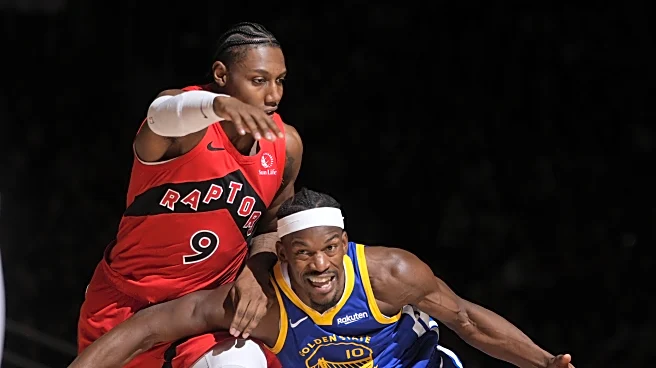

With under a minute to go in the third quarter of the Golden State Warriors’ lone visit to Toronto — with the Warriors up by 10 points — the ball was inbounded to Gary Payton II, in what was supposed to be
a typical bring-up sequence. What wasn’t typical, however, was that Payton was bringing the ball up.
Payton doesn’t profile as one of the team’s most proficient ball handlers. Perhaps Steve Kerr felt it necessary to shuffle some of the ball-handling responsibilities to a veteran who operates practically as a guard-sized big on offense. This was a downstream effect of De’Anthony Melton being sidelined for this game — someone who profiles as one of the team’s more capable bring-up ball handlers.
(Pat Spencer also could’ve handled some of the ball-handling responsibilities against the Raptors but was not employed by Kerr in what ultimately was another DNP-CD.)
Think of the worst possible outcome produced by Payton bringing the ball up. That outcome turned into an ugly reality:
Truth be told, the ball pressure from Ja’Kobe Walter wasn’t all that suffocating. Payton practically stumbled and overdribbled himself into losing the ball, resulting in Walter getting the steal and the easy two points — part the Raptors scoring 35 points off of the Warriors’ 20 turnovers.
Payton’s somewhat comedic turnover ultimately was the catalyst for a series of events that did not inspire laughter nor joy. The Raptors — perhaps realizing that the Warriors were bereft of bona-fide ball handlers, sparked by Payton’s embarrassing turnover — immediately employed a sudden rush of full-court pressure, as if to test the Warriors to see if they can calmly break their efforts to swarm them in the back court.
As it turned out, the Warriors failed spectacularly:
In the specific instance above, the mistake turned out to be Jimmy Butler willingly dribbling along the sideline and creating a third inanimate defender alongside the other two Raptors’ defenders who are attempting to trap him. Butler is compelled to escape from a potential trap by rushing and passing the ball while jumping up in the air — and in the hands of a red jersey.
One would think the Warriors would learn their lesson with regard to dribbling toward the sideline, where a trap would be at its most potent. However, on the very next possession, with the Raptors once again employing full-court pressure, Brandin Podziemski commits the same mistake as Butler before him:
Nursing a five-point lead with 1:32 left in the game, the Raptors again send pressure against the Warriors. Again, a Warrior (Will Richard) commits the cardinal sin of dribbling along the sideline and into a trap, with practically nowhere to go. The pressure gets to Richard, and he coughs up the ball:
Even Steph Curry — despite a 39-point performance on 56 percent True Shooting — fell victim to dribbling too close to the sideline, getting himself trapped, and being pressured to pass out of the trap, resulting in a deflection and another turnover:
“At the end of the third (quarter) and the end of the fourth (quarter) we just got scattered,” Kerr said to reporters after the game. “I’ve got to get us better organized during those stretches, that’s on me. They turned up the pressure. We didn’t handle it well and they scored 35 points off out turnovers. That was the game.”
In Kerr’s self-admission of his failure to get his team organized against the Raptors’ token full-court pressure, the paramount advice of avoiding the sidelines was either ignored or outright unmentioned. The fact that the Warriors kept making the same mistake over and over — in all honesty, a basic no-no that at the lower levels are taught to basketball players as part of their development — can only point to a lack of basic understanding of how to beat full-court traps.
Perhaps Kerr should’ve also employed an additional ball handler in Spencer in order to maximize the number of players on the floor who could dribble and calmly make decisions amid constant pressure. Nevertheless, other factors may have come in play with regard to the decision not to play Spencer (i.e., him having 20 games left out of the 50 allotted to two-way-contract players).
But the Warriors’ turnovers against the Raptors wasn’t just from their incompetence against full-court pressure. One crucial turnover — arguably the most back-breaking of the game — came on a Draymond Green pass in what was a scripted after-timeout (ATO) set play.
Take note that the turnover came on a drawn-up action that Kerr had previously concocted earlier in the game, as a counter to Curry being top-locked:
Curry screens for Green to receive the pass in the corner in order to create a direct passing angle to Curry, who counters the top-lock on him by simply turning around receiving the pass underneath the rim for a layup.
At the 1:07 mark and down by a single possession, Kerr goes to the same ATO set. With the Raptors keying in on a potential Curry turnaround to counter the top-lock, Curry instead lifts up to set a “rip” screen for Butler. Multiple defenders converge on Butler’s cut, crowding the paint and making it difficult for a pass to get through to Butler.
However, Green goes with the first read and insists on getting the ball to Butler, despite its ill-advised nature:
If Green would’ve expanded his options, he could’ve seen Richard left open as a result of Butler’s cut — a preferable option to stubbornly thread the ball through a window that was never that open to begin with.
“I kicked myself, I tried to run a little backdoor play where Steph’s setting the backscreen for Jimmy late in regulation, (then) bring Steph off of a split cut if the back cut hadn’t worked,” Kerr said of the play above. “I put Draymond in a tough spot. That was on me. I needed a better call in that situation to get the ball to Steph or Jimmy and give them space.”
I would argue the play that Kerr called for which he blamed himself wasn’t necessarily a bad decision — but rather, bad execution and subpar decision making on Green’s part. But if Kerr were to do it all over again and place the ball in Curry or Butler’s hands, it may have gotten the Warriors a better shot, let alone get a shot off.
After all, Curry proved that, with the spacing provided, he could cook his assignment in one-on-one situations: