
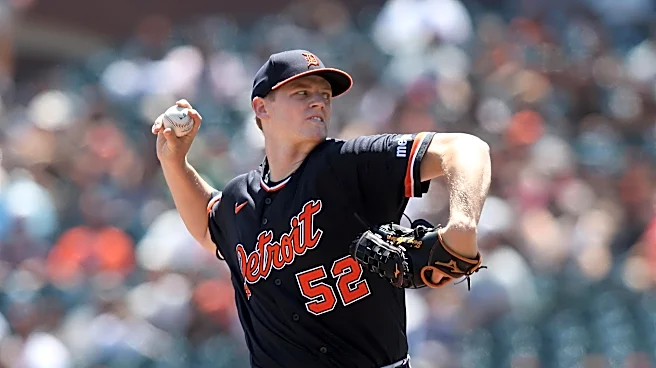
While the Detroit Tigers’ offense is drawing most of the attention during their epic run from June 1 to the present, their much maligned bullpen has also played a part in turning the season around. Some credit for this has to go to the team at large, as good starting pitching and plenty of run scoring makes it far easier to keep a bullpen in order. Another crucial element to good bullpen work is team defense, and the return of Gleyber Torres, Javier Báez, along with Zach McKinstry swinging a hot
enough bat to play most days, has really solidified them as a defensive unit as well. Adding in Max Clark to play above average center field has been the final piece of that puzzle. Even so, several key members of the bullpen have clearly pitched better over the last 10 weeks going back to June 1, and none more than veteran lefty Tyler Holton.
In 2023-2024, Holton was one of the most valuable relievers in baseball. One could scoff at his mediocre strikeout rates, but his extremely low walk rate, along with keeping home runs in check, lent plenty of support to the idea that Holton wasn’t just getting lucky on balls in play. He was an absolute workhorse for the Tigers, appearing in 125 games and throwing 179.2 innings with a combined 2.15 ERA. That’s an ace caliber season for a starting pitcher, but Holton managed it while pitching two to three games per week on short notice, occasioally spot starting, and otherwise never knowing when his number would be called, or for how long he’d have to pitch once he was on the mound.
In 2025, things finally started to slip. Holton’s strikeout to walk ratio remained excellent, but he had a few stretches in which teams got to him for a lot more home runs. After posting a 0.80 HR/9 mark across 2023-2024, that mark skyrocketed to 1.72 HR/9 in 2025, Holton’s age 29 season. Of course, he wasn’t alone as many of the Tigers relief options went down with injury or struggled to re-create their 2024 performances. While Holton managed to pull it together enough to pitch well in September, it seemed as though the lack of strikeouts had finally come back to bite him, and that his run as an unconventionally great reliever was at an end. That impression was only strengthened when Holton struggled early in 2026 as well.
Through May 31st, Holton had posted a 4.50 ERA/4.36 FIP for a bullpen that crumbled to dust in May. His strikeout and walk numbers were still solid, but still the home runs were coming more frequently than they used to as right-handed hitters continued to tee off on him.
Holton has long drawn attention for having two distinct three-pitch mixes depending on hitter handedness. Against lefties, he jams them with sinkers and bends sweepers down and away into the right-handed batters box, while mixing in fourseamers up to change hitters’ eye level. Against right-handers, Holton mainly features cutters, with a mix of changeups and fourseamers, along with a bit of curveball away to steal strikes on the outer edge. The pitch that was really betraying him even as his sweeper improved was the changeup.
Right-handed hitters posted a gruesome .452 wOBA, .462 ISO combination against the changeup prior to June 1 of this year. The pitch was averaging 12 inches of horizontal run, and two inches of vertical movement. Whatever adjustment Holton made to the changeup, since that point he’s added almost three inches of arm side run, and two inches of vertical movement. It’s fading away arm side more, and dropping a little less. As a result it seems to be harder to see out of the his hand with a bit flatter shape, but then fades away arm side more than expected. The result has been a lot more weak contact.
Right-handers have posted just a .187 wOBA and a .087 ISO against the changeup since June 1. Whether it’s the change in movement to accentuate the horizontal break, or whether Holton is just setting it up and commanding the changeup more effectively, it’s completely turned his season around. His main weapon against right-handers, his cutter, was also getting hit harder than usual this year, but that may have simply been because it was the only pitch working for him and hitters were able to sit on it. Since June 1 hitters have done absolutely nothing against the cutter, despite the fact that the average movement on it hasn’t changed at all. Fixing the changeup fixed his whole approach to attacking right-handed hitters and turned him back into the versatile reliever the Tigers relied so heavily on in 2023-2024. Once again, he looks like one of the better relievers in the game, and the struggles of 2025 now look like a single season blip in his career numbers.
Good to have you back, Tyler.
Holton isn’t all the way back to his 2023-2024 numbers just yet, but considering how rough the 2026 season started off for him, it’s remarkable that his numbers are once again lining up so well with his peak seasons. The strikeouts continue to trend up, and the home runs continue to trend down. If he can keep that up for the next seven weeks or so to finish out the season, everything should line up nicely once again with his career numbers, with only that home run spike in 2025 to remind us that he fought through a rough stretch for over a season before finally getting everything back in form.
The Tigers bullpen still badly needs a real ace reliever down there, one capable of turning out the lights on good opponents with strikeouts and weak contact. It’s hard to have faith in Kenley Jansen managing it, although Drew Sommers has certainly provided an overall boost in stuff for the high leverage crew. That lack may once again be their undoing down the stretch or in the postseason, and the disinterest in adding relief help at the trade deadline remains a baffling oversight. But with Tyler Holton back to dealing like he did in 2023-2024 it’s once again a deeper, more flexible bullpen for A.J. Hinch and Chris Fetter to deploy. Whether it’s enough to get them into October where they can use their starting pitchers more flexibly, and perhaps find ways to make it work, remains to be seen.