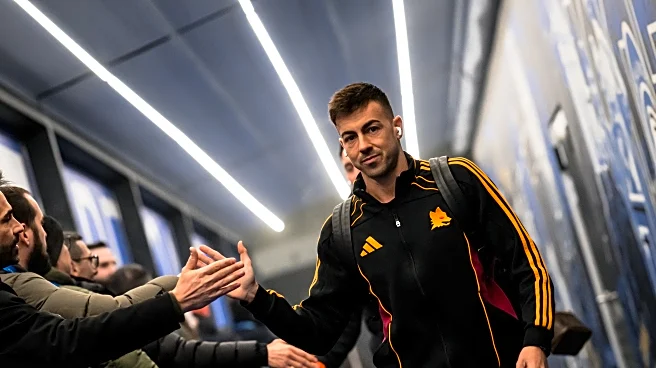

Roma travel south to Lecce tomorrow, with the sting of their last match still hurting Romanisti worldwide. The club’s weekend 1–0 loss to Atalanta, decided by an early Giorgio Scalvini header from a set
piece and followed by nearly 80 minutes of Roma possession that rarely turned into danger, was not just three points dropped but another missed chance to firmly establish the club as a Champions League qualification favorite. Roma had spells of control and moments of promise, but nothing that ever truly forced the issue. What lingered after the final whistle was not anger so much as the sense that this was another game that slipped away due to a lack of effort.
That feeling has become familiar. This Roma side is not in crisis just yet, but it does feel stuck. Performances hover somewhere between solid and encouraging, and the early success of the side is keeping them in contention for the goals the club dreams of, yet results keep falling short of what the team needs. The loss to Atalanta felt typical in that sense. The squad was organized, calm, but ultimately ineffective when it mattered. As the table tightens and expectations stay high, every match begins to feel a touch heavier. Now, Roma are chasing confidence and some version of themselves that feels reliable on a week to week basis.
With that in mind, tomorrow’s match against Lecce feels like both an opportunity and a danger. Roma should handle this one easily in a perfect world (Lecce are just outside the relegation zone), but that will only happen if they play with the clarity and intent that has not been consistently on display as of yet. As all small sides do against the giants, Lecce will play compact, physical, and difficult to break down. Roma will need patience to break them open, not to mention conviction. While it’s certainly expected, a convincing win tomorrow could suggest that this side has actual mental fortitude. They need to show they can respond to disappointment with something sharper than control and something stronger than good intentions.
What to Watch For

A Serious Shot for El Sha?
One thing worth watching tomorrow is whether Stephan El Shaarawy really does get a start. Italian media reports this week have suggested that he is in line to be in the XI against Lecce, which would be a notable vote of trust in a player who, at this point, feels more like part of Roma’s emotional core than its tactical future. El Sha is 33 now, extended through 2026 more out of continuity than expectation, and very clearly in the later phase of his career. He is no longer someone Roma can build around, but he remains someone Roma turns to when they need a certain kind of energy, especially when matches start to feel flat or predictable.
That energy still has immense value, however. El Shaarawy has never been a player defined by raw numbers so much as by rhythm. His instinct to carry the ball forward, to attack space directly, and to look for quick combinations in tight areas can change the feel of a match even when it does not immediately change the scoreline. Against a Lecce side that will almost certainly sit deep, defend narrowly, and dare Roma to break them down patiently, his willingness to take risks and run at defenders could matter. Roma have looked too comfortable lately moving the ball side to side without ever really asking a question. El Sha’s game, even now, is at its best when it is built around asking one.
There is also something quietly symbolic about GPG deciding to bring El Sha in with the starters. When a team feels stuck, managers often turn to players who understand the club as much as the system. El Shaarawy has been part of Roma across multiple eras, multiple coaches, and multiple resets. If he does start tomorrow, it will not be because he is the future, but because he represents a version of Roma that plays with a little more urgency and a little more edge. That might be exactly what this team needs right now; a quick reminder of how to press when a match is there to be taken.
Who Steps Up in the Defense?

Roma head into Lecce with what can only be described as a serious defensive problem, not in theory or tactic (their defense is still one of the best in Europe) but in personnel. Gianluca Mancini and Mario Hermoso both picked up bookings against Atalanta that triggered automatic suspensions, and Evan Ndicka remains away at AFCON, meaning Roma will line up without their entire first-choice back three.
With all that in mind, even if the winter mercato means a new defender joins the squad, the name that now matters most is Jan Ziolkowski’s. He has featured in limited minutes so far, usually in controlled situations and usually when the game is already settled. In those appearances, he has looked composed on the ball and physically capable, if understandably cautious, given his inexperience. There has been nothing alarming, but nothing yet that answers the question of how he holds up when the match is alive, when space is tighter, and when the pressure is not abstract but immediate. It’s almost a guarantee that Ziolkowski will play from the first minute against Lecce, and with that comes a truly important opportunity for the defender—can he show himself to belong with some of the best central defenders in Europe?
What makes that opportunity more complicated than “show your stuff, kid” is that he will not be stepping into a familiar structure, surrounded by world-class defenders. After all, so many of the starters are unavailable. The defenders around him (perhaps Devyne Rensch, perhaps Zeki Çelik) will also be new to these roles, new to each other, and new to being relied upon in this way. That means Ziolkowski’s task is not just to defend well individually, but to help create order where there is none yet. To communicate, to position himself cleanly, to avoid the kind of small error that turns a quiet match into an anxious one. If he can do that, it might say even more than the good shifts he’s put with more experienced hands at his side.