
Around 11 a.m. on May 29, 1949, veteran scout Tom Greenwade rolled up to a home in Commerce, OK to link up with a teenage ballplayer and his father. After watching the kid play each of the two days prior, Greenwade was intrigued enough to drive from Commerce to Baxter Springs, KS for another showcase. That day in Baxter Springs, he saw something that took him by surprise. Facing a lefty for the first time with Greenwade in attendance, the teenager stepped into the right-hander’s batter’s box. After lacing
four line drives, the switch-hitter retreated to Greenwade’s car along with his father. The three hashed out a $1,500 contract for the remainder of the season to start his career in pro ball. Mickey Mantle was a Yankee.
Thomas Edison Greenwade
Born: August 21, 1904 (Willard, MO)
Died: August 9, 1986 (Willard, MO)
Yankees Tenure: 1949-64
Greenwade grew up in Willard, a small town in Missouri that he’d call home throughout his life. He was an early standout as a pitcher and outfielder, playing in both the minor leagues and independent ball from 1923 into the ‘30s. While he had some excellent seasons, he never got the chance to play in the big leagues, moving into coaching and, eventually, scouting.
For a young man with little pedigree, Greenwade’s ascent in the scouting world is astounding. Hired by the Dodgers in 1940, he proved himself to Branch Rickey immediately. By 1943, he was already the Dodgers’ top talent evaluator, leading to a historic assignment that would become integral to his legacy.
Having received approval from Brooklyn ownership to pursue Black players, Rickey had a conundrum. On the one hand, the process of selecting the player to break the color barrier had to be kept completely under wraps. Any awareness on the part of the public — or even the rest of the league — of the Dodgers’ plan could torpedo it at the outset. At the same time, it was imperative Rickey choose a player whose talent and temperament would make the experiment a success, a task that would generally require all hands on deck in his scouting department.
At a one-on-one meeting at Kansas City’s Biltmore Hotel in 1943, Rickey tapped the one and only scout who would be involved in this secret project. “All that secrecy had me buffaloed,” Greenwade later said of the historic discussion. “And I got more curious after he sat and talked to me about things that had happened in his life. He told me one story about the time a hotel refused to allow the catcher of his Ohio Wesleyan team to have a room. The catcher was a Negro, and I began to get the idea.”
Greenwade started the process in Mexico and Cuba, under the guise of recruiting for a hypothetical Black Dodgers Negro League franchise. The first candidate who was strongly considered was Cuban shortstop Silvio Garcia, a talented ballplayer playing in the Mexican League. Accounts differ on why Garcia was not the man to make the leap to the National League. The most titillating account is that Mexican League President Jorge Pasquel put a pistol on the desk during his meeting with Greenwade, implying in no uncertain terms that he would not permit Garcia to jump ship to the States. Another narrative is that Garcia told Greenwade he would fight any player who directed abuse towards him, a deal-breaker given what lay ahead.
Greenwade’s account was less dramatic. “He couldn’t pull the ball,” he said of Garcia. “He was a right-handed hitter – everything went to right field.” Regardless of the reason, the decision to pass on Garcia led Greenwade to Jackie Robinson. Still the only man on the job, Greenwade never spoke to Robinson while scouting him, observing him from a distance, at least in part for the sake of secrecy. The scout saw enough on the field to make his recommendation to Rickey that, despite a suspect arm, Robinson was the right fit for the Dodgers.
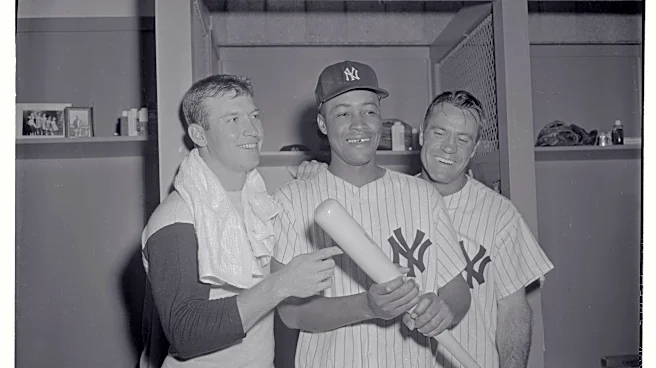
In December of 1945, Greenwade jumped across town, accepting an offer from the Yankees that would triple his salary. He would spend many more years in the Bronx than he had in Brooklyn, with Mantle his signature signing. Their relationship went beyond that day in Baxter Springs, with Mantle leaning on Greenwade while struggling as a 19-year-old rookie in 1951 and continuing to leverage him as an informal advisor in the years that followed.
Greenwade went on to sign a cadre of consequential Yankees, including Elston Howard, who would break the Yankees’ color barrier in 1955. In 1950, the year after his meeting with Mantle, Greenwade came out to scout the Negro League’s Kansas City Monarchs. The team’s manager, the legendary Buck O’Neil, encouraged him to take a closer look at Howard. Within a matter of days, the Yankees had acquired his contract. In a rare recommendation involving an established big leaguer, Greenwade was the man who encouraged the Yankees to trade for Kansas City’s Roger Maris, projecting greater production from the young slugger.
Greenwade retired in 1964, returning full-time to Willard, where the local high school’s ballpark still bears his name.
He died in 1986 and has remained an icon in the scouting world ever since, garnering induction into the Professional Scouts Hall of Fame as part of its second class in 2009.
Greenwade’s legacy is tangible; one need look no further than Monument Park at Yankee Stadium to see his impact. The legendary scout is directly responsible for four retired numbers out in Monument Park — those for Mantle, Howard, Maris, and Robinson, whose number is retired across baseball. Greenwade is at once a legend and an everyman, the blue collar scout who drove his Cadillac across America looking for the next great ballplayer and whose hit rate may never be equaled.
See more of the “Yankees Birthday of the Day” series here.