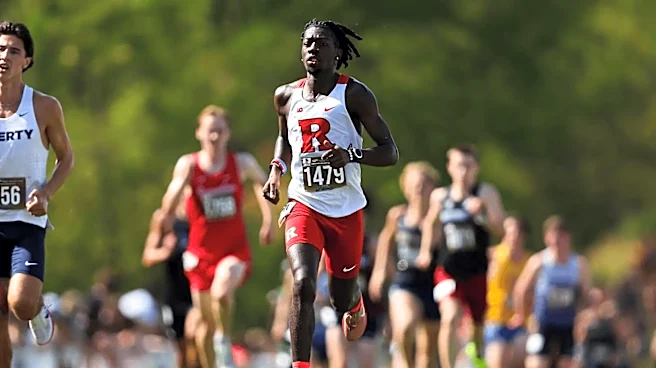









Lehigh called off the last six races of the 52nd Paul Short Run on Friday afternoon on medical advice, citing heat and temperatures that kept climbing. Rutgers had already run both of its races in those conditions on the Goodman Campus course, and its two teams came out of them with very different stories.
The women scored 437 points in the College Gold 6K and finished 15th of 37 scoring teams, 15 places better than they managed in this race a year ago and ahead of Big Ten opponents Maryland (17th,
496) and Ohio State (24th, 682). The men scored 683 in the Gold 8K and placed 26th of 35, a year after finishing 21st. Liberty won the women’s team title with 115 and Wingate the men’s with 58.
The Women Bring the Same Five Back
Lorena David, a senior, led Rutgers in 21:45.3 for 62nd. Kelseigh O’Neil, a junior and a preseason Big Ten Runner to Watch, came through 63rd in 21:46.1, eight-tenths of a second later. Molly Domurat, a freshman, was 79th in 21:56.8, and Maeli Gleason, a sophomore, was 92nd in 22:04.8. Sofia Condron, a senior, closed the scoring in 144th in 22:35.1.
That is the same five who scored at the Lehigh Invitational on Sept. 4, with Domurat and Gleason trading the third and fourth spots.
The math was 62-63-79-92-141 for 437. Condron finished 144th but scored 141st, because runners who did not count toward a team score come out of the scoring order. The same rule moved the displacers, freshmen Daphne Roskowski (203rd, 23:01.9) and Lydia Bereznitski (208th, 23:05.2), up to 186 and 190.
The top four ran within 19.5 seconds of each other. The one-through-five spread was 49.8 seconds, and 30.3 of it sat between Gleason and Condron. Rutgers’ team time of 1:50:08 worked out to 22:01.6 per runner.
That gap decided the placing. Bucknell was 14th with 422, 15 points ahead. Had Condron been 9.7 seconds quicker, she would have scored 125th instead of 141st, and Rutgers would have beaten Bucknell by a single point. Mercer sat 17 points behind in 16th.
Gleason is the clearest measure of both the conditions and the progress. She ran 22:11.5 for 227th in this race a year ago. On Friday she was 6.7 seconds faster in worse weather and 135 places higher. Cassidy Kidd, a junior, did not finish.
Pittsburgh’s Maureen Cheruiyot won the race in 19:47.7, and host Lehigh was 20th.
Lawson Runs Alone for the Men
Micah Lawson, a senior, finished 32nd in 24:44.8. That is 30 seconds slower than he ran here last October and 39 places higher, which is about as good a summary of the weather as the results offer, given Lawson’s talent.
Nobody was near him. Ryan Smith, a senior who won the IC4A outdoor 3,000 meters in the spring, was Rutgers’ second man in 25:59.9 for 157th, 1:15.1 behind Lawson. Gavin Rossi, the junior Monmouth transfer who won the Lehigh Invitational outright, followed in 26:06.6 for 174th. Blake Sealy, a freshman, was 183rd in 26:11.9, and Sean Matthews, closed the scoring in 26:17.4 for 191st.
In scoring places that was 32-146-160-169-176 for 683, with juniors Alex Patelski (234th, 26:49.6) and Maan Patel (262nd, 27:14.2) displacing at 208 and 228. The one-through-five spread was 1:32.6 and the team time 2:09:21, an average of 25:52.1, but two through five ran within 17.5 seconds of one another.
The lineup is the explanation. Of the five who scored the 35-36 win over Saint Joseph’s in September, only Lawson and Rossi scored Friday. Hisham Ettayebi, third for Rutgers at Lehigh, and Kyle Rakitis, fourth, both did not finish. Jack Moran, the fifth scorer that night, did not appear in the results.
The margins in that pack were thin. Bucknell and Siena tied at 660 for 24th and 25th, 23 points ahead. Six scoring places apiece from Smith, Rossi, Sealy and Matthews would have been worth 24 points, and in that part of the field six places cost between two and four seconds a man, roughly 12 seconds across the four. Host Lehigh was 27th, 34 points behind Rutgers.
Saint Joseph’s, the team Rutgers beat by one point on this course four weeks ago, finished 13th with 440. Penn State’s Nick Sloff won the race in 23:59.8, and the Nittany Lions were second as a team, the only other Big Ten program in the men’s standings.
Same Course, Different Five
I noted after Lehigh that a September opener against a mostly Division II and III field was not a referendum on anything, and that the men’s one-point win was evidence the distance to the top of the conference was being argued over rather than closed.
Paul Short was a much deeper field, and it argued back.
The women brought the same five. The men brought two.
The women’s result is the more durable one. The same scorers in nearly the same order and a 15-place jump from last year on the course where they will run the NCAA Mid-Atlantic Regional in November. Domurat, the Flemington product and Group 3 champion, scored third for Rutgers in a 37-team field in her second collegiate race, and Roskowski and Bereznitski displaced right behind her.
Sealy, the Manhasset, N.Y., product who broke a 45-year-old school record as a high school junior, scored fourth for the men. Four of the 14 runners in Rutgers’ two top sevens were freshmen.
What the men do not have yet is depth they can lean on when someone is missing. A lineup that won a meet by one point with five healthy runners lost two of them before the finish and a third before the start, and there was no one waiting to absorb it.
None of Friday’s times should be read too closely. Lehigh did not finish its own meet, 53 runners across the two Gold races did not finish theirs, and O’Neil ran 51.7 seconds slower than she did on this course a year ago. Starkes called it “a rough one out there” in Rutgers’ release. Everyone in the field ran in the same heat, and the places are the fair measure.
Rutgers goes to Madison next for the Nuttycombe Invitational on Oct. 9 at the Zimmer Championship Course, the same ground as the Big Ten Championships on Oct. 30, with the Princeton Fall Classic in between. Then it comes back to Bethlehem a third time for the Mid-Atlantic Regional on Nov. 13. The women now know they can sit 15th in a deep field on the Goodman Campus course with their best five. The men know they can be 26th on it without three of theirs, and whether that number means anything depends on who is healthy in November.