





The life of an NBA role player is one of uncertainty.
Every year could be in a different city. You’re fighting for guaranteed contracts every offseason. It’s more a matter of survival than finding a true home.
Some of these players evolve to the point of being not easily replaceable, allowing them to worry more about team fit and overall salary than survival. Those players are the ones with solid bench roles, but not the guys who are big franchise pieces.
I don’t know if Landry Shamet has reached that
second part, but he’s certainly evolved past the first, which is where he was to start 2025-26. A guy who didn’t have a guaranteed contract in the preseason for consecutive seasons, who’s already suited up for six teams in seven seasons, and someone who’s only sizable contract saw him bought out midway through, has reached the mountaintop.
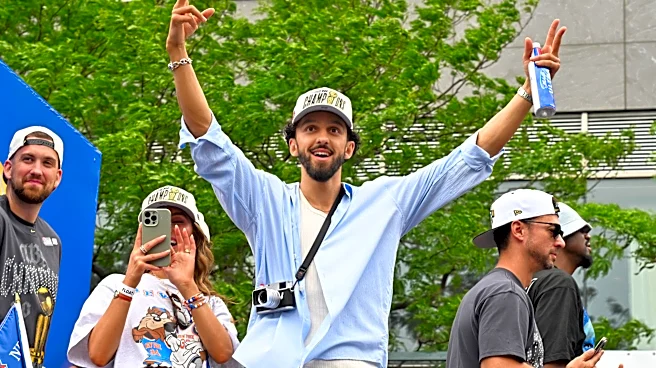
And the cherry on top? He did it as a key contributor, joining the likes of “Big Shot” Robert Horry, Steve Kerr, John Paxson, and more as a role player who stepped up big time and put his name in the history books for an NBA champion.

Shamet was born on March, 13, 1997, in Kansas City, Missouri, to a single mother, a former Division I volleyball player at Boise State. He didn’t meet his father until he was 24, so his uncle took on an important role in his upbringing, marred by financial instability. His family lost their apartment when he was in middle school after going bankrupt.
He went to Park Hill High School, where he became one of the best players in the state of Missouri. As a three-star recruit, he held offers from multiple Big Ten programs, but decided to stay close to home at Wichita State, enrolling there in 2015.
Shamet figured to be a big part of the Shockers’ plans in 2015-16 as a true freshman alongside Fred VanVleet and OAKAAK Ron Baker in the backcourt, but sustained a season-ending foot injury in his first career start against Division II Emporia State in November. When he returned the following year, he was thrust into the starting lineup, where he led a balanced Wichita State team to the NCAA Tournament.
After a season in which he was All-MVC First-Team and MVC Rookie of the Year, he took another step forward as a redshirt sophomore in 2017-18, leading the conference in three-point percentage and assists as the leading scorer on a 25-8 team. Despite two years of eligibility remaining, he declared for the 2018 NBA Draft, where he snuck into the first round, being picked No. 26 by the Philadelphia 76ers.
He wouldn’t even last an entire season in Philly. Despite showing flashes, including a 29-point outburst in January 2019, he was used as a small piece in the Tobias Harris trade, being sent to the Clippers with two firsts and two seconds for the one-time all-star that would become one of the most hated men in the city.
In Los Angeles, Shamet would start 23 of the remaining 25 games, earning a spot on the All-Rookie Second Team. He again played well the following season, splitting time as a starter and sixth man while being one of the best shooters on a team that was now built around Kawhi Leonard and Paul George. His performance in Game 3 against the Mavericks in the bubble was a big reason they got out of the first round.
But that would be his final few games as a Clipper. He was traded to Brooklyn that offseason in a three-team deal that landed Luke Kennard and four seconds in L.A.
While it would be his third team in three years, Shamet was on yet another winner and another team that was a title contender in 2020-21. He had another typical year, averaging nine points a game on 38% from downtown, but didn’t have an impact in the playoffs and couldn’t step up after injuries to Kyrie Irving and James Harden damaged their hopes of getting past the eventual champion Bucks. That offseason, he was flipped to Phoenix for Jevon Carter and the No. 29 pick.
Four teams in four years. Despite showing himself as a valuable role player, that’s still extremely concerning. He inked a four-year, $43 million extension before the season, which seemingly gave him stability. His two years there were solid, but slightly down due to a reduction in role.
Aside from Game 3 against Denver in 2023, he didn’t produce much in the playoffs, and recurring foot injuries limited him to 40 games in the regular season. Just one year into his four-year pact, he was dealt to the lowly Wizards in the Bradley Beal trade, being left to the fishes and exiled into NBA irrelevance.
As many do, he struggled after going from perennially making the second round of the playoffs to the worst organization in basketball. The 2023-24 season was miserable for him, as he shot a career low from behind the arc, struggled with more foot injuries, and was an afterthought late in the year for a Wizards team focused on development.
Just like that, he was waived in July and spent months on the free agent market. Less than two years after being a valuable role player for a perennial playoff team and making $10 million a year, he was on the cut line. Dozens of players are stuck in that limbo every year, barely sneaking onto NBA rosters or being forced to continue their careers overseas. That’s where Shamet was in the summer of 2024.
But circumstances brought him to New York. He was brought in during September to compete for a roster spot with guys like Chuma Okeke and Marcus Morris Sr., but got a life raft when the Karl-Anthony Towns blockbuster went through ahead of training camp, prompting Morris to be waived for space. When he was offered to re-sign after the trade went through, he said no, so with that and the loss of Donte DiVincenzo, a role existed for a player of his archetype.
Tom Thibodeau was a fan and planned for him to get minutes in the Opening Night rotation in Boston, but a devastating dislocated shoulder in the penultimate preseason game threw a wrench in the team’s plan and one in Shamet’s career.
He was released because of the team’s limited second-apron space and his non-guaranteed contract. Once again, his NBA career was in serious jeopardy.
But the Knicks believed in him more than it looked. They fully intended on bringing Shamet back when he recovered, going as far as to pick him in the G-League draft to keep him in-house during his rehab. It all culminated in him being re-signed in late December and making his Knicks debut on December 23, 2024.
He struggled early after the long layoff, but fully shook off the rust as the team got closer to the postseason. His shooting slump with the Wizards was an aberration. He had two games of making at least six threes in April. He was ready for his triumphant return to playoff basketball.
And then, he was just removed from the rotation. Cam Payne’s electric Game 1 against the Pistons necessitated more minutes for him, and Shamet’s poor play early in the series led to him being fully benched in Game 4, the rest of the Detroit series, and the entire Boston series. Thibs ran a tight ship, and with every game being a full-blown war, he had no time to deal with the bench.
Until the Knicks went down 0-2 to Indiana, that is. For the first time all season, true desperation was settling in. Needing a spark. Thibodeau inserted Mitchell Robinson into the starting lineup and unleashed Shamet and Delon Wright off the bench to add defensive intensity.
At least in the short term, it worked. Both added a needed spark to make a huge Game 3 comeback, and the team won their minutes in the first three games they played, but Indiana just simply had too many answers for what the Knicks could throw at them, ending their season in six games in the Eastern Conference Finals.
Despite a solid season, Shamet once again had a limited market when he re-entered free agency. He once again entered September without a contract, holding out hope that he would be able to stay in New York if he were to continue his NBA career.
Well, the offer came, and he once again was in a battle for the final roster spot. Malcolm Brogdon and Garrison Matthews stood in his way, and unlike last year, he was not the perceived frontrunner to make the roster.
Until Brogdon retired at the end of the preseason. While Mike Brown was always a big fan of Shamet, the needs of the roster likely had him on the outside looking in. For a guy who’s gotten some bad luck over the years, it was some good fortune shining on him.
Unlike last season, he had a big role on the bench right away, stepping up to make some big performances when guys went in and out of the lineup.
There’d be more adversity on the way before he got there, though. Yet another shoulder injury brought about fears of a similar injury to last year, which could’ve led to Shamet’s release.
Fortunately for him and the Knicks, it was a sprain, not a dislocation. He was back soon enough and continued to make big plays throughout a season where he played the most, shot the best, and scored the most in a half-decade.
But his story didn’t end in the regular season this time. This time, he was going to put his name in the history books.
He was out of the rotation after the first few games against Atlanta due to more early-series struggles, but all he could do was stay ready. When his time came, he didn’t let it go to waste.
Re-inserted in the rotation against Philly, it was his tremendous second quarter in Game 3 that flipped a sure Sixers win to a Knicks party in the City of Brotherly Love. His hot shooting bled over into Game 4, where he and Deuce McBride buried a franchise that gave up on him in less than a year.
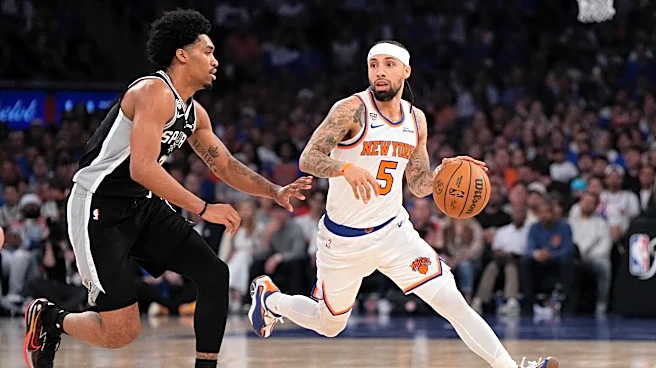
Against Cleveland, he hit three titanic threes down the stretch in Game 1, being the catalyst along with Jalen Brunson for the 22-point comeback. His game-tying three that rolled around the rim felt like redemption from the Haliburton shot and gave the team the feeling of a team of destiny. His name echoed through the Garden and through the streets of New York.
What he did against Cleveland was otherworldly. He went an unfathomable 11-for-12 from three in four games and was a plus-53. If it were a seven-game series, there’s a chance he’d get consideration for Eastern Conference Finals MVP for his standout performance.
He played huge roles in the first two games of the NBA Finals, making six threes and averaging 31 minutes a game, but he finally went cold afterwards. The Knicks were able to manage his minutes quality deteriorating and closed things out in five games. Shamet finished the postseason 26-for-50 from downtown.
A lifetime of instability, setbacks, and unfortunate timing led him to this moment. At times, it looked like he just wasn’t meant for this. At times, it looked like he had to settle with a fine, brief career as a role player, somebody whose legacy would be defined by dudes in bars 15 years from now saying “Remember that guy?”
Well, now nobody in New York will ever forget his name.
–
(P&T will be doing player-by-player article tributes over the next few weeks to commemorate the special team that ended our long, half-century nightmare)