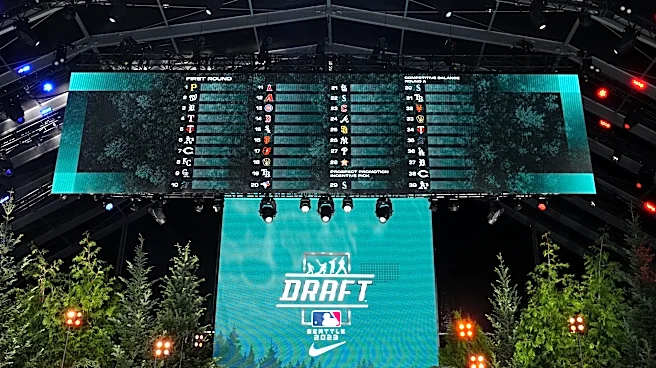




The Orioles completed their 2026 draft class across 20 rounds on July 11 and 12. This year’s class has 20 players in it, one for each round. The next step is to get players signed and into the organization. In most cases, that’s going to be settled before the trade deadline. The signing deadline this year is July 27 at 5pm Eastern.
In last year’s draft class, the Orioles signed 21 of the 24 players that they drafted. Although there have been “sign every pick” years in the Mike Elias era, this one
probably isn’t going to be one of them.
Bonus pool math
Last year, the Orioles had the largest draft bonus pool that any team ever had up to that point. The record was beaten by this year’s White Sox in the same way that last year’s Orioles did, with a draft week trade bringing a tradeable competitive balance pick into the mix. This year, the Orioles have the 13th-biggest pool available, with $13,114,200 as their official allotment.
The bonus pool system has been in effect since the 2012 Draft. Each pick in the first ten rounds is assigned a value that decreases as the draft goes along. Add up these values and you get a team’s total bonus pool. Discussion about whether a particular signing is overslot or underslot is relative to the value for that pick. The top Orioles pick at #7 overall has a slot value of $7,327,200, all the way down to the tenth round pick’s value of $198,900.
On the whole, players who have more leverage to get overslot bonuses are those who have just graduated from high school, as well as draft-eligible college sophomores and junior college players. They can just say they’ll go to college or play another year of college if they don’t like what a team offers. Picks who were either college seniors or even graduate students still playing baseball tend to get way under slot bonuses of $25,000 or less.
You can expect a team will sign a player taken in rounds 1-10. They lose their bonus pool money for an unsigned pick in those rounds. It will get done unless there’s a surprise medical issue, which has only happened once with the Orioles in the Elias-era drafts. Don’t worry about players unsigned as the deadline approaches.
The Orioles may end up having more bonus pool math to sort out this year compared to past years. They drafted three high school players and a junior college player within the first ten rounds, and another five high school players in rounds 11-20.
Players taken from rounds 11-20, and undrafted players, can receive a signing bonus up to $150,000 without counting against the pool. Any amount that exceeds $150,000 for these picks is what counts against the pool. Recently, the league added the option for junior college-bound players to sign late as “draft-and-follow” players for a bonus of up to $225,000 before next year’s Draft.
Also, a team can exceed its pool by up to 5% and it will only have to pay a tax on the overage amount, equal to 75% of the overage. There are steeper penalties for exceeding 5% that no team has ever incurred. In last year’s draft, the Orioles used nearly every dollar available to them in their 5% overage. This year, the extra 5% gives the Orioles an additional $655,700.
This article will be updated between now and the deadline as signings or non-signings are reported by media or announced by the team. Signing bonus information listed where available.
Players who have signed
- 16th round, 470th overall – Brayden Fry – SS – Cranford (NJ) HS (source)
Apparently not signing
Nothing official yet
For more information about this year’s draft class, check out my article on what is one of the youngest groups the Orioles have ever taken.
- 1st round, 7th overall – Eric Booth Jr. – OF – Oak Grove (Miss.) HS
- 2nd round, 46th overall – Ty Head – OF – NC State
- 3rd round, 82nd overall – Dominic Voegele – RHP – Kansas
- 4th round, 110th overall – Kevin Roberts Jr. – OF – Jackson Prep (Miss.) HS
- 5th round, 142nd overall – Jimmy Anderson – SS – Heartland CC (Ill.)
- 6th round, 171st overall – Zane Adams – LHP – Alabama
- 7th round, 200th overall – Ryan Piech – RHP – Xavier
- 8th round, 230th overall – Will Plunkett – SS – Mamaroneck (NY) HS
- 9th round, 260th overall – Collin McKinney – RHP – Arizona
- 10th round, 290th overall – Carlos Sanchez – UT – LSU-Shreveport
- 11th round, 320th overall – Ross Norman – RHP – Coastal Carolina
- 12th round, 350th overall – Leo Marrero – C – Hardee (Fla.) HS
- 13th round, 380th overall – Garrison Sumner – RHP – BYU
- 14th round, 410th overall – Miguel Hugas – RHP – Mercer (Ga.)
- 15th round, 440th overall – Braden Smith – RHP – Central Florida
- 17th round, 500th overall – Diego Gutierrez – RHP – San Diego
- 18th round, 530th overall – Gunnar Garrison – RHP – Eaton (Colo.) HS
- 19th round, 560th overall – Victor Salazar – OF – Paetow (Tex.) HS
- 20th round, 590th overall – Ross Davis – RHP – Rusk (Tex.) HS
Undrafted free agents
These players are also able to sign for up to $150,000 without counting against the bonus pool, with any amount beyond that going against the pool. These are signings collected by Baseball America, typically sourced from college team social media accounts reporting that their player has signed a contact.
- Regan Hall – LHP – Illinois
- David Lally Jr. – RHP – Michigan
- Colton Sampson – LHP – Seminole State JC (Fla.)
- Camden Wicker – RHP – Central Florida