


There’s something often prized above star power in baseball. It lies at the heart of the sport’s superstitions. It’s what a hitter aims for while drilling their swing, and what a pitcher practices with each wind-up. At the end of a lengthy 162-game regular season, it also tends to determine a player or team’s statistical success: consistency.
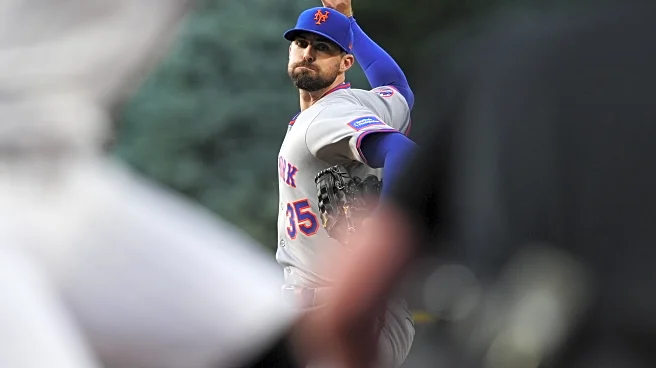
From 2022-2024, Clay Holmes was the model of a consistent reliever. Each season, he recorded an ERA+ between 129 and 155, a K/9 rate between 9.2 and 10.1, a BB/9
rate between 2.8 and 3.3, and most notably an innings pitched total fluctuating only between 63.0 and 63.2. So when Holmes signed with the Mets last December and began preparing for the 2025 season as a starting pitcher, doubt naturally crept up from corners of the baseball world.
Did Holmes silence the skeptics? Well…sort of. A glance at his end-of-season stat line would seem to indicate a successful experiment, with Holmes turning in a healthy volume of 165.2 innings pitched and a solid 3.53 ERA. In his previous three seasons combined, the right-hander had won a total of 14 games; in 2025 alone, he won 12. On paper, by the laws of 20th century baseball logic, those numbers pass the eye test.
But as anyone who watched Holmes’s season start-by-start knows, it certainly didn’t always feel like a walk in the park, especially when he was walking 3.59 batters per nine innings (the third-highest rate of any starter in the National League). Much like the 2025 Mets’ mirage of a season, Holmes’s first year in Queens began as a miraculous sprint before tumbling slowly into a sobering trudge. It was a journey which at first illuminated the organization’s ability to find creative ways to win, and ended by exposing their inability to address fatal flaws in the roster’s construction as it sunk out of contention.
The new Holmes was a quality starting pitcher, but the old Holmes wasn’t just a quality reliever; he was an elite one. In addition to his aforementioned BB/9 rate, his K/9, GB%, and Hard-Hit % all took notable hits between 2024 with the Yankees and 2025 with the Mets. The pitch bearing the most dramatic drop in effectiveness was Holmes’ slider, particularly against left-handed hitters. In 2024, lefties hit just .095 with no extra base hits against the pitch. In 2025, lefties hit .311 with ten extra base hits against it. It’s difficult to pinpoint exactly why this uptick occurred, as Holmes threw roughly the same percentage of sliders in the heart of the zone (46.1% in 2024 and 51.4% in 2025) and lost a fairly negligible 0.5 inches of horizontal break from year to year (it’s a game of inches, not a game of half-inches, after all). Still, lefties were crushing the pitch, which might explain why Holmes dropped its usage from 14.6% in June to 5.4% in July, instead favoring his more effective sinker and changeup combination for the remainder of the season.
The more troubling (and predictable) feature of Holmes’ season was his decrease in effectiveness as it progressed. Over his first seventeen starts, Holmes pitched to a 2.99 ERA. Over his following twelve starts, Holmes pitched to a 4.99 ERA. It was only in his final four starts of the season that Holmes bounced back, capping the year with six scintillating innings of one-run ball during a must-win Game 161 in Miami.
This pattern is par for the course, to some extent, when a team converts a reliever to a starter. During Cristopher Sánchez’s first full season as a starter in 2023, he pitched to a 2.66 ERA over his first nine starts; over his next ten starts, he pitched to a 4.15 ERA. In 2024, Jordan Hicks got off to a stellar start in the rotation, pitching to a 2.33 ERA over his first eleven starts; over his next nine starts, he struggled to the tune of an egregious 6.42 ERA, forcing the Giants to move him back to the bullpen. Even going all the way back to 2012, future Cy Young Award winner Chris Sale held a 2.11 ERA over his first seventeen starts after making the conversion with the White Sox; in his final thirteen starts, he pitched to a 4.32 ERA.
Holmes’s volume in 2025 was remarkable given the circumstances. He racked up 165.2 IP, more than doubling his previous career high of 70 IP which was shattered by the middle of June. But the Mets’ second-half roster simply wasn’t fortified enough for Holmes to inevitably falter when pushed so far beyond his comfort zone. Holmes wasn’t just getting knocked around by batters; he was getting knocked out early in games. In order to spare the bullpen and avoid prolonged losing streaks, the Mets would have needed at least a couple of reliable innings eaters who were ready to throw every fifth day. Instead, Sean Manaea and Kodai Senga were essentially on rehab stints at the major league level. Frankie Montas was putting up -0.6 bWAR. David Peterson, who stood as the Mets’ most reliable arm for the majority of the season, eventually crumbled come August. Griffin Canning and Tylor Megill, both of whom had promising starts, were slated to remain on the Injured List. The upshot was that from June 13 until the end of the regular season, Mets starters compiled the fewest innings pitched (428.2) of any staff in the majors, with Holmes averaging less than five innings per start during this period.
Still, the organization waited until mid-August to call up Nolan McLean, added elite bullpen arms but no starting pitching reinforcements at the trade deadline, and slowly saw their lead in the NL Wild Card standings slip away as summer turned to fall. In his post-deadline press conference, President of Baseball Operations David Stearns noted that Holmes was working to “get a little deeper into games,” indicating no plans to move Holmes to the bullpen or limit his workload. In his post-season press conference, Stearns acknowledged that his biggest lesson learned from the collapse was to be “more proactive” and “more aggressive” at times, and to act with a greater sense of “urgency.” Perhaps in no respect is this lesson more applicable than in the case of Holmes, who should not have reasonably been expected to provide both elite volume and elite quality while soaring past his previous innings total.
While signing Holmes wasn’t the Mets’ biggest move of the offseason, it was certainly their craftiest. He entered as an unknown factor with unclear expectations, and finished as one of just 29 pitchers in baseball with over 150 IP and an ERA under 3.75. The Mets successfully molded Clay Holmes into a starting pitcher, but they also asked too much of him from the start; when he got the ball on Opening Day in Houston, it foreshadowed his status as a player who would be saddled with an unnecessarily tall task in 2025.
The right-hander will enter next season at 33 years old, and he has a player option to remain in New York as a 34-year-old in 2027. Even after completing his first season as a starter, Holmes’s outlook remains uncertain. Will he struggle to stay healthy in the wake of a taxing season, something we saw with recently converted starters Reynaldo López and Ronel Blanco (both pitchers in their early thirties) in 2025? Will he build upon his first year in the rotation, offering even more volume and blossoming into a true ace? Will he replicate last season note-for-note, starting elite before losing steam late in the summer? No matter the answer, the Mets should be prepared to embrace whichever reality they encounter. If Holmes is at his best, with enough stamina to sustain his stuff and reliably go deep in games, then he could be one of the most valuable players on the 2026 Mets. But if Holmes can’t provide that pivotal and necessary consistency as a member of the rotation, then the team needs to be proactive in finding a solution.