




Life comes at you fast in the NFL.
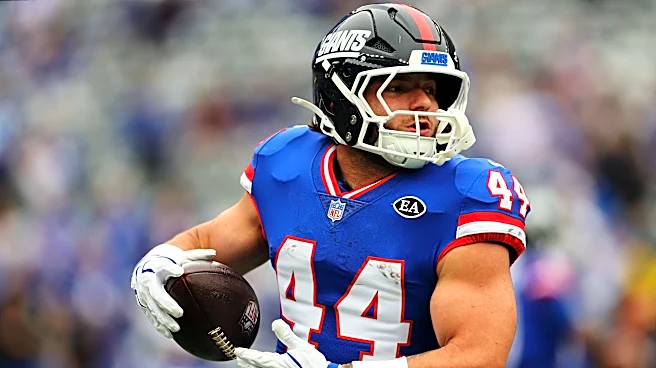
Last week, New York Giants running back Cam Skattebo was (effectively) benched following a game-changing overtime fumble against the Washington Commanders.
He saw just six snaps and zero carries against the New Orleans Saints in what was the second-lowest point of his NFL career. (Last year’s season-ending ankle injury being the lowest point of his career
)The Giants’ run game as a whole reached a new low after degrading over the three weeks from Week 4 to Week 6,
and the Giants’ running backs were averaging just 2.4 yards per carry against the Saints.
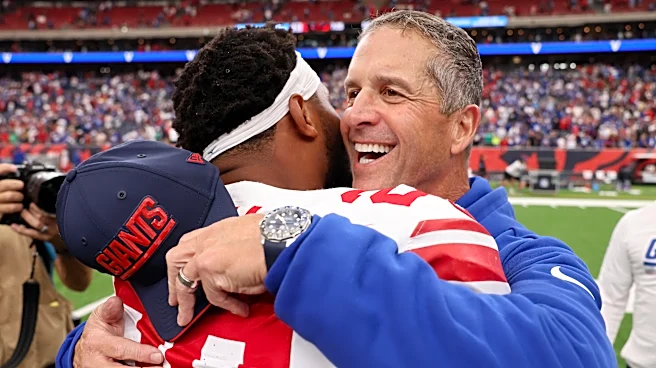
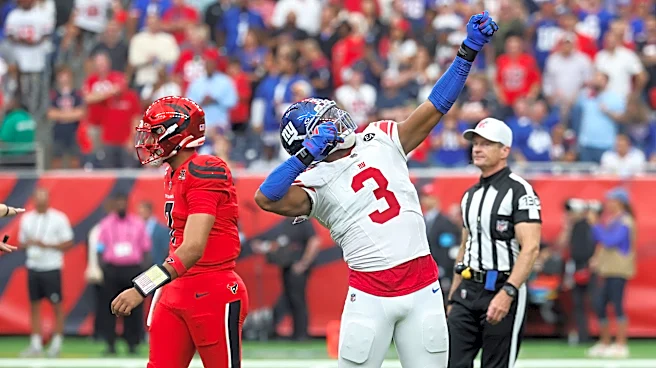
Fast forward seven days and Skattebo was once again the Giants’ starting running back. He responded to the lesson being conveyed by John Harbaugh by having the best day of his NFL career. The Giants’ running game got off to a bit of a slow start, but they eventually wore the Texans’ defense down and started breaking big runs. Skattebo had carries of 11 yards, 19 yards (4th down), 16 yards (touchdown), and 42 yards to set up Devin Singletary’s game-sealing 30-yard run.
All told, Skattebo had 17 carries for 124 yards (7.3 yards per carry) and a touchdown. It was his first 100-yard game as a pro, and by far his most efficient day. Prior to this week, Skattebo hasn’t had a 100-yard performance as a pro and just two games of more than 80 yards. Singletary, meanwhile, had 41 yards and a touchdown on five carries (as well as 14 yards on three catches).
The Giants’ running backs totaled 180 yards on the ground in just 28 carries (6.4 yards per carry), with three touchdowns. It would have been even more, except Skattebo also had a 7-yard run called back for unnecessary roughness.
So what changed this week? How did the Giants’ running game go from non-existent to game-defining in the span of a week?
We’ll start at the macro level and then zoom in.
Schemed for success
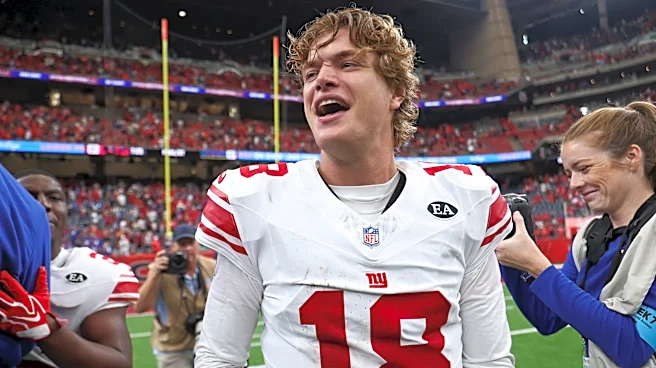
The decision to start J.J. McCarthy was a significant one for the success of the Giants’ running game. The threat of the zone-read or designed quarterback run added a critical element of indecision to the Texans’ defense that the Giants were able to exploit.
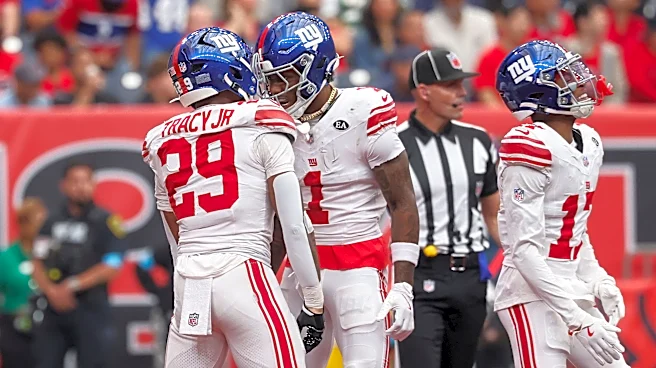
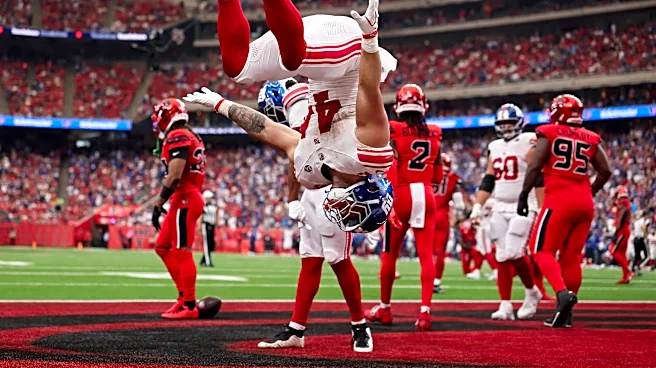
That was demonstrated perfectly on Tyrone Tracy’s touchdown run.
The Giants line up in 12-personnel on the 2-yard line. The condensed formation and short field leads to what is, effectively, a nine-man box while the Giants have just seven blockers on the play side. However, the play is also designed with an extended mesh between McCarthy and Tracy. That mesh creates the potential of a zone-read, which the Giants double down on by releasing Isaiah Likely into a shallow route to the right.

(Played at 1/2 speed)
The Giants run zone blocking to the offensive left, leaving the left defensive end (Jadeveon Clowney) and slot corner (Kamari Lassiter) unblocked on the offensive right. The extended mesh point and Likely’s route combine to freeze Clowney, Lassiter, and FS M.J. Stewart. The Giants’ offensive line does a great job of folding the Texans’ front to the offensive left, while the momentary indecision gives Tracy all the time he needs to get to the second level and across the goal line.
Tracy himself shows solid vision to anticipate both his blockers and the defense at the first and second levels, as well as the agility to hug his blockers and find room where the frozen defenders simply can’t reach him.
The Giants also made use of formations that, if they’ve used them before, they’ve used them extremely sparingly. Most notably, we saw the Giants align in the Pistol formation — as opposed to the Shotgun — in the second half of the game and use it to great effect.
The Pistol is something of a hybrid formation that combines elements of the traditional I formation with the Shotgun formation. Like the I-formation, the running back is several yards behind the quarterback. The quarterback, meanwhile, is 3 to 5 yards behind the center as in the Shotgun. The Pistol combines the advantages of both formations, giving the quarterback the view of the defense he enjoys in the Shotgun, while also giving the running back the runway he typically gets in a traditional I-formation.
The Pistol is also highly versatile and can be run as a spread formation with three to four wide receivers, or as a power formation with multiple backs or tight ends.
The Giants used the Pistol on Skattebo’s flagged run up above, but perhaps the most notable example of that came on Cam Skattebo’s fantastic 16-yard touchdown run. And in this case, the Giants come out in a very heavy 22-personnel set with two tight ends, as well as fullback Patrick Ricard and Skattebo.

The Pistol has a few distinct advantages for a back like Skattebo.
While Skattebo doesn’t have much top-end speed, he has impressive acceleration, and the additional separation between him and the line of scrimmage allows him to take the hand-off in stride before continuing to accelerate. The extra two steps allow him to hit the hole that much harder than from the shotgun. Likewise, the extra second gives the Giants’ blockers time to lock in and their blocks develop, creating more defined holes for the back.
Notably, there’s time for Chris Manhertz, Ricard, and Jermaine Eluemunor to seal off an alley for Skattebo on the right side, while Isaiah likely gets into position at the second level.
The longer runway also gives Skattebo a bit more time and perspective to scan the defense, and better perspective to anticipate defenders at the second and third levels.
The Giants probably shouldn’t eliminate the Shotgun formation completely, however using the Pistol at a much higher rate could be a positive development for the running game.
The backs: Vision, patience, and physicality
Before we talk about the running backs themselves, we need to give a tip of the cap to the Giants’ blockers.
Perhaps another week of practice with Brian Hudson as the starting center helped the interior, and perhaps getting Eluemunor back (albeit playing through an injury) made a difference as well. But the Giants’ blocking was some of the best we’ve seen since Week 1.
It wasn’t perfect, far from it in some cases, however the Giants maintained a physical edge throughout the game which eventually won out at the end. On top of that, the secondary and perimeter blockers like Malachi Fields, Manhertz, Isaiah Likely, and Ricard all played critical roles in turning merely “okay” runs into successful carries.
But turning to the runners themselves, each of the Giants’ backs played with a level of patience that we haven’t seen from them previously.
For example, one of the big topics of conversation has been how Skattebo would seek out contact and run full speed into defenders, not allowing blocks to develop or using his vision to find holes.
The first play of the game showed Skattebo running with much better tempo and patience behind the line of scrimmage, as well as seeking out his running lane.

Notice how Skattebo runs with a “slow to the hole, fast through” tempo, allowing the blocks in front of him to develop before hitting the line of scrimmage. He also does a very good job of using his pathing to pull second level defenders out of their alleys and allow for the blockers at that level to take them out of the intended running lane. Finally, he does a great job of waiting until Eluemunor makes his block to cut back to the right and access the running lane.
Ricard isn’t quite able to win the initial leverage battle and is ultimately shed by edge Will Anderson Jr. to stop the run after just 3 yards. However, this run was set up to go much further had the block been sustained for just an instant or two longer.
We can’t make the same types of claims about Devin Singletary as we can about Skattebo. While Singletary has never been spectacular in any one facet of his game, he’s at least competent in every area. He has consistently run with good patience and vision, allowing him to make use of his quickness and agility.
We got a prime example of this on the final play of the game.

It’s worth noting that this is another Pistol run, this time with Ricard in the backfield instead of playing as a tight end.
As in the first run of the game, we see Singletary doing a great job of tempoing his run to both give his blockers time to lock in their blocks, and to influence defenders’ angles. He also makes a series of subtle adjustments to his pathing to move defenders just out of position, allowing him to juke them and force poor tackle attempts.
From there, Singletary’s contact balance does the rest as he survives incidental contact and glancing blows to find the end zone.
Final thoughts
It’s notable that the Giants’ run game finally found traction and ignited against one of the NFL’s best run defenses. The Texans’ defense isn’t what we’ve come to expect from them over the previous two years, and they’re definitely feeling the absence of S Jalen Pitre. However, they still had the third-ranked run defense (83 yards per game allowed), and their defense has been hurt much more by explosive passing plays than gashed by the run.
Of course, the Giants had explosive passing plays as well, with McCarthy hitting six explosive passes on nine attempts of more than 15 yards downfield. That vertical passing stresses the defense, forcing them to pick their poison.
Nevertheless, the Giants’ offense responded and rebounded after woeful performances against the Commanders and Saints. The blocking was significantly improved (though, again, far from perfect), and the backs did a much better job of making the most of what was blocked for them. The coaching staff did their job in putting the players in position to succeed, and John Harbaugh pulled the correct lever in starting McCarthy.
Now the Giants go into a much-needed bye week. The question is whether they can maintain the momentum and build upon their performance against the Texans as they get healthier between now and their November 8th game against the Philadelphia Eagles.
The next step for them will be to continue to find down-to-down consistency, and perhaps a healthier Andrew Thomas and Jermaine Eluemunor, as well as a more settled McCarthy, will help lead to that consistency.
If so, the Giants’ performance in Week 7 was a great starting point and exactly what the team needed.