



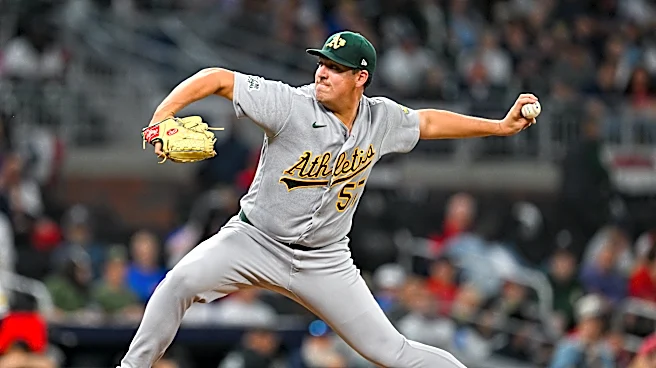
Without question the bullpen is the true dark underbelly of the A’s 2026 roster. The offense sputtered out of the gate but is widely regarded by pundits as having a “top 5 in MLB” ceiling with scoring runs being among the team’s lesser concerns overall.
The rotation is certainly questionable but outside of a shaky start when he was pitching sick, Luis Severino has looked great, Jeffrey Springs is throwing harder and pitching well, Aaron Civale has been solid in his 2 starts, and Jacob Lopez is still
recovering from a shortened spring training — with Gage Jump and Kade Morris on the way, there is enough to like about the rotation to think it can hang in there with a good offense behind it.
And then there’s the bullpen, which has already lost the A’s 2 games out of 10. But for a Michael Kelly hanging slider to Alejandro Kirk in the 9th and a Mark Leiter Jr. hanging splitter to cap a 4-run meltdown in the 8th, the A’s could be sitting at an even .500 right now, 5-5 and just 1/2 game out of 1st place in the AL West.
It’s nothing that couldn’t be foreseen, either. The A’s opened the season with 8 relievers none of which you would really want to put into a game in the 8th or 9th inning with a small lead. The only 2 free agent signings, Leiter Jr. and Scott Barlow, are at best solid “medium leverage” relievers suited to handling the 7th inning of a game you’re down 1. The same is true of Kelly and Justin Sterner. Hogan Harris and Elvis Alvarado have troubling avoiding walks, Luis Medina is wilder than them both and has trouble missing bats, and JT Ginn struggles to contain LH batters with a strong tendency to cough up the long ball.
A fair question is “How the heck did the A’s front office conclude this was going to work?” But today’s question is more practical: what could the A’s do, before they get buried in the standings, to improve the bullpen going forward. Remember that after last May’s 1-20 debacle, A’s GM David Forst admitted that the team was probably too slow to react to the bullpen’s repeated breakdowns and should have acted quicker.
Well, David, here’s your mulligan.
Solution #1: Roll with Jack Perkins
Jack Perkins is far from a sure thing, as evidenced by the fact that he suddenly walked 5 in his first appearance at AAA this season. But here’s the rebuttal: to the extent that Perkins does not reliably throw enough strikes, he is merely on par with 3 of the current relievers (Harris, Alvarado, Medina), only he has tremendous upside and he is really hard to hit.
You’re already rolling with relievers who need to throw more strikes. Perkins is, arguably, a better version who when throwing just enough strikes is legitimately a guy you want to see in a save situation. He may be a bit of a Billy Koch type of closer, but even Koch was able to notch 144 saves over a 4 year period from 1999-2002 while causing roughly the number of heart attacks.
Corresponding Move: Option Alvarado, simply because it’s redundant to carry 4 pitchers whose main vice is wildness. Alvarado can benefit from refining his mechanics, consistency, and poor results facing LH batters (.257/.382/.473) and can be called up again later.
Solution #2: “True LH specialist” in Brady Basso
The A’s didn’t sign or trade for a lefty who can neutralize tough LH batters and as a result the organization has precious few options. One of them is Brady Basso who looked shaky enough, I guess, in spring training that he was a surprisingly early cut.
Basso started the season no better coughing up 5 runs in 0.2 IP in his second appearance. However, in his two outings since then he has been great: 2.2 IP, 0 hits, 0 ER, 0 BB, 2 K. More importantly he has proven himself, albeit still in a small sample, as someone capable of dominating LH batters at the big league level.
Basso has faced 42 LH batters in the big leagues and they have hit .158/.214/.158 against him. That’s 0 extra base hits in a 6 for 38 showing (and only 3 BB). He needs to be in the A’s bullpen so that Hogan Harris, who has actually struggled against LH batters (.269/.378/.415), isn’t the only lefty available.
Corresponding Move: DFA Scott Barlow for reasons outlined next.
Solution #3: DFA Scott Barlow
It’s nothing against Barlow personally, nor a knee-jerk reaction to one terrible appearance in which he faced 4 batters, served up a HR and a double, and issued two 4-pitch walks in between.
The issue with Barlow is that whether the A’s failed to do their due diligence, or something happened between the signing and spring training, Barlow showed up to camp with velocity well below his career norms. If that’s injury related, of course, the A’s could use the IL instead of cutting ties with him entirely, but it’s also possible the decline is age related.
In 2021 Barlow was terrific for the Royals, accumulating 2.2 fWAR while averaging 95.3 MPH on his fastball. That velocity allowed his slider to really play up as he struck out 91 in just 74.1 IP and put up a 2.42 ERA.
In 2022 his fastball velocity dipped to 93.7 MPH but was still plenty good to serve as a quality reliever worth 0.9 WAR, 24 saves and a sterling 2.18 ERA.
In 2023 his velocity dipped again but only slightly, to 93.2 MPH. He managed good K rates (79 in 68 IP) but also walked 34 (one batter every other inning) and saw his ERA double to 4.37.
Then in 2024 his velocity continued to drop, this time down to 91.6 MPH. His BB rate spiked to 5.07/9 IP.
2025 was more of the same. Barlow’s velocity came in at 92.2 MPH but his BB rate jumped to 5.93/9 IP. Clearly he was not the same pitcher throwing around 91-92 MPH rather than around 94-95 MPH.
Here’s the big problem. Barlow is not even throwing 91-92 MPH in 2026. His fastball velocity is averaging all of 89.6 MPH, as it did in spring training, and this “new normal” is not conducive to getting big league hitters out. In other words there’s no reason to think it’s going to get better unless he figures out a way to add 4 MPH to his fastball. And that probably requires a time machine.
Corresponding move: Not directly related to the bullpen, but a DFA of Barlow opens up a spot on the 40 man for the A’s to call up Kade Morris, who has looked terrific both in ST and at AAA. Note that if Morris is capable of giving the A’s 6 inning starts, even if they are not all brilliant that length helps the bullpen. (Further note: Morris is listed as tonight’s SP for the Aviators so it appears he is not getting the call Friday to face the Mets.)
Solution #3: Play the “hot hand” with Wander Suero
Wander Suero is no lock down reliever. If he were, most likely he would not be a AAA journeyman at age 34. But relievers are famously volatile, unpredictable, subject to random good seasons and random bad seasons and Suero offers a glimmer of hope that he could Jeff Tam his way to a quality season or two on his way to obscurity.
First off, he actually looked quite good in spring training with his Luis Tiant-lite motion hiding the ball and his arm slot creating some deception. He got a lot of funky swings and weak contact and commanded his pitches well.
Secondly, Suero has picked up where he left off in the Cactus League opening the season strong at AAA Las Vegas. The underlying numbers don’t look terrific, but the sample is tiny. Probably more telling is that he is pitching in a hitter’s paradise and holding his own.
Suero has only made 3 appearances but so far: 3.2 IP, 2 hit, 0 ER, 2 BB, 2 K. For a bullpen sorely lacking in deception, whose status quo is clearly a dud, it’s a worthwhile shot in the dark to see if 2026 might be Suero’s year. If not he can always be optioned or released.
Corresponding move: DFA Michael Kelly, whom the A’s have overrated and who will very likely go unclaimed and land back at AAA.
What does this leave you with? It’s not exactly a sure-fire lights out pen, that’s for sure. But it feels to me like at least potentially a meaningful upgrade:
Closer: Perkins
Set up: Harris, Ginn
Key Lefty: Basso
Medium leverage: Leiter Jr., Sterner
Lower leverage (at least initially): Suero
Long Man: Medina
Worth a shot?