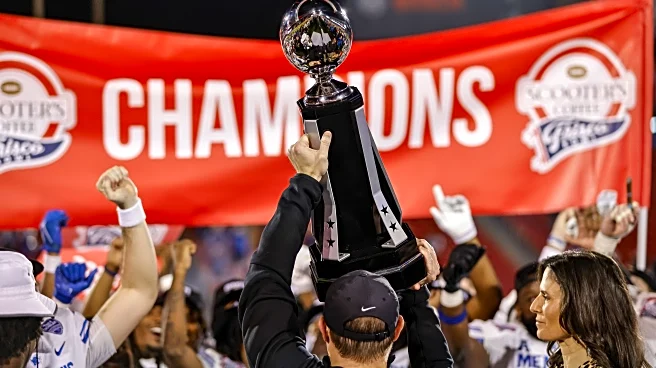


Last year, Ohio capped its first MAC Championship season since 1968 with a signature postseason win over Conference USA champion Jacksonville State, solidifying the program’s best season in the modern era.
This year, another opportunity for a statement win emerges in the Frisco Bowl against a 10-3 UNLV team which was in the College Football Playoff conversation at points in the last few seasons. Under interim head coach John Hauser, the Bobcats will look to win a fifth-straight bowl game— an incredible
streak that is nearly unmatched across the Football Bowl Subdivision level.
Game Notes
- Time and date: Saturday, December 23rd, 2025 at 9 p.m. Eastern time
- Location: Ford Center at The Star in Frisco, Texas
- TV network options: The game will be aired exclusively on ESPN; a valid subscription is required for viewing. Wes Durham (play-by-play) and Steve Addazio (color) will provide commentary, with Dana Boyle on the sideline.
- Streaming options: The game will be available for streaming on the ESPN App or on applicable cable/satellite services. A valid subscription is required for viewing on either platform. Other streaming carriers include Sling, DirecTV Stream, fuboTV, Hulu Live TV, or YouTube TV.
- Radio options: Marty Bannister (play-by-play) and Rob Cornelius (color) will provide the Ohio call for WXTQ-FM 105.5, while Matt Neverett (play-by-play), Caleb Herring (color), and Steve Cofield (sideline reporter) will have the UNLV call for ESPN 1100 AM & 100.9 FM. Brian Estridge (play-by-play), Elvis Gallegos (color) and Chris Mycoskie (sideline reporter) will handle the call for Bowl Season Radio on Sirius XM and the Varsity Network.
- Gambling considerations: UNLV is listed as a 6.5-point road favorite, with an over/under 66.5, per FanDuel.
- All-Time Series: UNLV won the only other meeting between the two teams in 1988, by a final score of 26-18.
About the Ohio Bobcats

Although the bizarre situation involving former head coach Brian Smith lingers, Ohio is still one of the most well-rounded teams in the MAC. Running back Sieh Bangura (1,256 yards, 14 touchdowns) and quarterback Parker Navarro (967 non-sack rushing yards, eight touchdowns) leads a devastating Bobcat run game that averages 229 yards per game. The duo should thrive against a UNLV defense which has averaged 175 rushing yards per game to opponents.
Along with his exploits on the ground, Navarro also threw for 2,232 yards and 14 passing scores. Chase Hendricks is by far his favorite target, with 950 receiving yards and seven touchdowns. The next closest receiver on the team has nearly 600 fewer yards. The Bobcats will need more contributions from receivers other than Hendricks against a ball-hawking UNLV secondary.
Ohio’s defense was one of the most stout in the MAC, allowing 22 points per game. Unlike UNLV, which draws its strength from the secondary, the defensive line sets the table for the Bobcat defense. Jay Crable (nine tackles for loss) and Anas Luqman (eight tackles-for-loss) occupy blockers well to allow safeties Jalen Thompson (80 tackles) and Adonis Williams Jr. (75 tackles) to make plays. Cornerback Tank Pearson is a bonafide shutdown corner with 11 pass breakups and two interceptions. The defense will have its hands full against a UNLV attack that is one of the most efficient in the country.
About the UNLV Rebels

UNLV has become a consistent College Football Playoff contender over the past two years. Although this year was not as successful as last year, the Rebels still found a way to win 10 games under first-year head coach Dan Mullen.
On offense, the patented “go-go” scheme the Rebels made popular last season may be gone, but the explosiveness remains. Anthony Colandrea is the trigger man for a balanced attack, which averages 256 passing yards and 203 rushing yards per game. Colandrea is just as dangerous a dual threat as Parker Navarro, totaling 3,275 passing yards, 787 non-sack rushing yards, and 32 touchdowns on the year.
Along with Colandrea, Jai’Den Thomas is efficient on the ground, averaging over seven yards per carry on his way to 985 rushing yards. Jaden Bradley leads a well-balanced receiving corps in both receptions (54) and yards (869), to front a unit which features three receivers each notching at least four touchdown receptions.
The Rebels struggle on defense, but were just effective enough to avoid wasting their prolific offense, allowing 28.9 points per game. UNLV struggles defending the run, allowing 175 yards per game and over five yards per carry. Nonetheless, the front seven is talented. Linebacker Marsel McDuffie anchors the defense with 103 tackles, while Tunmise Adeleye is disruptive on the line with six sacks and 7.5 tackles for loss.
The secondary is the real strength of the UNLV defense. Safety Jaheem Joseph forces defenses to focus on him with his nose for the football. Joseph has eight TFLs and three sacks on the year. In the air, defensive backs Aamaris Brown and LaTerrance Welch lead an opportunistic secondary with four interceptions apiece. In all, the Rebels intercepted 13 passes on the season.
Final Thoughts
The best in the Midwest versus the best in the West. It’s a college football tale nearly as old as the postseason. Matchups like this help to make up at least a little bit for the fading tradition of the Rose Bowl . The crowd at the cozy, 12,000-seat Ford Center at The Star could be in for one of the most entertaining matchups of Bowl Season.
Both teams can put points on the board easily with incredibly balanced attacks. The quarterback matchup of Anthony Colandrea versus Parker Navarro is be one of the best of the entire FBS postseason on paper. Both offenses match up well with their opposing defenses, so a shootout could be in order.
We’re anticipating both teams being at near full strength for this game— a rarity in the current bowl landscape. It may not be an exaggeration that the magnitude of this game makes it a springboard for a possible College Football Playoff run in 2026 for the winner.
.