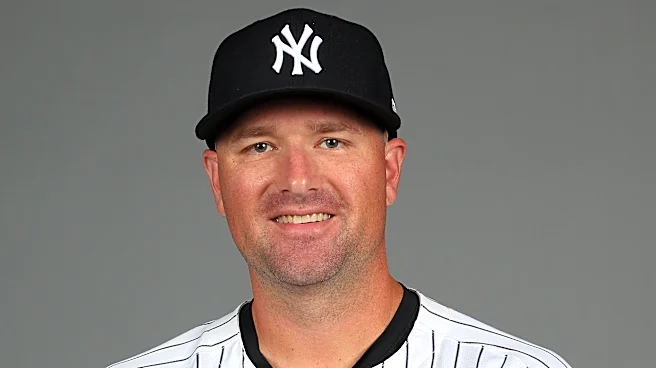


When the 2026 MLB season started, J.C. Escarra was entrusted with the inglorious position of backup catcher. Backup catchers occupy a unique role, as they are expected to shoulder a relatively steady workload while facing fairly low offensive expectations. Even with those low expectations, Escarra left fans and the front office wanting more in 2026.
Nothing personal, but many were surprised when the front office opted to pair Austin Wells with Escarra’s left-handed bat instead of going with a right-handed-hitting
backstop out of spring training. The former delivery driver filled the role through the first few months of the season before finding himself shuttled between the majors and Scranton. After a series of moves, he spent most of the summer with the RailRiders before returning to the big-league club in late September.
Grade: D-
2026 Stats: 32 G, 92 PA, 8 R, 16 H, 5 2B, 1 3B, 0 HR, 7 RBI, 0 SB, .188/.239/.271, 42 OPS+, 40 wRC+, 0.1 fWAR, 0.1 bWAR.
2027 Contract Status: Pre-arbitration eligible
In 2025, defense was Escarra’s calling card. He displayed strong framing and receiving skills, but unfortunately, he could not replicate those results in 2026. According to Baseball Savant, Escarra’s Catcher Framing Runs went from five to zero. The rest of his defensive metrics were still solid, with his blocking and throwing rankings placing him above average. However, losing that strike-stealing advantage is tough to overcome when you are a bit of a one-trick pony.
Offensively, Escarra struggled, even by backup catcher standards. His final slash line was .188/.239/.271, as he managed just 16 hits in 32 games, with no homers. In his defense, he did at least hold his own against lefties. In an extremely small sample of 21 plate appearances, Escarra hit .316 and slugged .421 while striking out just twice. This split of course was the other side of the coin to Escarra struggling mightily against right-handed pitching.
The underlying metrics don’t paint a much prettier picture. Escarra posted a .206 expected batting average and a .308 expected slugging percentage. His barrel rate dropped from 5.6 percent in 2025 to 4.5 percent in 2026, while his hard-hit rate fell from 43.1 percent to 33.8 percent. Simply put, Escarra struggled to make consistent quality contact against major league pitching.
At the end of June, the Yankees optioned the slumping catcher to Triple-A Scranton/Wilkes-Barre. Back in the minors, Escarra’s bat woke up, as he crushed International League pitching to the tune of a .301 average and 11 home runs in 256 at-bats. Trying to find his way back to the big club, Escarra started to dabble with switch-hitting. However, even after the press had some fun with the storyline, Escarra did not take a single official major or minor league plate appearance from the right side during the 2026 season.
Heading into 2027, Escarra is still under team control. With the Yankees expected to be in the market for a catcher, it is possible Escarra will once again factor into the Triple-A catching mix for the newly-minted Highlanders. However, at 31 years old, he is not exactly a prospect who needs everyday at-bats to develop. His minor league production shows that he can still hit lower-level pitching, but the challenge is translating that success against major league arms. If he cannot provide consistent offense, he needs to be elite defensively to justify a spot on the roster. Teams are always looking for catchers in the spring, so Escarra should continue to have some value moving forward.
One last note: the impact of Tanner Swanson taking a job in Seattle may be worth tracking this offseason. With the longtime catching coordinator now in the Mariners’ dugout, it is at least possible that a catcher like Escarra could be part of a trade between the two clubs this offseason if they are able to link up for a deal.
See more of the Yankees Roster Report Card series here.