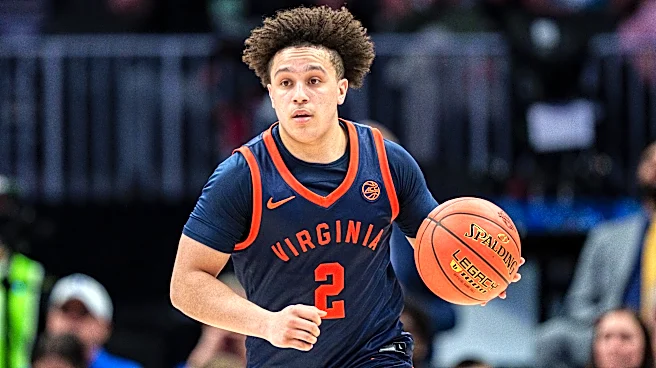

Chance Mallory represents the kind of story that is reminiscent of a bygone era.
Mallory committed to Virginia on Sept. 20, 2024. Twenty-seven days later, Tony Bennett retired.
In most recruitments, that is where the chances of Mallory playing college ball in Charlottesville would have ended. Mallory re-opened his recruitment on Oct. 29, considered Tennessee, Maryland, Virginia Tech and Vanderbilt, and spent five months surveying his options while the Virginia program was in limbo looking for a new
coach. Then, on March 22, 2025, within a day of Virginia hiring Ryan Odom, he re-committed.
“Virginia was always kind of in the back of my heart because coming here was my main choice,” Mallory said at the time. “I didn’t want to leave Charlottesville. I really didn’t want to go nowhere.”
That decision looks like a stroke of genius a year later, after a 30-win season in which he was a key contributor as a freshman.
This offseason he chose Virginia a third time. Mallory was the first Cavalier to say that he was “coming back.”
That was a big win for both Odom and Mallory. With Dallin Hall gone, the starting point guard job is his, priming Mallory for an elevated role and the national media is already calling Mallory a breakout candidate. This is the first in a series of preseason profiles on this year’s team, and there is no better place to start than with the hometown kid.
Year one: a sparkplug off the bench
A year ago, Virginia was incorporating almost an entirely new roster and one laden with upperclassmen. Naturally, that meant that Mallory would need to take a smaller role.
Coming off the bench behind a roster built around experienced transfers and international talents, Mallory played 24.1 minutes a night across all 36 games and averaged 9.3 points, 3.7 rebounds, 3.4 assists and 1.6 steals. He shot 42.2 percent from the field, 34.5 percent from three and 77.5 percent from the line. His 57 steals led the team, and his 121 assists were second only to Hall’s. He scored in double figures 20 times.
Moreover, Mallory did a great job limiting mistakes as he finished second in the ACC with a 3.0 assist-to-turnover ratio, just behind Hall. He turned it over only 41 times all season, about once a game, despite playing an aggressive, high-energy play style.
To contextualize Mallory’s performance on the court last season, Brian Geisinger of Basket Under Review found that since 2007-08, only four high-major freshmen, Mallory included, have posted an assist rate above 20 percent, a steal rate above 3 percent and a turnover rate below 15 percent. The other three are Tyler Ennis at Syracuse, Tre Jones at Duke and Kingston Flemings at Houston.
Another strength of Mallory’s is his ability to draw contact and get to the line. Mallory attempted 129 free throws against 232 field goals, more than one free-throw attempt for every two shots. That is an unusually high rate for a 5-foot-10 guard, a product of his aggressive attacking style, and it pushed his true shooting percentage to 58 percent.
Despite coming off the bench, Mallory received widespread praise for his performance. “He is the heartbeat of this team, and the energy he brings off the bench is needed,” Malik Thomas said in March. “His IQ is ahead of his years.” Miami coach Jai Lucas called him Virginia’s “swagger and their personality.”
Even so, Mallory was left off the ACC All-Rookie team, which included his teammate Thijs De Ridder, and Jacari White was the Cavalier who drew Sixth Man of the Year votes.
Mallory is inheriting a much larger and different role this year
Last year, despite the higher scoring numbers from Mallory, Odom relied on Hall as the team’s starting point guard.
Hall started all 36 games last season. However, he had a much different role on the team. Hall had the lowest usage rate of the starters and averaged 5.9 points and 4.4 assists with a 3.3 assist-to-turnover ratio, the highest in the ACC. In addition to this, Hall was relied upon as a steady perimeter defender and a calming presence on the court. Odom called him “the ultimate leader.”
In contrast, Mallory’s job was nearly the opposite. He came in to change the pace, pressure the ball and get downhill.
This season, Mallory must find a way to merge those two identities. Hall and Mallory combined for 7.8 assists a game last season. With Hall gone, Mallory must attempt to be both the steadying presence and the spark at the same time.
Odom has admitted as much: “There’s going to be a lot of pressure on Chance, but he’s built for it. Losing a guy like Dallin, who meant so much to the team, we need Chance to step up and he’s been dynamite.”
However, he will have help. Jan Vide, the 6-foot-6 Loyola Marymount transfer who averaged 12.1 points and 4.0 assists last season, gives Virginia a second ball-handler off the bench with previous starting experience. Jurian Dixon, the UC Irvine transfer, can take pressure off him as a secondary creator. Still, Mallory is the only proven ACC-level point guard on the roster, and with the additional minutes, he will need to prove he can score on his own while also facilitating Virginia’s other stars.
With four of the five positions in the starting lineup all but locks, the one remaining question is the wing next to Lewis. Nolan Adekunle, the 24-year-old, 6-foot-6 wing who came over from Gladiators Trier in the German BBL, is pushing for a starting spot. That gives Odom two realistic versions of his starting five.
The smaller version puts Dixon at the two and Lewis at the three next to De Ridder and Johann Grünloh. That lineup gives Mallory a second creator. Dixon averaged 15.9 points at UC Irvine and theoretically can take more ball-handling and playmaking responsibilities off of Mallory’s plate, which lets Mallory play off the ball for stretches.
The bigger version slides Lewis to the two and puts Adekunle at the three. That lineup has more size and more shooting. Adekunle made 42.3 percent of his threes in Germany last season, and Lewis shot 40.3 percent at Virginia. However, it puts a lot of pressure on Mallory to create off the dribble and find the open man.
Either way, Virginia’s 2026-27 offense will run through Mallory.
The national media has already started to take note of this. Sports Illustrated’s Kevin Sweeney ranked him the No. 9 point guard in the country: “Mallory was all kinds of fun to watch in a sixth man role last season. Now, he takes over as Virginia’s starting point guard and has a chance to absolutely explode.” As featured by Corner Media Co., college basketball content creator Ryan Hammer ranked him No. 3 on his list of 40 breakout candidates for 2026-27, behind only Trey McKenney and Davis Fogle.
What I will be watching
Mallory was dynamic as a freshman, but here are the key things to look for in a potential sophomore breakout.
The three-point shot against real competition. Mallory shot 44.4 percent from three in non-conference play (16-of-36). However, in 18 ACC regular-season games, that fell to 28.6 percent (18-of-63). In Virginia’s six losses, he went 5-of-24. Against AP-ranked opponents, he was just 3-of-17. At 5-10, Mallory is naturally at a disadvantage against longer defenders on top-flight teams like Duke (which unfortunately had Virginia’s number last year). Therefore, it is critical that he becomes a more consistent shooter to open up the rest of his game. Odom said this summer that Mallory “has just worked hard on being a knock-down shooter.” Anything around 35 percent in league play, on more attempts, would change how teams defend him.
The March fade. Across his final seven games, from the regular-season finale against Virginia Tech through the Tennessee loss, Mallory averaged 5.9 points on 12-of-40 shooting. He went scoreless against Virginia Tech. He had zero assists in 44 minutes across the two NCAA Tournament games, although that came with Hall running the offense. In part, this could be due to the “freshman wall” that many face as they adjust to the level and the physicality of a full collegiate season, which Mallory seems to acknowledge. “More minutes mean I’m going to get more tired, faster, so I’m just building my cardio and building my offensive game to be a more true point guard,” he said in July. Odom added that Mallory has “really worked on his body.” With him being the starting point guard this year, improved performance down the stretch is simply a necessity if Virginia is to achieve any of its postseason goals.
Pick-and-roll patience. Last year, Dallin Hall was clinical in the pick-and-roll. This year Odom said Mallory is “slowing down as well and reading situations better” in ball screens. That is critical if Mallory is to take on the primary playmaking responsibilities and maximize Virginia’s two All-ACC-caliber big men, De Ridder and Grünloh.
Fouls. While not as flashy as scoring or playmaking, this is an underrated facet of Mallory’s game that he needs to clean up. A year ago, Mallory committed 81 fouls in 866 minutes, about 3.7 per 40. He had four or more fouls in nine games and fouled out against Northwestern. His aggressiveness on the ball is part of why he is a good defender and ranked seventh in the ACC with 1.6 steals per game a year ago. However, this year, Virginia cannot afford for its only true point guard to spend stretches on the bench because of foul trouble.
Maintaining the free-throw rate. A year ago, Virginia ranked 10th of the 18 ACC teams in free throws attempted and ninth in free-throw percentage at 72.8 percent. Mallory, meanwhile, ranked 24th in the league in free throws attempted and 17th in percentage at 77.5 percent, despite coming off the bench. Not only does that point to his potential as a shooter, but Mallory’s ability to draw fouls and make them will be crucial for providing easy offense for Virginia.
The measuring sticks. Mallory will have multiple opportunities early in the season to match up with some of the other top-ranked point guards in the country. Three of the players Sweeney ranked ahead of or near Mallory are on Virginia’s non-conference schedule: Arkansas’ Jordan Smith Jr. (No. 10) on Nov. 8 in Washington, Marquette’s Nigel James Jr. (No. 7) on Nov. 25 at the Battle 4 Atlantis, and UConn’s Silas Demary Jr. (No. 3) on Dec. 20 at Madison Square Garden. This will give us a good opportunity to judge Mallory and Virginia against stiff competition.
What would count as success
Per 40 minutes last season, Mallory produced 15.5 points, 5.6 assists, 6.2 rebounds, 2.6 steals and 1.9 turnovers. Scale that to 31 minutes (he averaged 24 last year) with no change in efficiency, and you get roughly 12 points, 4.3 assists and two steals.
The floor: 28 to 30 minutes, 11 or 12 points, four assists and a turnover ratio around 2.5. That would still make him a solid starter, but it would indicate little progression and mean Mallory fell short of the breakout many expect. This also means Virginia will need to rely more heavily than anticipated on Dixon and Vide especially for creation.
What I would call a success: 31 to 33 minutes, 13 to 15 points (15 would have ranked 18th in the ACC last season), five to six assists (5.4 ranked fifth), 36 percent or better from three and an assist-to-turnover ratio still above 2.5. That is an All-ACC-caliber season as a sophomore, and it probably means Virginia is in the conference title race again.
The breakout: 15-plus points, six assists and 37 percent or better from three. This indicates that Mallory would have checked off all the potential questions we identified and has truly broken out. This would likely put him in the All-ACC second-team conversation and mean Virginia is likely a top-10 team in the country.
My prediction is the middle tier. I am a believer in Mallory despite the size limitations. He has already shown strong potential as a shooter (as evidenced by his free throw numbers), an ability to set up teammates efficiently (as his elite assist-to-turnover numbers showed as just a freshman), and a tenacious defensive attitude. The only question I have is whether he can sustain that level of energy and effort in an expanded role while maintaining efficiency down the stretch of the season.
Year two will force Mallory into a leadership position
A year ago, Mallory was one of the youngest voices in a locker room full of graduate transfers. Now he is one of four players Odom has singled out to lead.
Odom named De Ridder, Lewis, Grünloh and Mallory, the four returning rotation players who each averaged more than 21 minutes last season, as the group that must “really lead this team.”
“That’s what my job is as a point guard, to just try to help people whenever they need it,” Mallory said this summer. He also said he feels “more accustomed to what the coaches want” in year two.
A UVA kid as the face of UVA in the portal era
In a changing landscape of college sports, this is perhaps the most special part of this whole story.
Most college basketball rosters now turn over every spring. Fan bases rarely get to watch a player grow up anymore. Even though Virginia fans grew to love the 2025-26 team, many Virginia fans lamented this same thing at the start of last season when the team had almost an entirely new roster.
This offseason, Virginia went the other way. Odom brought back every scholarship player with eligibility remaining, a retention job that is close to unheard of in the current sport. The five departures, Hall, Thomas, White, Tillis and Onyenso, were all out of eligibility.
“Everyone wanted to come back on their own, and that speaks to Coach Odom and how much confidence he’s given us,” Mallory said.
Mallory is the clearest example of what that retention looks like. He went to Virginia basketball camps as a kid. He grew up admiring London Perrantes and Devon Hall and watched the best years of the Bennett era from the stands. He went to high school about seven minutes from JPJ at St. Anne’s-Belfield, where he became the school’s all-time leader in points (2,396), assists (488), steals (293) and wins (114) and was the 2024 VISAA State Player of the Year.
“He’s a hometown kid and wasn’t chasing big lights or anything like that,” his high school coach, Damin Altizer, said. “Home means something to him.”
There is also a lineage here. Virginia has a long history of small, tough point guards. Kihei Clark was also listed at 5-9 coming out of high school and played five seasons at point guard, including as a freshman on the 2019 national title team.
I want to be careful not to demonize the portal. Virginia has not ignored it either. Dixon, Vide, Christian Harmon, Kalu Anya and Nolan Adekunle all came from somewhere else. International players such as De Ridder, Grünloh and, last season, Onyenso have also become fan favorites.
But there is something nostalgic and almost romantic about an undersized, homegrown player being the point guard for a team attempting to complete the rise back to national relevance in an age when college sports have never been more clearly transactional.
On what it means to play for Virginia, Mallory said: “It means everything to me… for the whole city, it means a lot.”
As a freshman, he told Basket Under Review what he wants out of it: “When I leave UVA, I just want everybody to know my name. It’s as simple as that.”