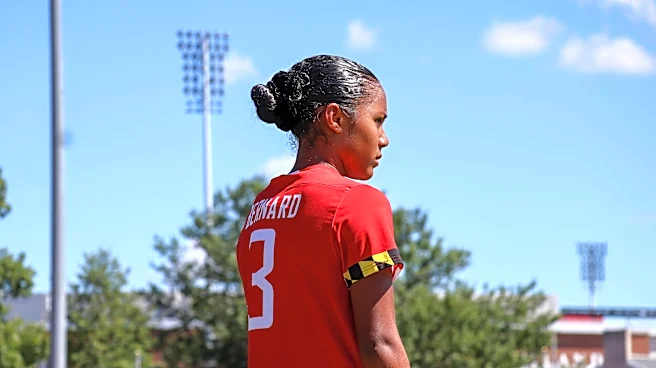





In the 90th minute of Maryland women’s soccer’s final nonconference game against Binghamton, Peyton Bernard was taken down in the box, resulting in a penalty. Bernard stepped up and drilled it, giving the Terps a 2-1 last-second win.
That game was played on Sept. 6. Maryland has not scored a goal since then and is five games into Big Ten play without having found the back of the net.
Maryland’s attack has struggled all year, with its 0.7 goals per game ranking 310th in Division I, tied with Le Moyne
and trailing both St. Peters and Bryant.
However, while they’ve been unsatisfactory all year, the Terps’ offense has been abysmal during Big Ten play, with the lack of goals being the result of much deeper issues on attack.
Maryland’s biggest problem is its lack of shots. The Terps have attempted just 37 shots in Big Ten play, good for 7.4 shots per game. Both of those numbers are dead last in the Big Ten.
While the number of shots has been problematic for the offense, the quality of those shots has been even worse. Just 12 of the 37 shots have been on goal, with the Terps attempting just 2.4 per game. Again, both those stats are last in the Big Ten.
“I think part of it is maybe we need to think a little less about it,” head coach Michael Marchiano said prior to the Terps’ third conference game against Penn State. “The players just need to take risks when they have a window to shoot a goal.”
The two biggest contributors to this inefficiency in creating shots on goal happen to be Maryland’s two most utilized forwards through conference play: Mckinley Heaven and Peyton Bernard.
While the build-up play has been there for the Terps’ attacking duo, the finished product has not. Combined, Heaven and Bernard have accounted for 32.4% of all shots in conference play but just 16.7% of shots on goal.
Maryland’s scoreless drought also coincides with a large efficiency drop from the pair, with that 16.7% shots-on-goal percentage down from a combined33.3% ratein the Terps’ first six games.
The lack of offense is eerily similar to that of Maryland’s 2023 squad, which went scoreless in Big Ten play. The comparison between the two teams goes deeper than just the lack of goals scored. In 2023, Maryland averaged 6.8 shots, with just 2.3 of those shots coming on goal per game.
That offense was led by Ava Morales and the aforementioned Bernard, who totaled 17 and 16 shots in 10 conference games, which is slightly more volume than anyone from the Terps’ current team is on pace for.
In 2023, Morales and Bernard combined for a 24.2% shot-on-goal percentage and suffered from the exact same efficiency struggles that the 2026 team has faced.
The parallels between the two teams are concerning, and being neck-and-neck statistically with a team that played all 10 conference games without scoring is not a great sign for the Terps.
However, there is one more piece from the 2023 team that could show the Terps a blueprint for getting the offense going.
Her name is Kennedy Bell.
The reigning 2025 Big Ten Forward of the Year and points leader for Michigan State, Bell was an insignificant piece in a dreadful Maryland offense back in 2023.
Bell did not score a goal all season for the Terps, tallying just one total point, with no signs pointing towards the superstar attacker she would blossom into.
Except, there was a sign. Despite just nine attempted shots, Bell’s shots-on-goal percentage was 55.6%. In 2024, it was slightly improved, at 57.9%.
There are two players on the Terps current team who, as Bell did in 2023, have small volume but incredible efficiency, and could be the key to Maryland’s offense the rest of the season if given more chances.
The first is Jolie Farmer, Maryland’s leading goalscorer who has battled injury all season. Farmer scored four times in the Terps’ first three games but has not found the back of the net since.
Farmer has played in just three of Maryland’s conference games but in her limited minutes, Farmer has produced two shots on goal on her three total attempts, good for a 66.7% shots-on-goal percentage. In the three games in which Farmer scored her goals, that rate was a whopping 90%.
“You have a player like Jolie Farmer, who’s producing, it’s like, are we creating different chances than we did then?” Marchiano said. “It’s not drastically different. It’s just a matter of executing when we get those chances.”
The other key piece for Maryland’s attack moving forward is also the biggest wildcard, Ellie Egeland. After an injury forced Egeland off the field for 354 days, she made her season debut against Wisconsin on Sept. 24. Since then, Egeland has been arguably the Terps’ best player, nearly scoring against Wisconsin and UCLA.
“I just think we need to keep taking shots, and I think that’s one of my personal specialties,” Egeland said, after the Wisconsin game. “I have the confidence that I can take a shot, and I can beat a player one [versus] one.”
Like Bell and Farmer, Egeland’s shot on goal percentage is the main takeaway from her two games of action. In just 54 minutes of play, Egeland has attempted five shots, with 60% of those on frame.
History is known to repeat itself, and this time Maryland needs to give more offensive volume to the players that boast impressive shot on goal rates.
If the Terps’ attack can ride Farmer and Egeland’s momentum, Maryland’s first conference goal of the year could be on the horizon.