

It’s a widely held belief that the Cowboys are not great starters. And at first glance, the numbers seem to bear that out: last year, the Cowboys had four games (24%) in which they failed to score a single point in the first quarter, and scored no more than a field goal in the first quarter in 10 out of 17 games (59%).
Those numbers sound alarming. They really aren’t. Last year, NFL teams went scoreless in the opening quarter 32% of the time and scored no more than a field goal in 52% of first quarters.
The Cowboys weren’t unusually bad in the first quarter last season. In fact, by league standards they were around average.
The Cowboys weren’t unusually bad in the first quarter last season. In fact, by league standards they were around average. The real issue was that those points rarely translated into an early lead.
Here’s the winning percentage, by quarter, of teams that held the lead at the end of each respective quarter last year (numbers don’t add up to 272 games because some games were tied at the end of a quarter).
body .sbnu-legacy-content-table td, body .sbnu-legacy-content-table th, body .sbnu-legacy-content-table { border: 1px solid #000 !important; border-collapse: collapse !important; } body .sbnu-legacy-content-table td, body .sbnu-legacy-content-table th { padding: 4px 6px !important; }| NFL win probability when in the lead, by quarter, 2025 | |||
| 1. Quarter | 2. Quarter | 3. Quarter | |
| W/L | 148 – 63 – 1 | 160 – 71 – 1 | 158 – 62 |
| in % | 70% | 70% | 72% |
Last year, teams leading after the first quarter won 70% of the time. Remarkably, that percentage barely changed as the game progressed. There’s no question that jumping out to an early lead can be a major advantage.
Playing with the lead changes the game on both offense and defense. Teams playing from behind are forced to take more risks, creating mistakes that teams with the lead are then able to exploit. Playing with the lead changes the game, so let’s look at how the Cowboys have done in this department, and try to figure out what’s behind it.
And we’ll start by contrasting the 2025 team with the three 12-5 teams from 2021-23.
body .sbnu-legacy-content-table td, body .sbnu-legacy-content-table th, body .sbnu-legacy-content-table { border: 1px solid #000 !important; border-collapse: collapse !important; } body .sbnu-legacy-content-table td, body .sbnu-legacy-content-table th { padding: 4px 6px !important; }| Cowboys record based on scores after Q1 | ||||
| Leading after Q1 | Trailing after Q1 | Game tied | ||
| Cowboys 2021-23 | 27-2 | 7-9 | 2-4 | |
| Cowboys 2025 | 2-1 | 4-4-1 | 1-4 | |
The difference is striking: where the 12-5 teams averaged almost 10 games per season in which they held a lead after the first quarter, the 2025 team had just three. The winning percentage when trailing or with the game tied after the first quarter for the 2025 team is 39%, that of the three 12-5 teams is only marginally better at 41%.
So, the issue for the 2025 teams was not so much about catching up, but about not being able to jump out to an early lead. And there are multiple reasons for that.
Ineffective Game Scripts
The first 15-20 or so offensive plays are pre-planned during the week. There are many reasons why these plays may not work: sloppy execution, the opponent anticipating the plays, or the plays simply not being very good. We also know that at least part of the game script is designed to figure out the opposing defense. Rather than immediately attacking to score, this probing approach on offense is not conducive to scoring early.
In any case, when these scripted plays fail to pick up first downs, the offense stalls, forcing them to play catch-up later in the game.
Deferred Strategy
Like most other teams, the Cowboys almost always defer possession to the second half if they win the coin toss. Deferring is usually the analytically correct decision because it maximizes the chance of consecutive possessions around halftime. But analytics always assume an average team. When you’re fielding one of the league’s worst defenses, voluntarily asking that defense to make the game’s first stop may no longer be the optimal strategy.
The Cowboys won the coin toss eight times last year, and elected to receive just once, in Week 7 against Washington. Perhaps the team was still optimistic about the defense in the first half of the season, but they knew for sure that they were in dire defensive straits in the second half of the season. They won three coin tosses in the second half (Weeks 14, 15, and 18) and still elected to defer in each one. Given what we knew about the defense by December, those three decisions are worth questioning.
Self-Inflicted Wounds
The Cowboys frequently derailed their own opening drives through penalties, dropped passes, or costly early turnovers, putting even more pressure on an already outmatched defense.
We often talk about how the offense remains largely unchanged versus last year and how that is a good thing. Last year’s Cowboys weren’t undone because they couldn’t score enough points or couldn’t come from behind. They were undone because they spent too much of the season playing from behind.
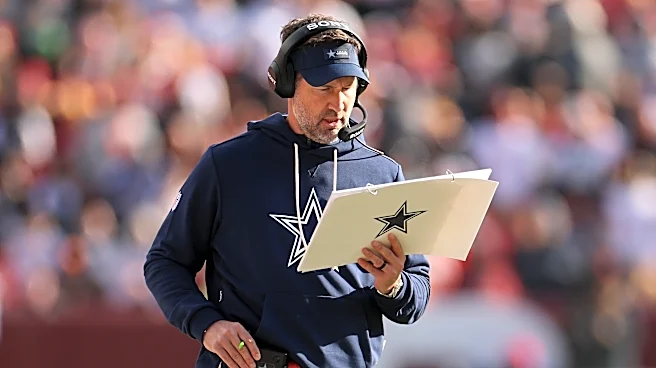
The 12-win Cowboys teams didn’t succeed because they were comeback artists. They succeeded because they spent most Sundays playing with the lead. If Brian Schottenheimer wants to get this team back into the playoffs, that challenge starts with the first two drives of every game.