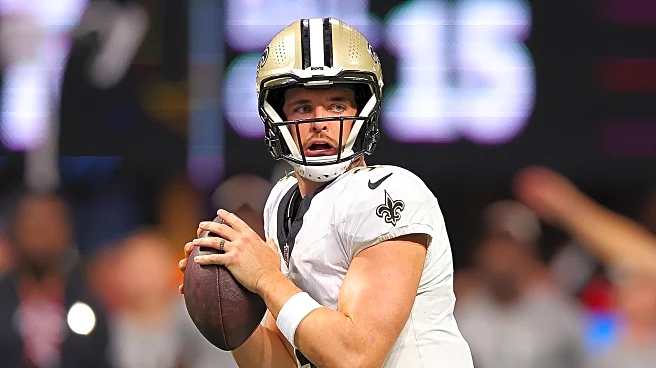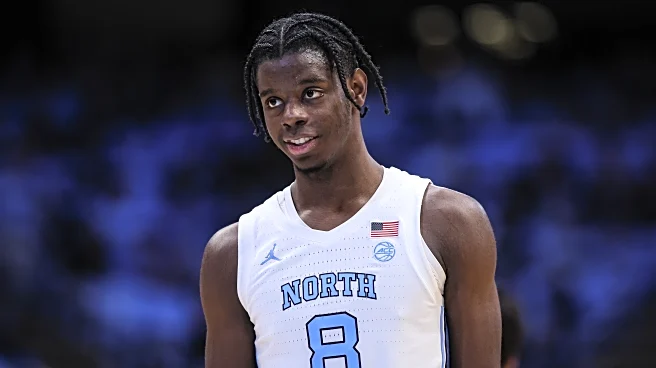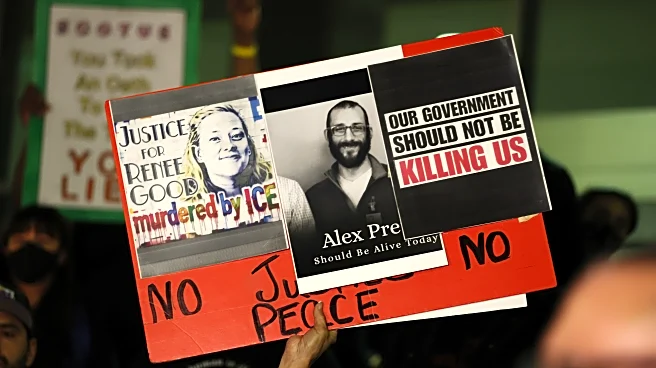

Despite the ICE invasion of Minneapolis that resulted in federal agents killing Renée Good and Alex Pretti among a laundry list of horrific incidents, the Golden State Warriors and Minnesota Timberwolves
played an NBA game on Sunday. The league said, “Play on,” after a 24-hour delay and the players obliged. They stepped on the court just 10 minutes away from where Pretti was pushed to the ground by a gang of federal officers and executed earlier in the weekend.
It’s clear that public sentiment is craving resistance. Fans were quick to laud NBA Hall of Famer Charles Barkley just for speaking about the incident on ESPN’s broadcast of Inside the NBA on Saturday. However, his statement only took a couple minutes amidst hours of basketball coverage. Barkley named Good and spoke to the sadness and fear surrounding this moment, but did not mention ICE, federal agents, Trump, nor make any specific calls to action beyond “somebody’s gotta step up and be adults.”
Several NBA players have broken from their own silent implicitness, something that has largely defined them since Barack Obama convinced them to end a wildcat strike during the bubble in 2020. Warriors star Steph Curry praised the protestors and expressed a belief that recent activism has “turned the tide in a more positive direction.” The NBA player’s union (NBAPA) released a statement that expressed condolences to Pretti and Good’s families alongside calls for people’s freedom of speech to be protected. They also did not explicitly mention ICE nor call for any additional action.
Unsurprisingly, the NBA itself has been the most cowardly. The league refused to mention ICE or even the killing of Good or Pretti in the statement postponing the Warriors and Wolves game. The league’s only other postponements over the weekend were as a result of inclement weather. Alex Rodriguez, former MLB star and part-owner of the Minnesota Timberwolves, was asked if he had anything he wanted to say to President Donald Trump. All Rodriguez said was, “There’s a lot of traffic.”
The NBA is far from alone. The government, particularly Republicans currently in control of all three federal branches, hopes people move on from these stories as quickly as possible. It’s clear that the powerful want everyone to move on and pretend nothing significant should change. Thus far, athletes are acquiescing.
The University of Minnesota has continued all athletics activities as scheduled. The NHL’s Minnesota Wild played on Saturday night without even a brief postponement. The NFL had its conference championship games this weekend with essentially no mention of the attacks or rebellions in Minnesota by media, broadcasts, or players.
No sport has had more prominent athletes speak out than professional women’s basketball. Breanna Stewart, a former WNBA MVP and co-founder of Unrivaled, a league largely operated by players themselves, held up an “Abolish ICE” sign during player introductions prior to a game on Sunday. Nevertheless, the league has continued as scheduled. There is no sign of any athlete-led movement resisting a return to status quo.
As people with far less power and financial security literally put their lives on the line to defend their communities from ICE, the police, and the national guard, where are the athletes willing to do more than make a statement? If athletes fail to seize this moment, it will confirm that anti-right athlete activism in the U.S. has been completely defeated by Trump and the reactionary “Shut up and dribble” brigade.
“We should never forget that everything Adolf Hitler did in Germany was ‘legal’ and everything the Hungarian freedom fighters did in Hungary was ‘illegal.’ It was ‘illegal’ to aid and comfort a Jew in Hitler’s Germany. Even so, I am sure that, had I lived in Germany at the time, I would have aided and comforted my Jewish brothers.” -Martin Luther King Jr. (Letter from Birmingham Jail)
Many of the most overlooked moments of the American slavery abolition movement came in the aftermath of the Fugitive Slave Act. The law was signed by Millard Fillmore in 1850 mandated local and state authorities to assist the capture of runaway slaves. Federal marshals were empowered to deputize citizens to join the hunt, leading to hoards of bounty hunters and slave catchers. The law also allowed anyone convicted of helping a slave escape to face fines of up to $1,000 and six months in prison.
Several of the most well known clashes following the Fugitive Slave Act came in Boston, where Black and white abolitionists had built the Boston Vigilance Committee to support the work of the underground railroad. In reaction to the new law, the committee restructured itself to prevent slave catchers from abducting people in the city.
The organizing work successfully stalled and thwarted slave catcher efforts in a myriad of ways. When slave catchers came in pursuit of William and Ellen Craft in late 1850, placards were posted around the city with descriptions of them. Crowds protested outside their hotels and followed them. Favorable police even arrested them multiple times to try and stall their work. The catchers ultimately left the city failing to kidnap anyone.
Slave catchers arrested Shadrach Minkins on February 15, 1851. Minkins was taken from a local coffee shop where he worked after serving the very people who kidnapped him. Yet, the Bostonian resistance did not give up when he was arrested. While he was held in federal custody at the courthouse later that day, a group of Black men stormed the courthouse, overwhelmed federal officials, and helped Minkins escape.
“We went to bed one night old-fashioned, conservative, Compromise Union Whigs and waked up stark mad Abolitionists,” wrote Amos Adams Lawrence, a wealthy businessman who became one of the largest funders of abolitionist work in the aftermath of slave catcher attacks on Boston.
“The white man made the mistake of letting me read his history books. He made the mistake of teaching me that Patrick Henry was a patriot and George Washington – wasn’t nothing nonviolent about Old Pat or George Washington. ‘Liberty or death’ was what brought about the freedom of whites in this country from the English. They didn’t care about the odds. Why they faced the wrath of the entire British Empire. And in those days, they used to say that the British Empire was so vast and so powerful the sun would never set on it because of how big it was. Yet these 13 little scrawny states tired of taxation without representation, tired of being exploited and oppressed and degraded, told that big British Empire, ‘liberty or death.’” -Malcolm X (The Ballot or the Bullet)
Cancerous American myths have shaped a culture full of passive rugged individualism. So many political conversations are derailed by leveraging oppressed groups against one another. In my moments of cynicism, I worry that isolation has infected our ability to organize as well.
Would I have been drawn to prison and police abolition if not for generations of my family who have lost years of their lives to incarceration? Would I have been drawn to socialized medicine if I hadn’t grown up seeing my mother fight our health insurance company to cover the treatment she needed for her potentially fatal auto-immune condition?
It was not Donald Sterling’s decades of documented racism and slum lording that led NBA players to threaten a work stoppage to force his ousting as Los Angeles Clippers owner, but a recording of racism aimed at NBA legend Magic Johnson. While NBA players had made statements following police killings before, it was the killing of George Floyd in the summer of 2020 that built the momentum eventually leading to the NBA’s wildcat strike in August of that year. Floyd was close friends with former NBA player Stephen Jackson.
Growing up in the age of social media, I was constantly led to believe that we hold people accountable by filming their worst actions. It seems now when we see harm, we think about how we are impacted first. Are we going to record it, call it out, or ignore it? Rarely do we consider how we could act to stop it.
What does it say about our culture that we have seen the police murder countless times yet have no cultural expectation of anyone to try and intervene? Why don’t we have any lauded examples of a hero bravely risking their lives to stop the police from hurting someone?
In those moments, I try to ground myself in anarchist calisthenics. The premise is straightforward. While we often view heroic actions as isolated, they always require bravery that someone has consistently practiced on a smaller scale many times before. As explained in Sunset Distro, “In these small acts of resistance, you teach yourself how to be free, how to act in courage, despite being in fear, and you come one step closer to manifesting liberation here and now.”
Most people don’t want communities to be terrorized by police. Most people understand the cruelty of ICE. Most people believed ICE should be abolished before Pretti was killed.
But the world isn’t shaped by what we want. Politics aren’t empowered by what we hope for.
They are built by what we do.
“I had reasoned this out in my mind; there was one of two things I had a right to, liberty, or death; if I could not have one, I would have the other.” -Harriet Tubman (to Sarah Bradford)
In the spring of 2024 a poem called “there’s laundry to do and a genocide to stop” by Vinay Krishnan briefly caught social media virality. It was met with a chorus of people, largely Americans, feeling seen by the poems description of cognitive dissonance living life amidst the horrors of genocides abroad. As the poem spread, I found myself uncomfortable with how many people seemed validated by it.
The phrase “there’s laundry to do and a genocide to stop” repeats throughout the poem as the narrator goes about their life. The repetition reads like an attempt to stall. The narrator is putting off doing their laundry because they will not stop the genocide. They cannot bring themselves to do their laundry because they would then only have one thing left to do: and they are too afraid to face their own nihilism.
Yet, despite my frustration with this poem, there is something to be learned in the gap between a goal and the actions you can take to achieve it. The narrator’s goal is to have clean clothes, but understands to get there they must do their laundry. By contrast, they can only name their desire to stop the genocide without any actionable step to get there.
We do not know the precise route to achieving our political goals. Even if we engage in constant study of our history, each moment requires a different iteration of a movement. So, we must make the building blocks we climb.
“Black people needs some peace. White people needs some peace. And we are going to have to fight. We are going to have to struggle. We’re going to have to struggle religiously, to bring about some peace. Because the people who we are asking for peace, are a bunch of meglomaniac warmongers and they don’t even understand what peace means. And we’ve got to fight ’em. We got to struggle with ’em to make them understand what peace means.” -Fred Hampton (Fighting for Peace)
If you have not already, it is time to step toward resistance.
If you work in law enforcement or for a private company closely aiding the military/police industrial complex, ask yourself if you’re willing to risk facing the consequences for sabotaging evil actions? If not, quit.
If you work with companies that have contracts with law enforcement or coordinate with them in other complicit ways, can you use your labor power to try and leverage them into ending those relationships?
Make an extra effort to talk to your neighbors in the coming weeks. Bake some cookies and do some rounds. Get to know what they do for work, and maybe even what expertise they have. Exchange contact information and put out feelers to get a sense of their political leanings.
If they seem open to it, have a conversation about pursuing ICE Watch training together. Build a group chat of folks you know from around the city to exchange information (although for security reasons limit the chat to basic coordination).
If you live in an area with an unhoused population, bring some food, wipes, heating pads, and other essentials around to distribute and get to know them. If you are familiar with navigating city or state resources, see if there are ways you can help them apply for assistance or to recover paperwork they may have lost. The unhoused are the most at-risk of being kidnapped by law enforcement because they are out in the open AND have often lost documentation that would prove their citizenship or migration status.
Attend both Know Your Rights and ICE/Cop Watch trainings. Knowing your rights can be critical in helping protect folks in some situations. At the least it can help you do things to make a civil case stronger for victims of violations to recoup financial damages later. Still, taking the step beyond simply knowing your rights to empowering yourself to engage with law enforcement remains most pivotal.
There is a reason federal agents have killed legal observers like Good and Pretti. Community members actively responding, watching, outnumbering, and calling attention to ICE and other law enforcement actions are by far the best form of community resistance short of armed militias. They know what they are doing looks depraved (because it is). So don’t let them hide it.
And when the movement brings minor (probably performative) concessions, do not take your foot off the gas pedal. We are seeing what ICE has done since its inception simply on a larger scale. Do not stop until ICE is abolished.
I am not the arbiter of activism. These are basic suggestions from my own understanding and experiences. Yet, in this moment, as many of my peers engage in the exact work that got Good and Pretti killed, it is hard not to look at the power and privilege of professional athletes with particular frustration.
NBA players are arguably the most powerful individual laborers in the country, if not world. There are fewer than 450 players on NBA rosters at the moment, and if those players refused to play, billion dollar teams, stadiums, television networks, streaming services, merchandise brands, concession conglomerates, ticketing agencies, gambling companies, and advertisers all face massive losses. With that comes the potential to wield massive political power.
The Timberwolves could refuse to play until ICE withdraws from Minneapolis, a fairly attainable demand. The Trump administration already offered to withdraw forces on Saturday, but wanted access to the state’s voting system in return alongside other demands. It’s a clear attempt to meddle in future elections that the state should reject.
If the entire NBAPA refused to play until ICE was fully defunded and abolished, the billionaire owners and corporations would face a conundrum. Would they risk public outcry from defending ICE by trying to force players to play? Or would the billions of dollars at risk push them to lobby congress for some action? If a union as prominent as the NBAPA refused to work, more would follow, creating an avalanche of political pressure.
And maybe not. Maybe corporate billionaires would fear labor exerting that much power successfully would create a precedent that would lead us to do it again. Or maybe too many players would refuse to stand by the cause and succumb to ownership pressures to return to the court.
By wielding their power the union risks push back against many of its financial gains for players. It would put players, lawyers, and staffers at risk of retaliation, but the odds are no one would lose more than some lucrative financial opportunities.
But goddammit isn’t failing worth something? What do we owe to those who have died if not risking failure?
What fucking future is left if we don’t?
“Had I so interfered in behalf of the rich, the powerful, the intelligent, the so-called great, or in behalf of any of their friends, either father, mother, brother, sister, wife, or children, or any of that class, and suffered and sacrificed what I have in this interference, it would have been all right; and every man in this court would have deemed it an act worthy of reward rather than punishment… Now, if it is deemed necessary that I should forfeit my life for the furtherance of the ends of justice, and mingle my blood further with the blood of my children and with the blood of millions in this slave country whose rights are disregarded by wicked, cruel, and unjust enactments, I submit; so let it be done!” -John Brown (John Brown’s Last Speech)
On my mother’s side, I’ve heard a story passed down about a Danish cousin who snuck out at night to put sugar in the gas tanks of occupying Nazi vehicles. On my father’s side, my great-uncle was a partisan in Italy during World War II. At one point, the fascists were rounding up young men who were suspected partisans in the northern villages of Liguria where he lived. As my great-uncle tried to evade them, he eventually came to a church where he asked a priest for help.
As the story goes, the priest led him around the building and opened up a hidden door into a dark room that had been carved into the foundation. The priest closed the door and left this teenager alone in the darkness with no way to leave the space on his own. Had the priest been killed, my great-uncle would have likely died underneath the church. Instead, the priest eventually returned and freed him.
My great-uncle died before I was born. I never met my Danish cousin either. I can only imagine the terror they felt in those moments when an early death was so plausibly imminent. We are all preceded by someone in our lineage who has risked their lives in ways we would deem heroic.
We are living amidst a spiraling empire that is the largest and most maniacal death machine humanity has ever known. No one is safe. Even those who bow to power will one day fall on the wrong end of its cruel stupidity.
The difference between a coward and a hero isn’t who’s afraid.
Everyone’s afraid.
You can either cower and be buried by that imposing shadow of fear or straighten your back and run toward it. Run towards the horrifying possibilities our enemies hope to make reality and fight like hell until they are erased by the light of our collective imagination.
We don’t need a hero. We need all of us to live heroically.
To cite a quote from one of my favorite stories, “We can’t have saved the world. We have to constantly be saving it. Me after you. You after me.”
So let’s save it together.