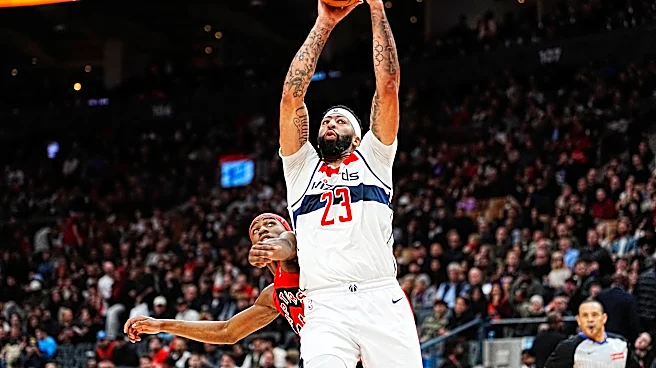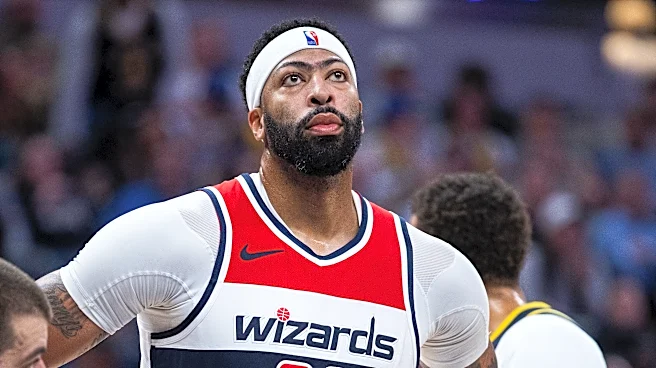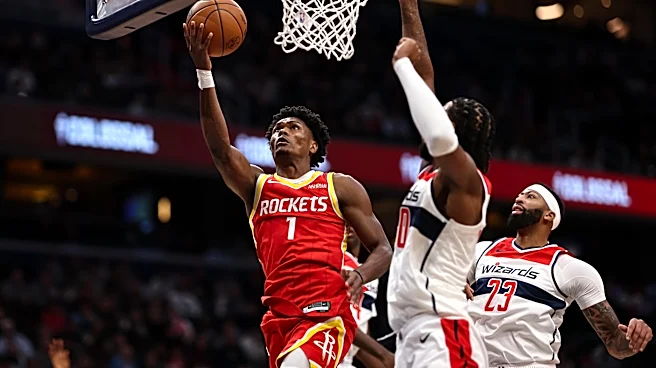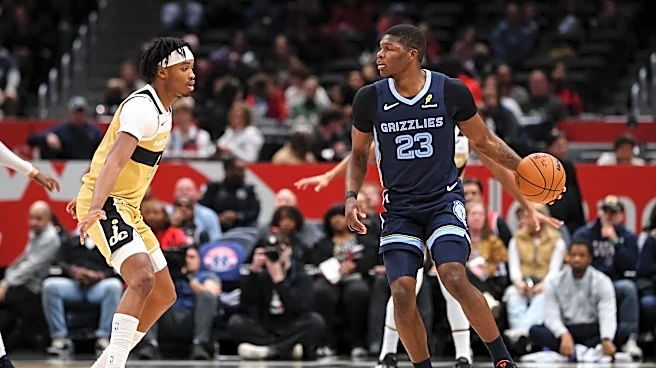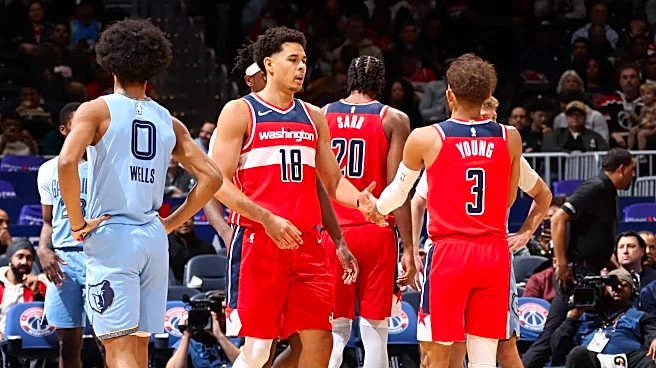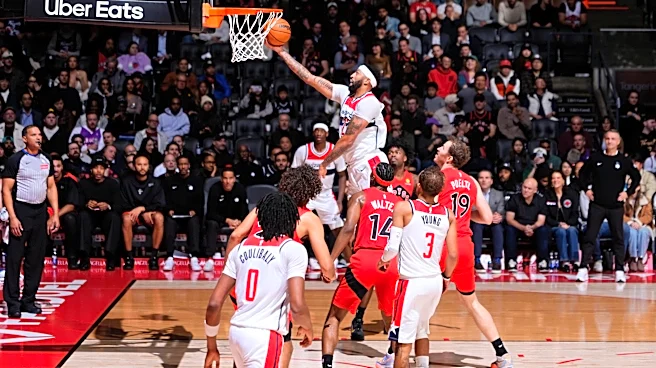

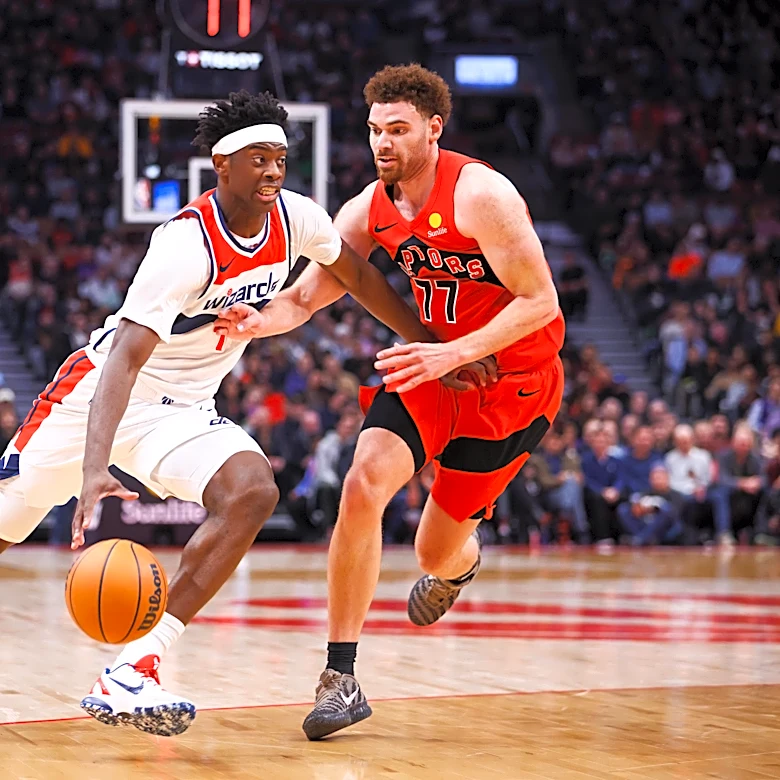

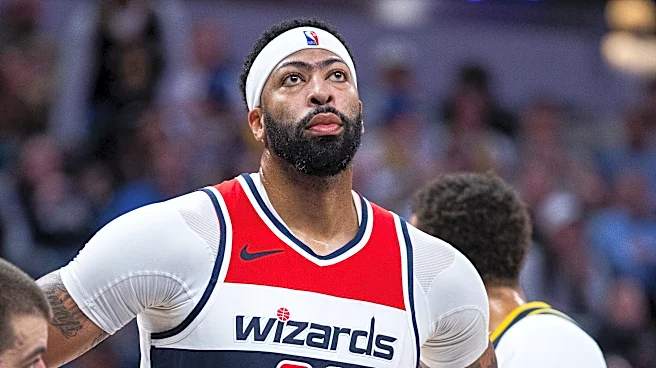
It wasn’t easy or pretty or even all that satisfying, but the Wizards ended their losing streak at eight by beating the Toronto Raptors in Canada last night.
The winning formula was a tight rotation (only seven players got more than 10 minutes) and an opponent missing their three best players. Bonus factor: the opponent lost another member of their top six just four minutes into the game.

There were times last night when it felt like the Wizards were doing good things. Like, in the fourth quarter,
Toronto kept running possessions to the very end of the shot clock. It looked like Washington was playing strong defense. And then I’d remember Toronto was relying on Immanuel Quickley, Jamal Shead, and Ja’Kobe Walter for offense.
Which is not to slur any of those three — they’re all some degree of solid professional players. But they all fit best as third, fourth, or fifth options. Supplementary, not driving forces.
Or, Anthony Davis would look awesome ripping down an offensive board. And then I’d notice that he’d overpowered the 6-1 Shead or the 6-2 Alijah Martin.
The lack of talent available to Toronto helped the Wizards in at least one other way. Up six with under two minutes to play, the Wizards gave the Raptors a wide open three, which they missed. Thirty seconds later, Walter picked Trae Young, who was trying to bring the ball up court and had an opportunity for a layup. He dribbled the ball off his foot, turning an easy two into a turnover.
The Wizards still turned the final minute into an adventure. First, when they were up five with about 36 seconds to play and for some reason Anthony Davis took a fadeaway 20-footer (which he missed). And then when AJ Dybantsa brought the ball up court and lost it out of bounds when he was pressured by Shead.
But, adventure or not, the Wizards did get the win — something they have often not done against a weakened opponent over the past few decades.
From the Notebook
- The first entry in my notebook for the night — before opening tip — was about how Toronto was missing its top three players. I jotted, “Trap game.”
- First offensive possession, the Wizards ran a complicated looking horns set that had multiple screens and cuts and guys running all over the place. So they could throw the ball to Davis at the free throw line and get a heavily contested runner that missed. Davis bailed out the possession by getting the offensive rebound, getting fouled and making a free throw.
- I was in the process of jotting a note about how the Wizards seemed to be constantly on the edge of committing a turnover when Alex Sarr lost the ball out of bounds trying to make a move inside.
- About three minutes into the game, there was a very nice offensive action from the Wizards. The ball arrived to Sarr on the wing. Kyshawn George came up from the corner into a dribble handoff coming towards the middle. He drove with advantage, Jakob Poeltl (Sarr’s man) was forced to help, and George made the easy kickout to Sarr for a wide-open three. That’s good basketball.
- Maybe 10 seconds later, Dybantsa blew up a Toronto dribble handoff and got a breakaway dunk.
- Get used to it: Toronto repeatedly brought Young into the action on defense and attacked him. Even when Young gave a good effort (which was most of the time), the other four defenders had to help, which created openings. That’s something the Wizards could get away with against a team missing its top three players.
- One offensive possession rankled. While Will Riley and Davis tried to figure out how to attack on the strong side, Dybantsa was on the weakside wing, and Bilal Coulibaly and George with both in the weakside corner. And no one cut. Or lifted. Or screened. They…just stood there and watched. Davis bailed out the possession by drawing a foul.
- Raptors analyst Jack Armstrong made this observation in the third quarter: “The Raptors are on a back-to-back, but they’re the ones making the hustle plays. They look like they’re the better conditioned team.”
- At the 4:55 mark of the third quarter, George had a major size advantage in the post…and took an awkward fading jumper, which he missed. Terrible shot selection in that situation.
- At 1:42 of the third, the Wizards had a 3-on-1 fast break that somehow ended up in a Coulibaly charge.
- Dybantsa fan boy moment — check out 10:29 of the fourth quarter. Amazing drive and finish by the 19-year-old rookie — WOW power and athleticism.
- About three minutes later, Dybantsa made a spinning move while driving and finished with a dunk. Another moment of outlandish athleticism.
- In the span of about a minute during the fourth quarter, Young failed to pay attention and got backcut by Shead for a layup. He followed that up by not tagging Walter on a Poeltl missed free throw, which gave Walter a free run into the lane for the offensive rebound.
- Young got his dribble picked twice in the final couple minutes of the game.
- Terrific game overall from Dybantsa, by the way — 23 points, 12 rebounds, strong defensive effort.
- Davis was too much inside for the depleted Raptors — 24 points, 14 rebounds, a steal and two blocks.
- George played 40 minutes, scoring 20 points and avoiding the turnovers and fouls that have undermined his impact.
- Sarr was good — 13 points, 2 rebounds, 3 assists, and 3 blocks in 22 minutes.
- Another poor shooting night for Young. Plus three turnovers. Not so good.
Four Factors
Below are the four factors that decide wins and losses in basketball — shooting (efg), rebounding (offensive rebounds), ball handling (turnovers), fouling (free throws made).
The four factors are measured by:
- eFG% (effective field goal percentage, which accounts for the three-point shot)
- OREB% (offensive rebound percentage)
- TOV% (turnover percentage — turnovers divided by possessions)
- FTM/FGA (free throws made divided by field goal attempts)
Stats & Metrics
PPA is my overall production metric, which credits players for things they do that help a team win (scoring, rebounding, playmaking, defending) and dings them for things that hurt (missed shots, turnovers, bad defense, fouls).
PPA is a per possession metric designed for larger data sets. In small sample sizes, the numbers can get weird. In PPA, 100 is average, higher is better and replacement level is 45. For a single game, replacement level isn’t much use, and I reiterate the caution about small samples sometimes producing weird results.
POSS is the number of possessions each player was on the floor in this game.
ORTG = offensive rating, which is points produced per individual possessions x 100. League average so far this season is listed in the Four Factors table above. Points produced is not the same as points scored. It includes the value of assists and offensive rebounds, as well as sharing credit when receiving an assist.
USG = offensive usage rate. Average is 20%. Median last season was 17.7%.
ORTG and USG are versions of stats created by former Wizards assistant coach Dean Oliver and modified by me. ORTG is an efficiency measure that accounts for the value of shooting, offensive rebounds, assists and turnovers. USG includes shooting from the floor and free throw line, offensive rebounds, assists and turnovers.
+PTS = “Plus Points” is a measure of the points gained or lost by each player based on their efficiency in this game compared to league average efficiency on the same number of possessions. A player with an offensive rating (points produced per possession x 100) of 100 who uses 20 possessions would produce 20 points. If the league average efficiency is 115, the league — on average — would produced 23.0 points in the same 20 possessions. So, the player in this hypothetical would have a +PTS score of -3.0.
Players are sorted by total production in the game.