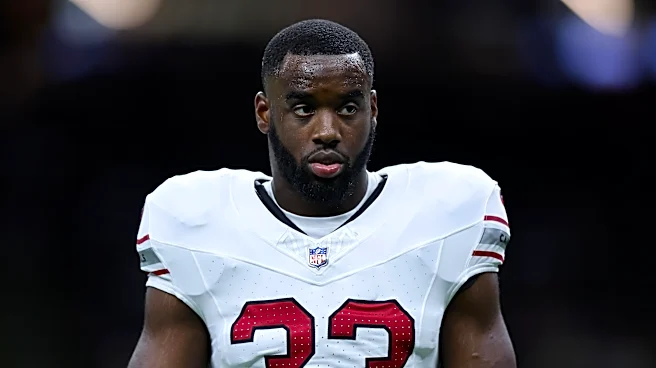


The Arizona Cardinals, like every other NFL club, have 90 players signed for training camp. On Sunday, August 30, the roster must be pared down to 53 players. That is a lot of guys suddenly unemployed.
The day after is when teams begin making claims off the waiver wire for players that have been released from other teams.
RELATED: POSITIONAL PLAYERS THAT NEED TO BE ADDRESSED
The person doing the player cuts? That is “The Turk.”
In 1946, a new professional football league began, called the “All-America
Football Conference” (AAFC). This new NFL-rival league consisted of eight teams, of which four would be situated in NFL cities such as Chicago, Cleveland, New York, and Los Angeles.

The AAFC raided NFL rosters and coaching staffs. They signed players who were once on NFL rosters and then entered World War II, but had contract offers waiting for them. This new league signed numerous athletes who had to forgo their sophomore, junior, and senior college seasons, and upon return, found that all of their eligibility had been forfeited.
Paul Brown was hired to coach the AAFC Cleveland squad while he was still in the Navy. The Cleveland Rams eventually received approval from the other owners to relocate to Los Angeles, a move that Rams owner Dan Reeves had been lobbying for two years. He finally got his wish when air travel became available, replacing the need for trains to travel to games.
Back in those days, pro football teams held their training camps at small college campuses. This provided remoteness for both players and coaches. Athletes could focus solely on the game and studying the playbook without the distraction of having to mow the lawn, or change the oil, or wives or girlfriends or both, the baby waking up at 2:00 a.m., or little Billy having a bad dream.

These campuses had a football team, so there was a stadium for practice and other practice fields. Players could sleep in empty dorm rooms, which usually housed two students per room – perfect for a duo of players. Classrooms were ideal for position meeting rooms, and there was a mess hall for meals.
The isolation was ideal for focusing on the upcoming season.
For the longest time, the NFL, and later the American Football League, would schedule some preseason games in cities that were devoid of NFL teams. This brought the game of pro football to a new set of fans in the hopes that they would grab onto the game and follow a team.
At one time, the State of Florida did not have any professional teams in any sport. So, the NFL scheduled exhibition games. Jacksonville had the 62,000-capacity Gator Bowl, while Miami had the 72,000-seat Orange Bowl available. The Tangerine Bowl in Orlando could hold 60,000, while Tampa offered 74,000 seats in Tampa Stadium. All of these cities have since had a professional football team call them home, with three now having NFL franchises.
In today’s NFL universe, the league is more focused on bringing its game to international venues and fans. But back in the day, they were more focused on expanding their presence to non-NFL cities and states in the hopes that fans would choose a favorite team and follow their seasons.

All across the country, the NFL and AFL had preseason games in Memphis, Tulsa, Norfolk, Sacramento, Jackson, Hartford, Boise, Birmingham, Austin, Shreveport, San Antonio, Portland, Mobile, San Jose, Oklahoma City, and Tucson. Columbus, Ohio, held an annual Browns contest in the preseason for decades. Even cities that now have NFL clubs were visited beforehand, such as New Orleans, Las Vegas, and Nashville, to name a few.
As training camps went along their merry way, after certain preseason games, there would be a round of player cuts. Clubs would have 90 players in camp, and then on the Monday after the exhibition game, the franchise would have to pare down to 85 players. After the next preseason game, the roster would then be shortened to 75 players. And finally, after the final exhibition game, the coaching staff would have to get to 53 players.
Except for the final cuts, all of the player releases would occur at the training camp college campus.
And who would do the cuts? The “Turk.”
The Turk was a mystical creature who would prowl NFL training camps. What once was two players soundly asleep in a college dorm room would become one player who would wake up and find an empty bed beside him with maybe a single sock on the floor, a pencil once used to take notes, and a half-eaten apple sitting on the nightstand.
No blood, no claw marks, no suitcase, and no roommate would be found.

“The Turk” is the term used for the person who would come to get players that are about to be cut. This was always an assistant coach. Cuts were performed when it became dark, after players had retired to their rooms to study, but before the 11:00 p.m. lights out.
The scene is usually a closed door with players engulfed in their playbooks, and the brightly lit hallway lurks a shadow that would approach. If the shadow continued, both players were safe. If the shadow stopped, the door would creak and open slowly, and the coach would say, “(Insert player name), coach wants to see you. Bring your playbook.”
Then the assistant coach would accompany the player into the head coach’s office, who would then tell the athlete his “release speech” and send the player to the airport, or, back in the day, the train station.
When the other surviving team members would wake up and gather for breakfast, they would notice other players who were no longer in the room.
“The Turk” had come in the night and snatched them.

This was coined in 1949 by Don Paul, a Los Angeles Rams linebacker, who would say, “The Turk always strikes at night.” As was the Rams’ custom and all the other teams’, the cuts were done in the evening on cutdown day. This eliminated the other players from seeing their now-former teammates leave the campus since everyone was in their rooms.
The reason Paul used the term “Turk” is that, in the 12th through the 16th centuries, the Turkish army made most of its raids and attacks after dark.
Thus, the term is still used even today.
Barry Shuck is a pro football historical writer and a member of the Professional Football Researchers’ Association