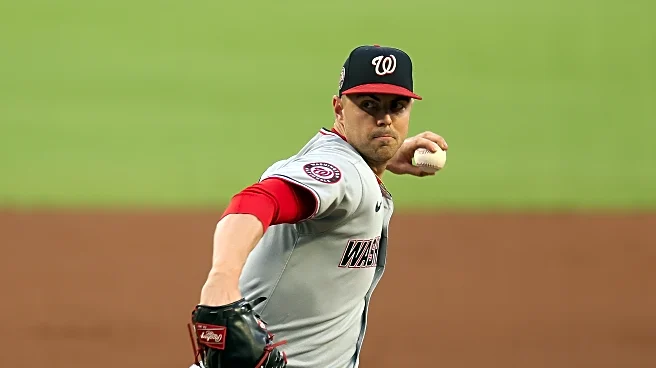

The Texas Rangers addressed the hole in their 2026 rotation in dramatic fashion on Thursday, trading five minor leaguers to the Washington Nationals to acquire lefthanded starting pitcher MacKenzie Gore.
So let’s talk about this deal, and what the Rangers are getting in Gore.
Start with the basics. Gore is a lefty who turns 27 in February, listed at 6’2”, 193 lbs. He is under contract for the 2026 season at $5.6 million, and has four years of service time, so (assuming the next CBA doesn’t change initial team control rules) Gore will be arbitration eligible for the 2027 season as well, and will be eligible for free agency after that.
The San Diego Padres took Gore #3 overall in the 2017 MLB Draft, after Royce Lewis and Hunter Greene, and right before Brendan McKay and Kyle Wright. Of the players drafted and signed in the first round in 2017, Gore’s career 6.0 bWAR is the sixth highest, behind Greene, Trevor Rogers, Brent Rooker, Tanner Houck, and David Peterson. Jake Burger, incidentally, is 8th on that list. It wasn’t a great first round.
Gore was highly rated on the prospect lists until an awful 2021 season, which saw him generally drop to the bottom of, or out of, top 100 lists. However, he was good enough in the spring of 2022 to earn a spot on the San Diego Padres Opening Day roster, and other than the occasional rehab assignment, he’s been in the majors ever since, mostly with the Washington Nationals, who the Padres traded him to as part of the Juan Soto deal. Gore was on the injured list when he was traded, and wasn’t activated from it the remainder of 2022, so he didn’t pitch for the Nationals until the following year.
For the Nats, he made 27 starts in 2023, totaling 136 innings, with a 4.42 ERA, 4.89 FIP, and 5.20 xERA (coincidentally, the same xERA he had in his 16 appearances for San Diego in 2022). Not great. He showed improvement in 2024, putting up a 3.90 ERA, a 4.19 xERA and a 3.53 FIP, and more or less stayed steady in 2025, with a 4.17 ERA, 4.33 xERA and 3.74 FIP.
Over the past two seasons, Gore has put up 3.8 bWAR and 6.1 fWAR, with his FIP being better than his ERA causing the fair sized spread between the two metrics. He’s been a 2-3 win per season pitcher. His bWAR in that stretch is tied for 53rd among major league starting pitchers, an ordinal slot he shares with Zac Gallen, Jose Quintana and Tanner Bibee, as well as (in many fewer innings) Tyler Glasnow and Noah Cameron. Within a couple of bWAR either direction, and with similar games started, are are Bailey Ober, Jose Berrios, Jack Flaherty, and Luis Castillo.
Prior to yesterday, the 2026 Texas Rangers had had a rather aching need for a capable major league starting pitcher to ink, rather than pencil, into its rotation. Nathan Eovaldi and Jacob deGrom are a very solid top of the rotation, though injury issues are a concern. Jack Leiter had a solid first full season in the majors in 2025, and could well take the next step in 2026 and establish himself as a quality #3 starter, but expecting him to be the #3 on a team with playoff aspirations right now would seem to be aggressively optimistic.
But even if you are comfortable with Leiter as your #3, your final two spots are still an issue. Absent any other moves, Kumar Rocker and Jacob Latz would be filling those roles. Rocker, in what was really his first full season as a professional, having signed in 2022 and missed the bulk of 2023 and 2024 due to Tommy John surgery, showed flashes of what he was capable of, but overall was not good in the bigs in 2025. And Latz hasn’t been a regular starter since 2021, working largely out of the pen since then, and functioning as a swingman for the major league club in 2025.
Behind them, well, the options are underwhelming. Jose Corniell looked good in 13 appearances in the minors after returning from Tommy John surgery (though not so good in 5 AFL appearances), but after missing all of 2024 and most of 2025, he’s probably not ready to handle a major league workload, and with only 34 innings above A ball, he’s probably not ready to handle major league hitters. David Davalillo and Leandro Lopez were added to the 40 man roster, but each has just a half season at AA and no time at AAA, and they are probably a year away from being asked to do anything but temporarily patch over a spot on the major league staff in an emergency. Patrick Murphy is back on a minor league deal, after impressing in camp last spring, pitching well in Round Rock, getting hurt, and then de-camping for the KBO for the second half of the 2026 season, but you aren’t really going to want to count on him to meaningfully contribute to the major league rotation.
Cody Bradford is due back, per reports, sometime in May, after undergoing internal brace surgery last year. He was very good in the rotation in 2024 when he was healthy, but only pitched in 14 games because, well, he wasn’t healthy enough. I imagine the plan is to have Bradford — who turns 28 next month, and thus isn’t really a youngster — join the rotation once he’s built up his pitch count on a rehab assignment, and so you can say that the situation is less dire once he’s ready.
But Bradford has an injury history, dating back to college — he dropped to the 6th round in 2019 because he missed most of his junior year due to Thoracic Outlet Surgery — so one has to be concerned about his ability to stay on the mound. And that’s before taking into account the workload issues, given he threw just 82 innings in 2024 and 0 in 2025. Again, he’s in his late 20s, so the workload concerns are less than with someone like Corniell, but it is still an issue.
So throughout the offseason, adding an established, competent major league starter to the rotation seemed like a no-brainer, given that the organization has playoff aspirations. While the trade market was always a possibility, it seemed more likely the team would be poking around in the free agent market, particularly the lower end, given the team’s reported budgetary constraints. And with Chris Young publicly stating in recent weeks that the team wanted to improve its “starting pitching depth,” versus just saying its “starting pitching,” my expectations, at least, were dampened. I was fearful Young was talking adding “starting pitching depth” in the sense of bringing back someone like Patrick Corbin, or even worse, adding NRIs to potentially compete for a rotation spot, rather than getting someone that you would have a degree of confidence in.
So getting Gore was a pleasant surprise. He’s under contract for $5.6 million for 2026, a dollar amount that, as I pointed out yesterday in the comments (though one should never read the comments, of course), is pretty much what Shawn Armstrong got on a one year deal a month or so ago. In a free agent market where Adrian Houser got 2 years, $22 million, $5.6 million for a 2-3 win pitcher is a coup, especially when one considers that Gore isn’t eligible for free agency until after 2027.
All that being said, what is more intriguing about this deal is the potential upside that MacKenzie Gore offers.
I mentioned yesterday that I could see Chris Young viewing this as potentially his version of the trade the Houston Astros made almost a decade ago for Gerrit Cole. Cole, like Gore, was a former top draft pick and top 10 prospect — he was taken #1 out of UCLA in 2011, having famously spurned the Yankees in 2008 after they took him with their first round pick that year. Cole, like Gore, had been a (pro-rated) 2-3 win pitcher the previous two seasons, though unlike Gore, he did have a really good season earlier in his career, one that saw him get Cy Young and MVP votes. Cole, like Gore, was seen as someone whose results were not as good as his stuff would suggest that they should be. Cole, like Gore, was shipped out with two years of team control remaining, for a quantity-over-quality package (the Pirates received Michael Feliz, Jason Martin, Colin Moran and Joe Musgrove*).
* The big difference between what the Astros gave up and what the Rangers gave up is that Texas traded guys who are mostly years away, while the Pirates got young major leaguers or guys who were, theoretically, major league ready.
We know what happened after that. The Astros worked with Cole on some changes, and he blew up, putting up 12 bWAR in his two seasons with the Astros, finishing 5th and 2nd in the Cy Young balloting, and signing a gigantic deal with the New York Yankees, for whom he has won a Cy Young Award as well as collecting a second and fourth place finish.
I don’t think the Rangers make this trade if they don’t think they have the potential to unlock…I hesitate similar improvements from Gore, because that would mean turning him immediately into one of the best pitchers in baseball. So I will say, the potential unlock significant improvements that could make him a front of the rotation starter.
Gore was a five pitch pitcher in 2025 who threw four of his pitches 95% of the time. He was a fastball/curveball/slider/changeup guy his first two years in the majors, and threw the changeup rarely. In 2024, he largely junked the slider (he threw it 38 times that year, along with 16 sweepers) and added a cutter. In 2025, he brought the slider back and reduced his use of the cutter.
In terms of his utilization of his pitches, lefties saw mostly sliders (44.3%) and fastballs (42.3%), with the occasional curveball (12.4%) mixed in, along with 7 cutters. His slider was extremely effective against lefties (.219 wOBA and .225 xwOBA), while his fastball was…not (.451 wOBA and .387 xwOBA). Against righthanded hitters, he throws a little over half fastballs, a little over a quarter curveballs, with the remaining 20% roughly two-thirds changeups and one-thirds cutters. The results on his fastball are okay, and the xwOBA on the other three pitches against righties are all below .300, though his changeup has had a negative run value each of the last two seasons, per Statcast, due largely to his inability to consistently throw it close enough to the strike zone for batters to swing at.
Gore throws hard but none of his pitches have a ton of movement, particularly horizontally — other than his cutter, all his pitches had below-average horizontal movement last year, and only his fastball and curveball (fortunately, his most used pitches) have above-average vertical movement. If you look at Statcast’s list of similar pitchers based on velocity and movement, #2 is 2025 Jacob Latz, which, well…that’s not terribly encouraging. Yusei Kikuchi’s 2024 and 2025 seasons, along with 2022 seasons from Daniel Lynch IV and Kyle Muller, round out the five in the list.
What Gore does have, though, is great extension — 86th percentile in 2025, and that was the lowest percentile placement he’s had in his four years in the majors — which allows his pitches to play up. That helps explain why he’s able to successfully miss bats — his 27.2% K rate was in the 80th percentile in 2025, as was his 29.7% whiff rate, while his 29.9% chase rate is in the 70th percentile.
While Gore’s bat-missing ability is very strong, what has held him back is a lack of command. That is reflected in both his walk rate — 9.1% the past two seasons, 9.6% for his career, both below average — and in the quality of contact he gives up when batters do make contact off of him. One can look at his BABIP and see a career BABIP allowed of .324, with a BABIP of .325 and .340 the last two years, and chalk up the spread between his FIP and ERA to bad defense. Just getting him to Texas — a team that won the Gold Glove for team defense in 2025 — and that should fix the problem, one would assume.
Alas, it is not that simple. Gore’s command issues manifest, not just in having trouble throwing strikes, but also in not throwing quality strikes. While batters swing and miss off of him a lot, when they do make contact, they make loud contact. His barrel% and hard hit% has been in the bottom 15th percent every year except 2024, and his xwOBA on contact for his career is .404, including a .403 mark in 2025, compared the to MLB average of .369. The result is a career HR/9 rate of 1.17 (1.13 in 2025), and the 10th highest BABIP in 2025 out of 117 MLB pitchers with at least 100 innings pitched.
For the first three months of 2025, he appeared to have figured things out. There were 103 pitchers who throw at least 2000 pitches in the bigs in 2025, and through the end of June, Gore’s wOBA and xwOBA were both .294 — that xwOBA was the 20th best in the first three months of the season out of those 103 pitchers. He had a 3.09 ERA and a 2.97 FIP, which are outstanding numbers, and rightly earned him a spot on the National League All Star team.
That performance was largely driven by a 31.7% K rate and a 33.0% whiff rate — the only pitchers with a higher whiff rate in the first three months were Logan Gilbert, Dylan Cease and Tarik Skubal. The problem with loud contact, however, hadn’t gone away — his wOBA and xwOBA on contact were both .398, and that xwOBA on contact placed him 91st out of those 103 pitchers in the first three months of the season. Its just that he generated enough Ks, and avoided enough walks, to be able to be great despite that.
As you can probably already guess, Gore was not able to sustain that over the final three months of the season. He allowed a .363 xwOBA in the second half, worse than all but 12 of the 103 pitchers with at least 2000 pitches in 2025. His whiff rate dropped to 24.7%, 47th best, and his K rate dropped to 20.4%, while his walk rate jumped from 7.3% to 12.4%. If we ignore his first two starts in July (which were both good), and look at just his results in the second half of the season, he put up a 6.75 ERA and a 5.49 FIP. That is…bad.
I will note that Gore did have two brief injured list stints in the second half, one in late August due to shoulder inflammation, one late in the year an ankle impingement that ended his season. If one is an optimistic, one can certainly choose to believe that the second half dip was due to physical issues, and that if he’s fully healthy he’ll pitch like he did in the first half of the season.
One could also say that his second half numbers are skewed by a horrendous four start stretch right after the All Star Game, when he allowed 23 runs in 15.2 innings, walked 11 guys, allowed six home runs, and struck out just 10 batters, and if we take his six starts from there until his penultimate start of the year, and ignore his final start, when he allowed four runs in two innings but * hand waves * that was probably because of the ankle injury that resulted in him going on the injured list the next day, he put up a 2.84 ERA and 3.23 FIP. Of course, you can make a whole lot of pitchers look really good if you just ignore their worst starts.
Also, interestingly, we saw the same sort of split in performance in 2024 as in 2025, albeit in a less extreme fashion. Gore was 40th out of 103 pitchers in xwOBA through the end of June in 2024, and 73rd from July 1 on.
So what is our takeaway from all this?
Gore has the ability to be a front line starter. He has pitched like a front line starter in the first three months of each of the past two seasons, and pitched like a legitimate #1 starter in the first half of the 2025 season. Given that he was touted as a potential front line starter leading into the 2017 draft, and then through most of his minor league career, that isn’t really surprising.
The question is whether Gore can be a front line starter consistently — put up a full season performance worthy of a #1 or #2 starter. The question is whether going from the Nationals — who have been terrible the entire time Gore has been there — to the Rangers will make a difference, whether the Rangers can work with Gore to make improvements to allow him to tighten his command, make adjustments with his pitches and/or pitch selection, that will allow him to take a step forward.
If that happens — if Gore can consistently perform at the level he has in the first half of the past two seasons — then this trade is a home run for the Rangers. They will have gotten two cost-controlled seasons of a legitimate TORP for a package that is much less than what a cost-controlled TORP commands.
And if that doesn’t happen, and Gore ends up being a 2-3 win pitcher the next couple of seasons…well, the Rangers would still have a guy who is worthy of being in the rotation of a playoff team, something that they really needed to add this offseason anyway.