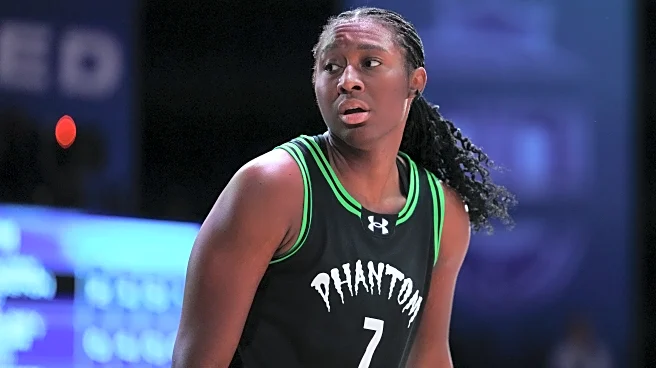




If there was an early-season favorite for a fictional Unrivaled Most Improved Player Award, it would be Aliyah Boston. And in large part due to Boston, Phantom is Unrivaled’s most improved team.
Last year, Phantom finished a league-worst 4-10, outscored by 138 points, or almost 10 points per game, for the season. Through five games, this year’s Phantom has all the indicators not only of a playoff team, but of a true contender. At 3-2, Phantom has the league’s best scoring margin, outscoring opponents
by over eight points per game and 41 points overall.
Phantom’s areas of improvement also correspond with Boston’s strengths. They’re better on the boards and more active defensively, increasing their rebounds, steals and blocks per game. They’re also a much better assisting team, an area where Boston, arguably Unrivaled’s best passing big, gives the club an extra edge.
Of course, Boston herself had to better. Her debut Unrivaled season was unimpressive, suggesting, in contrast to some players, her game was suited to 5×5 but not 3×3. A member of Vinyl, Boston saw limited minutes, cleaning the glass with success when she got the chance but otherwise failing to make much of a positive impact.
So far this season, she looks like the player fans have grown familiar with since her days at South Carolina and through her first three WNBA seasons with the Indiana Fever. She’s averaging over 18 points and eight rebounds per game. Her two blocks per game lead the league, while her 1.8 steals per contest rank fourth overall. She’s also tossing 2.6 assists per game, or 13 overall; that compares to just nine total last season.
Boston also is doing all the little, smart things that irritate her opponents and arouse the ire of fans of the other team, but please her teammates and supporters. That includes her more innocuous habits, such as consistently running the floor to draw in an opposing defender and create more favorable transition scoring opportunities for her guards, something Unrivaled commentator Sarah Kustok complimented her for when Boston visited the booth during a recent broadcast.
More notoriously, she’s swinging elbows, hooking opposing players’ arms and setting moving screens.
The latter is something that her teammate, Kelsey Plum, has gained an appreciation for, which she (somewhat reluctantly) admitted as guest on Boston and Candace Parker’s podcast, Post Moves. Having frequently been the victim of Boston’s illegal screening tricks, Plum is now the beneficiary, creating a two-woman game that is the best in Unrivaled.
Plum and Boston’s fast partnership, as well as Plum’s overall rapid acclimation to Unrivaled, also has been critical to the Ghost Gang’s growth. KP is fifth in Unrivaled in scoring at 22.6 points per game. Her six assists per game are the third-best in the league.
Phantom head coach Roneeka Hodges also deserve credit for her club’s success. Recognizing the effectiveness of the Boston-Plum pairing, she’s not messing around; rather, she’s establishing rotations that maximize their shared court time.
On Friday night, the Ghost Gang goes for a second-straight win against Vinyl (8:45 p.m. ET, TNT/truTV).
Unlike Phantom, Vinyl has yet to find their groove. Similar to last season, the club is inconsistent. Their talent sometimes is in-tune, connected and engaged, but, too often, it record scratches, resulting listless losses. Coming off one of the poorest games of her Unrivaled career, at least expect Dearica Hamby to be dialed in to deliver a bounceback performance.
Rose and Mist meet in a get-right matchup
Rose has lost two-straight games. Mist lost their last game. Week 3 of Unrivaled thus tips off with two veteran clubs desperate for a win (7:30 p.m. ET, TNT/truTV).
No, Rose’s unexpected Ls are not the fault of Kahleah Copper, who missed Rose’s three opening wins. Rose, however, needs to rediscover how to play most effectively with Copper, a high-usage offense-first player.
With Copper sidelined, things fit a bit more cleanly for Rose, with Chelsea Gray surrounded by “stars in their role” who are more defensive-minded play finishers. Shakira Austin and Azurá Stevens are mobile bigs with elite defensive length; offensively, both are capable of cashing in on dimes from Gray, while Stevens can also stretch out to the 3-point line. Lexie Hull and Sug Sutton are eager to get after perimeter players defensively, all while serving as spot-up 3-point shooters.
Those players’ more defined roles put a lot of the offensive creation burden on Gray. But she, and Rose, were thriving. Rose has to figure out how to share some of those responsibilities with Copper, while maintaining their defensive integrity.
Mist, likewise, has some things to solve in order to reach their upside. Head coach Zach O’Brien should take a cue from Hodges by having his club, like Phantom, lean into their best pairings and combinations.
That must begin with more Allisha Gray.
As a member of Lunar Owls last season, Gray logged almost 20 minutes per game, scoring 19.4 points, compiling 2.7 assists and grabbing 5.7 boards. This season, Gray is putting up 21.7 points, 4.0 assists and 5.3 rebounds—in just 13.3 minutes per game. After finishing second in the 2025 WNBA season in total minutes, Gray has proven can handle a bigger load; she’s one of the fittest players in the sport.
It’s time for Mist to get serious and maximize Gray, deploying her and Breanna Stewart as much as possible.
Will Rose or Mist approach this as a must-win matchup, making the hard decisions required to avoid another defeat?