



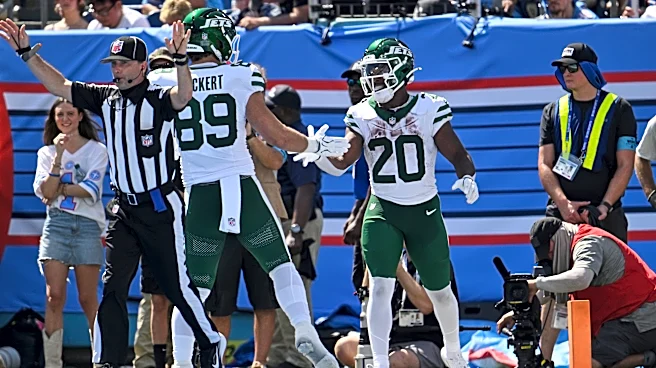

It’s been an interesting few days.
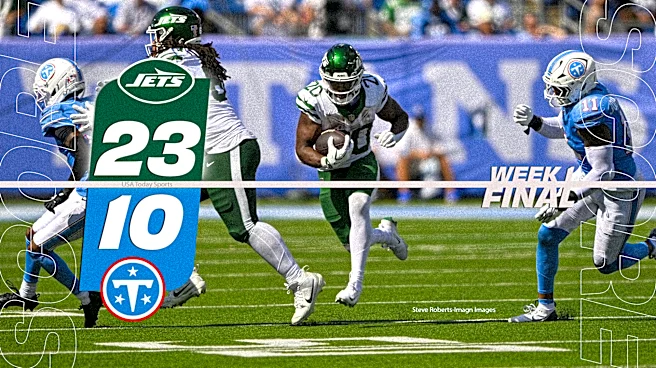
The Jets won their first game of the season on Sunday, and they did so in dominating fashion. Fast forward a few days and rightfully Jets fans don’t know what to do with themselves.
This past Sunday marked only the second time the Jets have won their first game of the season in the last eight years. And the other time they won Week 1, Jets fans could barely enjoy it. That was the game where Aaron Rodgers tore his Achilles, and the fanbase was left watching in horror
as he struggled to stand on the field. So even when the Jets won Week 1, there was an impending sense of dread that the season was already lost. For all intents and purposes, this was the first time in eight years I can confidently say that the Jets won their season opener and it actually felt like a win.
And I can’t help but notice that a sizable portion of the Jets fanbase legitimately has no idea how to process this. The other day, on my way to work, I literally heard two Jets fans talking. One of them said, “I forgot what this feels like.” That pretty much sums it up.
On one hand, you have a bunch of Jets fans who are overtly optimistic and excited. They are looking at what happened Sunday and thinking, maybe this team is actually good. Maybe this season could be different.
On the other hand, you have another sizable portion of the fanbase that seems almost incapable of enjoying it. They’re waiting for the other shoe to drop. They’re prepared for disappointment because, quite frankly, that is what being a Jets fan has taught them to do.
Not to get overtly psychological here, but I think there are actually two contrasting things happening. The first is cherophobia. Cherophobia is a psychological term used to describe an irrational fear of feeling happy or hopeful. One of the reasons people experience it is because of past negative experiences or trauma. As Jets fans, we know all about that. When you’ve spent years watching promising seasons fall apart, convincing yourself that things might finally be different only to have the team rip your heart out, eventually you start protecting yourself from the possibility of disappointment. And honestly, I understand it.
But then there’s another psychological concept that I think is influencing the other side of the fanbase: the anchoring effect. The anchoring effect is a cognitive bias where people rely too heavily on the first piece of information they receive when making subsequent judgments or estimates.
When it comes to estimating the Jets’ chances for the rest of the season, the only regular-season evidence we have right now is overwhelmingly positive. The Jets didn’t just win. They dominated. So naturally, that first piece of evidence becomes the anchor. Fans immediately start reaching for the most positive interpretation of what they just saw. If this is what the Jets look like, then maybe they can do this. Maybe they can do that. Maybe this team is actually capable of making a run.
Where does this leave us this week? You have one group of Jets fans whose past experiences are telling them, “Don’t get too happy. You know how this ends.” And you have another group whose immediate experience is telling them, “Why shouldn’t we be excited? Look at what just happened.”
Both reactions make sense. The problem, of course, is that neither one of those reactions necessarily tells us what the Jets actually are. It’s been one game. That doesn’t mean we should dismiss what happened Sunday. It also doesn’t mean we should extrapolate the entire season from it. I’m going to do my best to contextualize below what we just saw Sunday. What I think is realistic to get excited about and what isn’t. What Week 1 can tell us about a team and what it normally cannot. Here’s some things we do know:
Week 1 Is Not Fundamentally Different Than Any Other Week
This is something that I’ve heard a lot over the years. That Week 1 is particularly noisy and should be ignored more than other weeks. However, this isn’t really true when you look at the data. In other words, Week 1 doesn’t contain any less predictive value than using Week 2, Week 3, Week 6, Week 7, etc. The sample is obviously still small, but there isn’t something inherently different about the first game of the season that makes it uniquely unreliable.
For starters, I want to preface this by saying that in any situation, looking at a one-week sample can lead to false conclusions. It’s a small sample.
Former PFF data scientist Timo Riske outlines this in the thread below, which helps explain why Week 1 has probably developed a reputation for being more “fake” than any other week:
For Jets fans, I think this distinction is important because we are rightfully scared that we are being deceived by what we saw.
For starters, most Jets fans remember that last year, the Jets’ offense looked significantly better in Week 1 than it did for much of the rest of the season. So naturally, there is going to be some skepticism that we’re watching the same thing happen again.
But just because it happened last year doesn’t mean it is any more likely to happen this year. And that brings me to my second point.
The Jets Didn’t Dominate In Flukey Ways
If we’re going to look at the things that tend to hold steadier from week to week, I think you have to be at least a little more encouraged by the fact that the Jets dominated in some of the more stable metrics.
I frequently cite EPA/Play and Success Rate. EPA/Play is incredibly useful and probably the gold standard in today’s NFL for analyzing offensive and defensive efficiency. However, EPA/Play can be volatile in small samples. One or two plays can have an enormous impact on a team’s EPA/Play in a single game. Over the course of a season, when you have several games in the sample, that volatility begins to stabilize. But in the short term, you can absolutely draw the wrong conclusions from it.
Success Rate, for those who don’t know, is a little more measured. In the simplest terms, Success Rate is a metric that measures how consistently a team produces a productive outcome relative to the down and distance. Unlike total yards or yards per play, which can be heavily influenced by one explosive play, Success Rate essentially treats each snap as a binary outcome: Was the play successful or was it not?
A play is generally considered successful if it gains:
- On first down, roughly 40% to 50% of the yards needed.
- On second down, roughly 60% to 70% of the remaining yards needed.
- On third or fourth down, 100% of the yards needed to move the chains or score a touchdown.
Essentially, we are measuring how often a team stays on schedule rather than allowing one or two massive plays to dictate the numbers. And from a Jets perspective, they ranked really well on both sides of the ball.
On first and second downs, the Jets ranked fourth in offensive Success Rate last week, led by a rushing attack that was successful on over 55% of its plays.
Defensively, the Jets ranked 12th in Success Rate, led by a rushing defense that ranked sixth.
Now, there is obviously no guarantee that any of this lasts. Like I said, it’s one game.
But I feel a little more confident knowing that the Jets’ dominance wasn’t simply the result of weird turnovers, one major penalty, or one or two explosive offensive plays caused by a busted coverage. They were consistently successful. Which does make me feel a little better about what we saw. This was a measured, dominant performance that showed up in the types of metrics that tend to be more stable from week to week. And this leads me to my last point.
The Players We Expected To Play Well Played Well
For the most part, this is another thing that stood out to me. If you had asked me before the season what I expected the most realistic strength of the Jets to be, I would have immediately said the offensive and defensive lines. From a talent perspective, and simply from a resource perspective, those are the two units the Jets have invested the most into.
The offensive line features two tackles in their third and second years respectively who were not only top-12 picks, but have already flashed at the NFL level despite both being under 24 years old. It features a young guard entering his prime who just got rewarded with a lucrative contract extension.
The defensive line is similar. The edge rushers are two first-round picks, including the No. 2 overall pick. They added multiple guys in free agency across the line. They traded for a young, talented player in T’Vondre Sweat. Quietly, the interior is made up of a handful of established NFL veterans who have graded out well over the last year or two.
And those were the two units that led the charge on Sunday.
This wasn’t a case where the Jets got some out-of-the-blue success from a career journeyman having the game of his life.
No disrespect, but this wasn’t Jaiquawn Jarrett randomly being a part of a three-turnover day and spearheading the defense. This wasn’t Isaiah Crowell running for 219 yards on 15 carries. This wasn’t Zach Wilson rushing for 91 yards, nearly doubling his previous career high. This was the Jets getting production from the areas where you would have expected them to get production based on what they have invested in those units.
And again, that gives me some sense of optimism.
There is obviously a difference between a unit playing well for one game and a unit proving that it is actually one of the better units in the league. We still need to see this continue. But I think it’s much more plausible that the Jets can get strong performances week over week from these units as opposed to other aspects of the team.
In Summary
Overall, it truly is a wait and see.
The Titans are likely going to be very bad this year, but this is the first time in years that I’ve seen a Jets team tangibly beat up on a weaker opponent. And I think that distinction matters.
Now, I’m not saying this is a playoff team. It’s an extremely young roster that is still in the process of rebuilding. But for one week, I was definitely encouraged. The Jets played well in the areas where we expected them to play well. They dominated in ways that weren’t particularly flukey. And while none of that guarantees anything about the rest of the season, I think it gives us a legitimate reason to feel better about what we saw.
They’ll get a much better test this week, and that should tell us a lot more about whether this team is actually taking a step forward or if we’re going to see a return to the struggling Jets team we’ve watched over the last several years. For now, though, I’m going to enjoy it.
Let’s hope they can keep the good vibes going.