


As you probably already saw, I provided my knee-jerk reaction to the Durbin trade last night. Despite Harrison’s willingness to publish the articles that I send him, Brew Crew Ball doesn’t keep me around for my hot takes — they keep me around for my analysis.
As BCB’s resident optimist (usually), I figured it would be a nice change of pace to dive a bit deeper into the return for Caleb Durbin, Andruw Monasterio, and Anthony Seigler. Milwaukee traded two players (Durbin and Monasterio) who both played
significant roles for last year’s NL Central champions, while the third player (Seigler) served as valuable depth for a couple months. If a trade isn’t coming, that means that the Brewers are confident that the players coming over from the Red Sox — Shane Drohan, Kyle Harrison, and David Hamilton — are going to help in 2026.
So, what do the Brewers see in each player?
Kyle Harrison
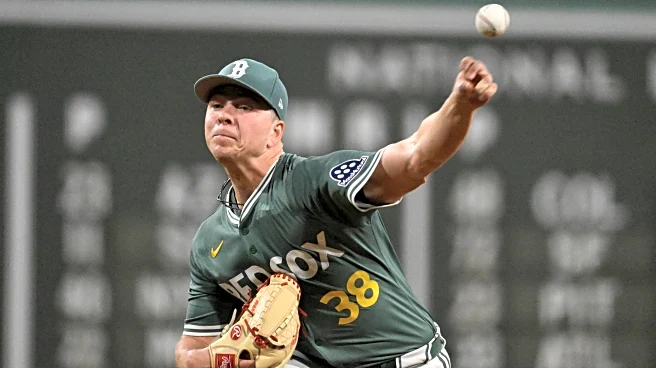
Harrison, in my opinion, is the crown jewel of the deal. I have an article coming on why Brandon Sproat will be the next Brewers’ “pitching lab” success story, but that label could also very well apply to Harrison.
San Francisco picked Harrison in the third round of the 2020 draft, signing him away from his commitment to UCLA. Per Paul’s article from yesterday morning, Harrison “was ranked as a top 25 prospect in the league prior to the 2024 season by both Baseball America and MLB Pipeline” and was one of the main pieces (if not the main piece) in the deal that sent Rafael Devers to the Bay Area.
While Harrison’s stats as a major leaguer aren’t half bad (4.04 ERA last year), there’s reason to believe that he has yet to unlock his full potential. His best pitch is his fastball, which has been pretty great so far in his time as a major leaguer. Opponents hit .195 with a .310 slugging percentage against his fastball in 2025. He doesn’t throw all that hard (although he sometimes touches 96-97 mph), but his fastball plays up due to above-average vertical movement from a low three-quarters arm slot. Lower arm angles also generally produce lower vertical approach angles, which is something the Brewers have been looking for in their pitchers.
Harrison’s other pitches are still mostly question marks. He threw his fastball nearly 60% of the time last year. His second- and third-most commonly used pitches were his slurve (27.4% of the time) and changeup (8%). Per a scouting report from SoxProspects.com, Harrison added a cutter and sinker while with the Red Sox. While the cutter shows “potential playing off of his fastball,” he barely threw either pitch in 2025 (3.7% and 2.0% respectively) so there’s not a lot to analyze there.
According to that same scouting report (published around the time of the Devers trade), the Red Sox “tweaked his slurve” upon joining the organization — perhaps explaining why he threw it over a quarter of the time last season. When his slurve is on, it looks good, but it was fairly inconsistent — as shown by the stats. Opponents hit .333 against the pitch in 2025 (.639 slugging percentage).
To put everything above more succinctly: Harrison has one great pitch (his fastball), a second offering that the Red Sox thought would be serviceable with some tweaks (his slurve), and a couple other pitches that are pretty much unknowns. This fits the profile of a number of pitchers acquired by Milwaukee in recent years (most recently Ángel Zerpa). The acquisition of Harrison probably means that the Brewers “pitching lab” thinks they can turn one of his secondary offerings into a second out-getter. Considering his prospect pedigree, already solid numbers as a big leaguer, and the Brewers’ track record of maximizing their pitching talent, I think Harrison’s ceiling as a Brewer is higher than some might think. Remember the reaction to the Quinn Priester trade?
Shane Drohan
The 27-year-old Drohan had a great season last year after a few rough seasons in the minors. He ranked 15th on Baseball America’s list of the top 30 Red Sox prospects. Drohan was originally a fifth rounder out of Florida State but stalled out and was eventually selected by the White Sox as a Rule 5 draft pick. Unfortunately, Drohan suffered a shoulder injury that necessitated nerve decompression surgery and ended up back with the Red Sox. After rejoining Boston’s organization, he proceeded to have his best season yet (2.27 ERA over 12 Triple-A appearances). Health is the main worry with Drohan at this point — he’s only thrown 70 1/3 innings since the end of the 2023 season.
Drohan’s arsenal is a little closer to Sproat’s than it is to Harrison, Zerpa, and other acquisitions that have one or two standout pitches and a couple offerings that need work. Drohan has four pitches that, per Baseball America, are “fringe-average.” Baseball America sees him as a “multi-inning reliever/spot starter who could bounce between Triple-A and the majors.” I’d be inclined to agree that he’s probably just a depth option, but maybe Milwaukee really likes one of his offerings and thinks that with a few tweaks he could be something more. Regardless, as last year’s pitching injuries made obvious, any contender needs a stable of arms who can show up when called on, eat innings, and get outs. If he turns into something more, that’s a bonus.
David Hamilton
The 28-year-old Hamilton is versatile, fast, and solid defensively. He was pressed into action due to injuries in 2024 and had a solid season (.248/.303/.395 in over 300 plate appearances). However, Hamilton came back down to earth last year, hitting under .200 as a part-time player.
Hamilton, in my opinion, projects as a utility infielder. It’s easy to see him playing the Monasterio role, picking up innings at a few different positions and providing somewhere around replacement-level offense. As in the case of Drohan, if he turns into anything more, that’s a bonus.