


When Daronte Jones was hired by the Commanders in January, fans were upbeat at the prospect of bringing a Brian Flores-style of defense to Washington. The thought was that Jones would install a similar scheme, one defined by simulated pressures, post-snap movement and relentless stress on the quarterback. Alignment versatility was to be the the hallmark of Washington’s new defense.
Adam Peters added a slew of free agents on the defensive side of the ball along with the Daronte Jones hire, including:
- Odafe Oweh (EDGE)
- K’Lavon Chaisson (EDGE)
- Leo Chenal (linebacker)
- Nick Cross (safety)
- Amik Robertson (corner)
- Tim Settle (defensive line)
- Charles Omenihu (defensive line)
The general manager doubled-down on his defensive additions in the 2026 NFL draft, adding linebacker Sonny Styles with the No. 7 overall pick and promising EDGE Joshua Josephs in the fifth round. Pinning their hopes for a revitalized secondary on the installation of a different scheme with more pressure up-front, fans were excited about the potential of the Washington Commanders defense in 2026.
Six weeks into the season, the reality has been a far cry from the one fans envisioned.
While it has held up against the run, Jones’ defense ranks 26th in total defense, 29th in passing and scoring defense, 25th in third-down defense, and dead last in red-zone defense. Meanwhile, the Vikings defense ranks second in total defense, third in passing defense, and first in scoring, third-down, and red zone defense. While no one expected the Commanders’ defense to rise to the same tier as the Vikings this season, the idea that Jones’ squad would be at the bottom of several critical rankings, including scoring defense, didn’t seem fathomable at the start of the season.
So where has Daronte Jones gone wrong thus far?
The answer, per usual, is complicated, but in this article we will explore some of the reasons why Jones’ defense has not lived up to the standard set by his mentor Brian Flores so far.
The defensive line isn’t generating pressure
The film and numbers from the first third of the season confirm that Jones is molding his defense in the shape of Brian Flores’ scheme instead of trying to install a completely different version. While not leading the league with a 66.5% blitz rate like the Vikings, Washington is still ranked third in blitz rate, bringing the heat 42.5% of the time. There is also plenty of pre-snap movement and alignment changes occurring under Daronte Jones’ direction.
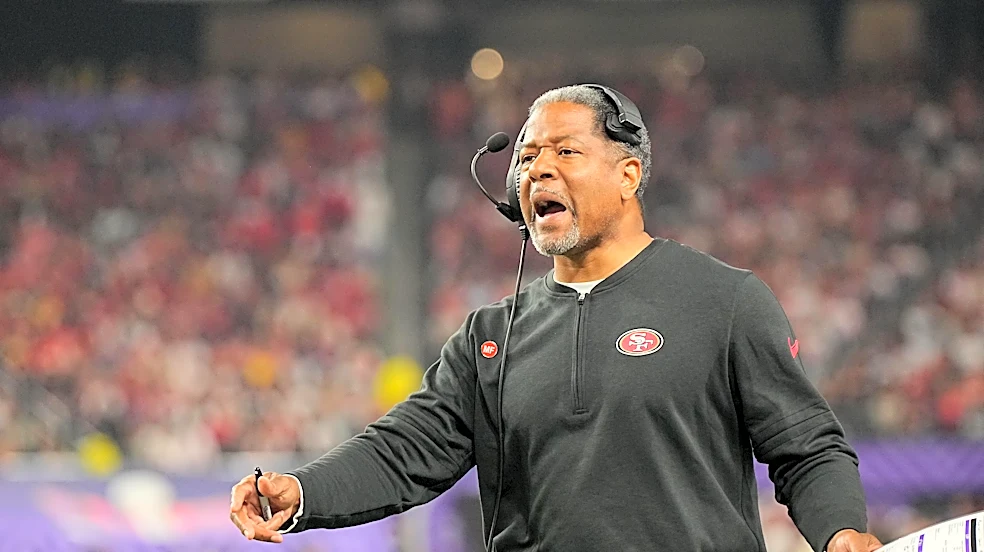
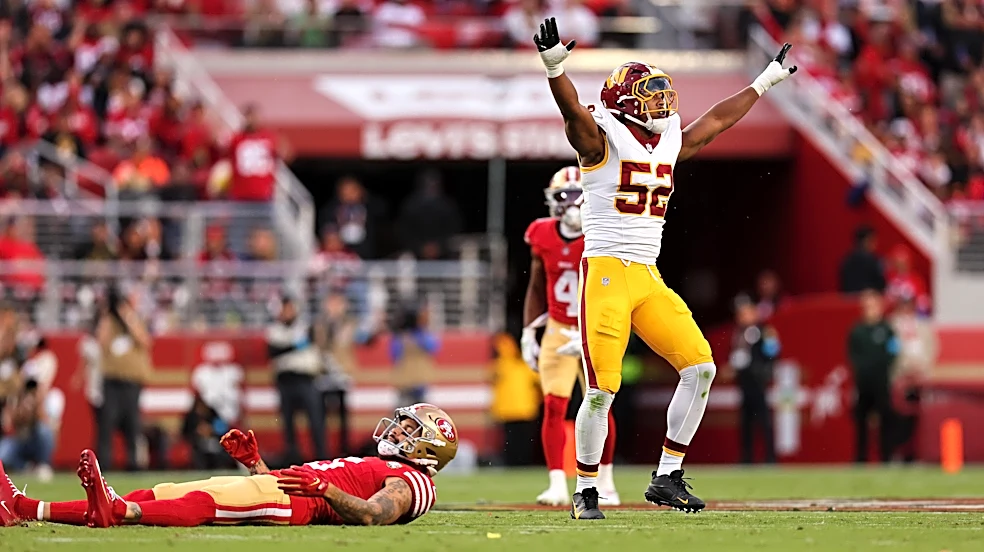
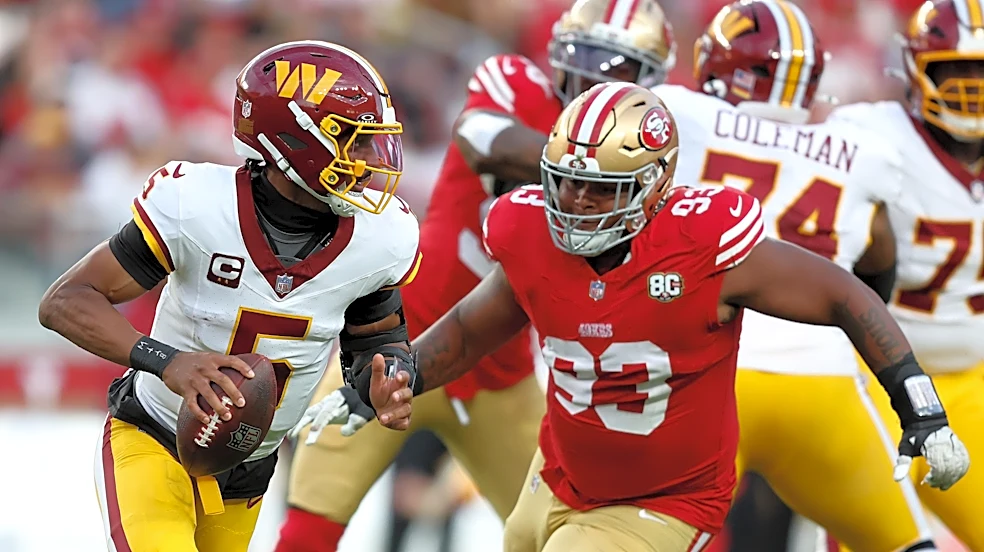
As you can see from the second graphic, the problem is not Jones deviating from the philosophy, but that it hasn’t been nearly as effective at generating pressure. Against the 49ers on Monday night, the defense brought the blitzon 41.2% of quarterback Brock Purdy’s dropbacks but only pressured the quarterback on 17.6% of those plays. These single game rates are a microcosm of the overall problem with the Commanders’ defense right now.
It is not just in blitz packages that Washington has struggled to generate pressure. Below you can see pass-rushing stats for the league through Week 6 courtesy of Sam Hoppen.
At the bottom of the chart you can see the Commanders rank fairly low with a pressure rate of 36.5%, and extremely poor in quick pressures with a rate of 14.5% on the season. Conversely, the Vikings rank at the top in pressures with a 48.6% rate, and extremely well in quick pressures with a 23.5% rate. The other thing to note is the non-blitz pressure rate between the two teams. The Vikings generate pressure 50% of the time in these situations, while the Commanders defense only does so 33.3% of the time.
The lack of pressure comes from several issues. The interior personnel are better in run defense than pass rush and the defensive line hasn’t been able to win their one-on-ones. Stunts and blitzes have not been coordinated, allowing opposing offenses an opportunity to exploit voids in the rush and coverage mismatches down the field. In addition, the disguises and simulated pressures aren’t working; many times the rushers are either being easily identified or players are still getting into position when the ball is snapped.
The secondary doesn’t have what Daronte Jones needs to run his scheme
Back in May, I wrote an article detailing the three things Daronte Jones would need in order to make his scheme work for the secondary. From that story:
It all sounds great, but how would Daronte Jones make it work for the Commanders in 2026? There are three keys for success.
The first, communication, has been an Achilles’ heel for the Washington secondary for as long as many of us care to remember. Joe Whitt Jr. and later Dan Quinn, tried to shift to several of these coverage schemes to fix the issues in the secondary, but communication errors resulted in continued coverage busts.
The second is tackling. While always important for any defense, the suggested coverages tend to funnel passing attempts to the flats and short parts of the field. Effective tackling can limit additional yards and help get the offense in 3rd-and-long situations and also create more opportunities for the quarterback to make a mistake.
Finally, you need versatile, high IQ players to execute the first two.
Unfortunately, Daronte Jones has none of the three.
Communication has once again been a talking point this season, and the coverage busts continue to happen despite changing the lineup several times. Washington’s defense has a missed tackle rate of 11.6% so far this season and after giving up multiple scores, Jones has simplified his defense.
Unfortunately, simplified coverage schemes mean less to decipher for the opposing offense. Another side effect is that Jones has chosen to run more Cover 0 behind some of his blitz schemes. While conceptually easier, Cover 0 is inherently difficult to run, as it leaves defensive backs on an island. The Commanders’ 7.3% Cover 0 rate is one of the highest in the NFL, and Jones’ defense has been burned on several occasions when they have chosen to run it.
At times it seems like Jones has let the opposing offense dictate his scheme instead of the other way around.
While part of the personnel issues in the secondary have come from injuries, the coaching staff (and front office) also failed to recognize several pieces that needed to be upgraded in the offseason. Mike Sainristil’s struggles have been well documented; the cornerback has effectively been benched at this point. Quan Martin continues to play too deep and linebacker Frankie Luvu is still a liability in coverage. Flores is known for using three-safety looks and it was thought that Jones would do the same. But in some games this season, Washington has looked like it couldn’t field one solid starter at the position, let alone three. On Monday night, Jones opted for more three linebacker looks, but with the loss of Leo Chenal and Jordan Magee just now returning, that means more Kain Medrano and Luvu in coverage.
How does Daronte Jones bring his defense up to the Brian Flores standard?
This is an unfair question. There is no way for Daronte Jones to make the current lineup on par with what we are seeing in Minnesota, especially in his first year in Washington. Part of Brian Flores’ success lies in placing the defensive play-calling in the hands of players that have four years of continuity in the system. One of Flores’ key veterans shared his thoughts on the subject in a recent article by the Athletic ‘s Alec Lewis:
“In my opinion, you couldn’t have remotely close to the same success with a first-year group,” linebacker Blake Cashman said. “You wouldn’t be in the same realm if you just threw together a bunch of guys who have never done what we do the way we do it.”
So far, this has proven to be the case for Daronte Jones, as the Commanders’ defense has done a poor job adapting to what they are seeing on the field. The goal for the remainder of the season should be to correct the coverage busts in the secondary, improve the tackling, and find a way to apply pressure. Improvement in the defensive statistics will naturally follow.
The return of Trey Amos and Nick Cross may provide an opportunity for Jones to shift the secondary lineup yet again, but this time it may be the best version we have seen so far. Amos split time with Rasul Douglas on Monday night, but as Trey gets back into game shape, he can play full time on the outside with Douglas as a sub on the opposite boundary. This would allow Amik Robertson to shift inside to the slot position at times, where he should be able to solve some of the issues in the middle. Nick Cross and Jeremy Reaves would play in two-high safety looks. Martin should go to the bench.
Up front, Jones should discontinue the delayed stunts and twists he is trying to deploy. In their place, the defensive coordinator could run simpler concepts and shift to more second-level blitzes as the Commanders used in the second half Monday night. Luvu in particular is adept at timing those plays, with the added benefit of having Frankie drop into coverage less. Here we see how effective they were at bringing Sonny Styles, and then Douglas, on the some of these concepts.
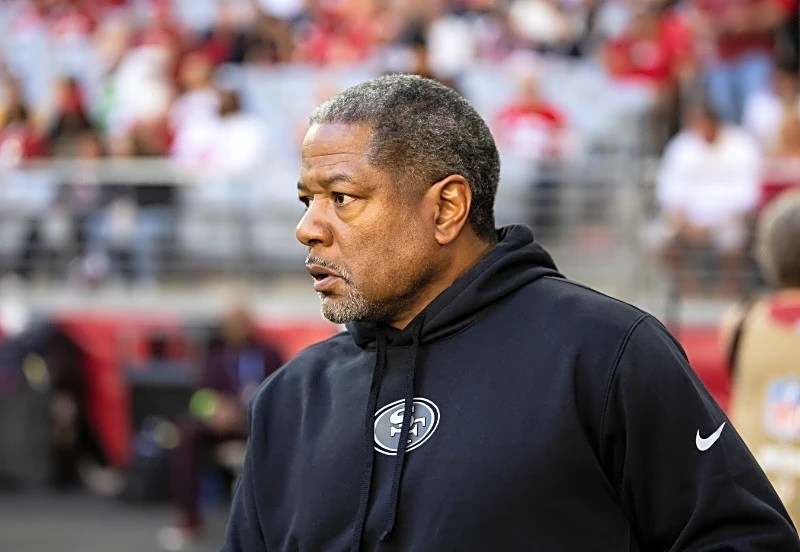
The recent addition of Steve Wilks to the defensive coaching staff adds another element to what Commanders fans will see after the bye week, but hopefully it will not include playing coverage behind a 4-man rush like it did in the first half versus San Francisco. The personnel in the secondary aren’t good enough to hold up in coverage, and the linemen up front aren’t good enough to win one-on-one battles on a consistent basis.
Jones will need continuity and additional personnel to effectively run the defensive scheme he envisions, but Daronte might end up not getting either one before his time as the Washington Commanders’ defensive coordinator is over.