
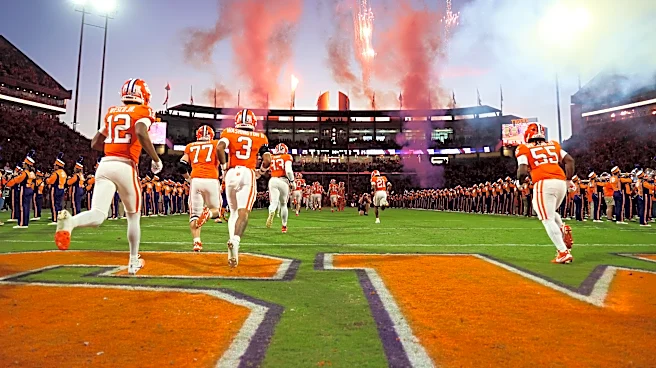
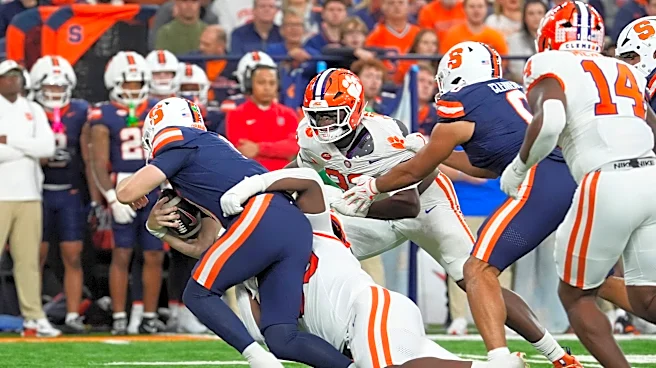
Clemson got out of Syracuse with a win, and at this point in the season, there is something to be said for that. But this was hardly a performance that should inspire much confidence. The offense continued to look disjointed, struggling to put together complete possessions and leaving far too much work for the defense. Fortunately, the defense was up to the task, creating disruption and doing enough to keep Syracuse from taking advantage. The Tigers will take the result, certainly, but the performance was another
reminder of just how much of a work in process this team is.
OVERALL OFFENSE: OFF 57.6 (second-lowest of the season)
- EPA/play: -0.07 (30th percentile)
- Success Rate: 32% (7th percentile)
- Yards/play: 6.10 (62nd percentile)
- 3rd Down: 31% (23rd percentile)
- Red Zone: 0% (3rd percentile)
– Below-average efficiency despite respectable yardage. Clemson averaged 6.10 yards per play, but a 32% success rate shows how rarely the offense consistently moved the chains. The -0.07 EPA/play was slightly below neutral, but the overall execution remained poor.
– Third down became a dead end. Clemson converted just 31% of its attempts. Early-down EPA/play was nearly neutral before dropping to -0.33 on late downs. The 13 pass attempts to just four rushes on late downs illustrate how often the offense was forced into difficult conversion situations.
– Red-zone production was nonexistent. Clemson went 0% in the red zone. Whatever yardage the offense managed to accumulate, it failed to turn those opportunities into points.
– Negative plays compounded the problem. Clemson surrendered three sacks and six tackles for loss. Those plays made an already inconsistent offense even less capable of sustaining drives.
– The turnover battle stayed even. Clemson gave the ball away twice, but the defense also forced two takeaways. The offense didn’t capitalize on that defensive help enough to make the game more comfortable.
– One of the season’s poorest offensive performances. The 57.6 OFF grade was the second-lowest of the year. The slightly negative EPA/play shouldn’t be mistaken for a catastrophic efficiency performance, but the success rate, red-zone failure and late-down struggles reveal an offense that still cannot execute consistently.
PASSING OFFENSE: PASS 64.6, RECV 56.6, PBLK 69.4
- EPA/dropback: -0.22 (21st percentile)
- Success Rate: 34%
- Explosive Pass Plays: 2
- Depth Of Target Split: 28% Deep, 17% Medium, 24% Short and 28% Behind LOS
– Poor passing efficiency. Clemson’s -0.22 EPA per dropback ranked in the 21st percentile. A 34% success rate reinforces the difficulty the Tigers had generating consistent production through the air.
– Very little explosive production. Clemson managed just two explosive pass plays (45% of the total). Without chunk gains to change the complexion of possessions, the passing game struggled to create momentum.
– Late-down effectiveness deteriorated. Passing success fell from 42% on early downs to just 23% on late downs. When Clemson needed a conversion, the passing game became considerably less effective.
– The PFF grades were ordinary, not encouraging. PASS 64.6 and PBLK 69.4 were generally around season averages, while RECV 56.6 was a weaker mark. None of the three grades suggests a particularly strong performance from its respective unit.
– No receiving touchdowns. Clemson failed again to get a receiving touchdown from its passing game. That certainly reflects the lack of finishing production, although the RECV grade also evaluates the receivers’ overall execution rather than simply whether they scored.
– Depth of Target distribution. The offense did a much better job at attempting passes throughout the full range. A notable change from earlier in the season where the largest portion was under 10 yards and behind the LOS
– The passing game remains unreliable. Poor EPA, limited explosive plays and declining late-down success left Clemson without a dependable way to move the chains.
RUSH OFFENSE: RUN 69.6, RBLK 44.5 (lowest of the season)
- EPA/rush: +0.10 (64th percentile)
- Yards/rush: 6.50
- Line Yards: 3.36 per carry
- Stopped Runs: 36% (10 of 28)
– Decent numbers floated by two big runs. The run game looked better than it actually was. Reynolds’ 20-yard run and Green’s 53-yard run accounted for 73 of Clemson’s 182 rushing yards, or 40% of the total. Without those two carries, Clemson averaged 4.19 yards on its remaining 26 attempts.
– Very little explosive production beyond those two plays. Just 2 of 28 carries (7.1%) went for explosive gains. More than a third of Clemson’s attempts gained two yards or fewer, making the overall 6.50 yards per carry misleading.
– The offensive line had its worst run-blocking performance of the season. The 44.5 RBLK grade was a season low. Only two linemen graded in the 60s, while the other three finished in the 50s or below.
– Production depended heavily on two players. Reynolds and Green combined for 160 of Clemson’s 182 rushing yards. That concentration of production is another indication that the running game lacked consistent execution across the offense.
– The overall rushing grade hides the blocking problem. RUN 69.6 was a respectable grade, but RBLK 44.5 tells a very different story. Individual efforts and a couple of long runs helped the overall numbers, but the line did not provide a dependable foundation.
OVERALL DEFENSE: DEF 75.7
- EPA/play allowed: -0.16 (17th percentile)
- Success Rate allowed: 38% (25th percentile)
- Yards/play allowed: 5.64 (50th percentile)
- Havoc Rate: 21% (81st percentile)
- Third Down: 35% allowed (31st percentile)
– Yardage allowed without corresponding efficiency. Syracuse ran 88 plays and accumulated 412 yards, averaging 5.64 yards per play. That’s considerable production, but the -0.16 EPA/play and 38% success rate show the Orange struggled to turn that volume into consistent offensive success.
– A disruptive performance. Clemson generated 15 havoc plays, including six tackles for loss and three sacks. The 21% havoc rate ranked in the 81st percentile and was one of the defense’s biggest strengths.
– Third-down defense limited Syracuse’s opportunities. The Orange converted just 35% of their third downs. Clemson did a good job preventing Syracuse from consistently extending drives despite the number of plays and yards it accumulated.
– The defense maintained its effectiveness throughout the game. Syracuse’s EPA/play was relatively consistent between early and late downs. Clemson wasn’t relying on one particular situation to limit the offense; it maintained a similar level of disruption and efficiency control across downs.
– The defense helped balance the turnover battle. Clemson forced two takeaways to match the offense’s two giveaways. Those stops were important contributions in a game where the offense struggled to generate points.
– A strong performance, but not a dominant one. The 75.7 DEF grade and 21% havoc rate reflect a productive afternoon. Still, allowing 412 yards means there is room to improve, even if Syracuse struggled to make those yards count.
PASS DEFENSE: COV 69.8, PRSH 72.3
- EPA/dropback allowed: -0.29 (15th percentile)
- Yards/dropback allowed: 5.56
- Explosive Play Rate allowed: 7%
- Sacks: 3
– Syracuse struggled to generate passing efficiency. The Orange attempted 43 passes and finished with 263 yards. The -0.29 EPA per dropback and 7% explosive-play rate show that Clemson generally kept the passing game from producing meaningful gains.
– The pass rush made an impact. Clemson recorded three sacks, contributing to the 15 total havoc plays. The 72.3 PRSH grade was one of the defense’s stronger position-group marks.
– Coverage was solid, not exceptional. The 69.8 COV grade was more modest than the pass-rush grade. Syracuse’s 59.8 PASS grade also reflects the difficulty the Orange had producing through the air, though the coverage unit still has room to improve.
– Tackling remains a concern. The 58.1 TACK grade was a weak point on an otherwise solid defensive performance. Clemson limited explosive passing production, but better finishing on individual plays would make the coverage results more convincing.
– The pass defense did its job. Syracuse accumulated passing yardage, but struggled to turn it into efficient or explosive production. The combination of pressure and limited chunk plays was an important part of Clemson’s defensive success.
RUSH DEFENSE: RDEF 77.3, TACK 58.1
- EPA/rush allowed: +0.04 (52nd percentile)
- Yards/rush allowed: 4.70
- Stuff Rate: 13%
- Stopped Runs: 33% (10 of 30)
- Line Yards: 3.36 per carry
– Syracuse had some yardage, but little consistent efficiency. The Orange finished with 141 yards on 30 carries, averaging 4.70 yards per attempt. Its +0.04 EPA/rush was close to neutral, suggesting a fairly ordinary rushing performance.
– Clemson disrupted a significant number of carries. Syracuse had 13% of its attempts stuffed, while another 33% gained two yards or fewer. The Tigers regularly forced the Orange into unproductive situations.
– A strong PFF grade for the run defense. Clemson’s 77.3 RDEF grade was one of its best defensive marks. The grade reflects a much stronger performance from the run-defense unit than the overall tackling grade might suggest.
– There was still room to finish plays better. Syracuse averaged 4.70 yards per carry, and the 3.36 line yards per carry shows the Orange found some room to operate. Clemson’s 58.1 TACK grade also points to missed opportunities to end plays more effectively.
– A strength, but not a shutdown performance. Clemson generally kept Syracuse’s rushing attack from becoming a consistent source of offense. The number of stopped runs and strong RDEF grade are encouraging, even if the yardage allowed wasn’t negligible.
FINAL ASSESSMENT
The defense gave Clemson a path to win by disrupting Syracuse and limiting its efficiency, but the offense made the game harder than it needed to be. The passing game lacked production, the running game relied heavily on two long plays, and the offensive line’s run blocking was a major concern. A win is a win, but the performance offered little reason to believe the offense has yet to solve any of its underlying problems.