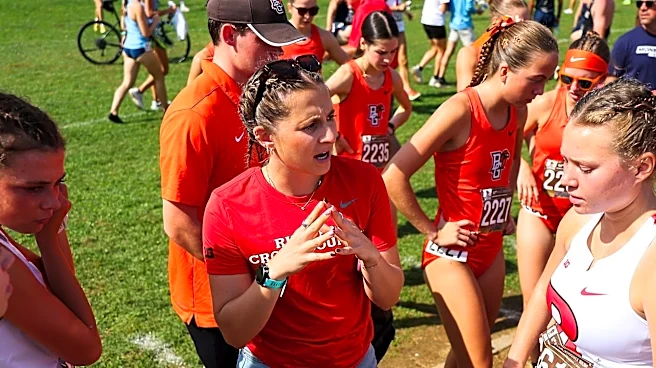







Both Rutgers teams ran the B races at the Nuttycombe Invitational on Friday, the undercard to the championship races on the Zimmer Championship Course in Madison, Wis., and both finished eighth. Micah Lawson led the men in 14th in 24:11.1. On the same course, that time would have placed him 144th of 232 in the men’s championship race.
That is the scale of the day, and it belongs up front. Lorena David’s 21:39.6 would have been 186th of 222 in the women’s championship race, and dropped into either
championship race, both Rutgers teams would have scored last. Inside the B races, the men scored 195 and placed eighth of 12 scoring teams, 42 points behind Colorado and 29 ahead of Nebraska, and the women scored 175 and placed eighth of nine, ahead of only host Wisconsin. Wake Forest won the men’s B race with 53 and Northern Arizona the women’s with 18, while New Mexico and West Virginia won the championship races.
The two teams got to eighth in opposite ways. The men put two runners in the top 21 and then waited 39.6 seconds for a third. The women had nobody inside the top 30 and all five scorers across the line in 32.4 seconds. One team had a front and no pack, the other a pack and no front.
Lawson Closes From 27th, Then a 39-Second Wait
Micah Lawson ran the smartest race of anyone in scarlet. He was 79th at 2K, four seconds off the front, then 31st at 4K and 27th at 6K. He covered the last 2,000 meters in 6:02.5, the sixth-fastest closing split of the 122 finishers, passed 13 runners doing it and finished 14th in 24:11.1.
Gavin Rossi, a junior, ran it the other way. He was 15th at 4K and 9.8 seconds clear of Lawson at 6K, then closed in 6:18.9 and finished 21st in 24:17.7.
Then nothing for 42 places.
Maan Patel, a junior from Monroe, came through 64th in 24:57.3, 39.6 seconds behind Rossi. Stephen Kyvelos, a junior from Manalapan, was 85th in 25:18.3, and Hisham Ettayebi was 86th in 25:18.4. Ettayebi was 71st at 6K and 19.6 seconds clear of Kyvelos. Kyvelos made up all of it, and a tenth more, over the last 2,000 meters. Sean Matthews (94th, 25:28.0) and Ryan Smith (105th, 25:48.9) displaced.
The math was 12-18-46-59-60 for 195, a team time of 2:04:02.8 and an average of 24:48.6, with a one-through-five spread of 1:07.4. Because three unattached runners and 13 programs without five finishers did not score, Lawson’s 14th was worth 12 points and Patel’s 64th was worth 46.
Washington and Michigan State tied for fifth at 129, and Rutgers’ first two outscored the first two of both. Its third through fifth then gave back 68 points to Washington and 76 to Michigan State. Just over 23 seconds apiece from Patel, Kyvelos and Ettayebi would have passed Colorado for seventh. Nebraska, which did not enter the men’s championship race, was ninth, and Minnesota 10th.
David also ran her race in reverse. She was 13th at 2K and 18th at 4K, then lost 16 places over the last 2,000 meters on a 7:37.6 closing split, the 76th-fastest in the race. O’Neil took 9.6 seconds out of her in that stretch.
The fifth-woman battle was not where the meet went. Condron’s 45 points beat Washington State’s fifth by one and trailed Michigan State’s by four. Had Domurat, Gleason and Condron each found 8.4 seconds, Rutgers passes both teams and finishes sixth. The women’s B race had 99 finishers and four DNFs, and host Wisconsin was ninth, 88 points behind Rutgers.
A Front With No Pack, a Pack With No Front
I noted after Paul Short that the men did not yet have depth to lean on when someone was missing, and that the women’s result was the more durable of the two.
Friday, Rutgers had bodies. Twelve men finished, Ettayebi was back from his DNF, and Patel and Kyvelos, two of the four men back from last November’s Mid-Atlantic Regional scoring group, scored for the first time this season. The hole behind the front two was still 39.6 seconds wide.
The full lineup showed up. So did the gap.
The women held to form, which is both the compliment and the complaint. The closest any of them came to the front Friday was David’s 13th at 2K, before she faded. Domurat, the Flemington product and Group 3 champion, scored third for Rutgers for the second straight meet, and three of the 14 runners in Rutgers’ two top sevens were freshmen, all of them women. On the men’s side, freshman Jay Adimala was Rutgers’ eighth man in 25:53.5, and Blake Sealy, who scored at Paul Short, was the last of 12 in 27:01.9.
The Big Ten results need the same honesty. Rutgers sent its top runners to the B races. Washington, Minnesota, Michigan State and Wisconsin sent theirs to the championship races and their reserves here, so the women lost to three Big Ten second teams and beat a fourth, and the men’s win over Minnesota came against reserves as well. Northern Arizona’s B women, whose varsity was third in the championship race, averaged 1:15.8 per runner faster than Rutgers.
Rutgers runs the Princeton Fall Classic on Oct. 16 and comes back to this course on Oct. 30 for the Big Ten Championships, where every program in the conference brings the varsity it kept out of Friday’s B races. What Friday taught about Zimmer is that the last 2,000 meters is where the places move. Lawson gained 13 there, David lost 16 and Kyvelos found 19.7 seconds on a teammate in the same stretch.
The men need a third runner who can stay within 20 seconds of Rossi, and the women need one who can stay near the front.
Neither showed up Friday.
Eighth twice is a real result, and Lawson’s last 2K was among the six fastest in his race. It still came one tier below the field Rutgers will see on Oct. 30, and there are three weeks to close that distance.