

Can you believe we’ve reached the last weekend of the regular season?
Filling in for Anne Rogers, Jackson Stone at MLB.com writes about Denny:
Matthews will be honored for his one-of-a-kind career on the television broadcast, as well as a special moment on the field, during Friday’s game in recognition of the achievement. But don’t worry, Matthews is planning to return for his 59th season in 2027.
“There’s so many reasons why I am still in Kansas City and the biggest reason is, I’m going to say organization
but that doesn’t mean a lot, because organizations are people. And the reason that I’ve been around this long is because of the people I’ve associated with,” Matthews said.
At The Star, Vahe Gregorian also profiles Denny Matthews:
But across seven different decades, the 83-year-old went from being one of 250 applicants for the job to one in a zillion at his craft as the last of the original Royals. And still an original in every way.
For context, consider that only four announcers in MLB history (led by Vin Scully’s 67 years with the Dodgers dating back to their Brooklyn days) have broadcast for the same team for at least 50 seasons.
That’s a milestone Matthews surpassed years ago, but that will be celebrated anew Friday at Kauffman Stadium as he broadcasts his 8,000th Royals game.
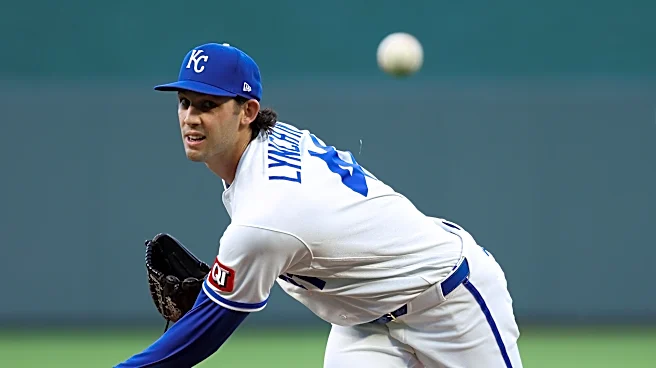
Jaylon Thompson covered the more competitive game on the field yesterday:
He also looked at James McArthur’s chances to return:
“I’m happy that I’m not having fluid and I’m happy that I could throw in some games,” McArthur said. “Wish I had more time and more season left to play. It’s unfortunate that the way it’s all timed out. I don’t get to go much more. But yeah, I’m feeling good.”
Tuesday’s return to Kauffman Stadium made it all worth it. McArthur won’t pitch for the Royals this season. However, he is set up for a healthy offseason and will get a chance to regain his bullpen spot next spring.
“He put a big smile on my face,” Royals manager Matt Quatraro said. “I couldn’t be happier for anybody from what he’s gone through these last couple of years. And the way he’s worked and dealt with it with grace and dignity and, you know, poise. I mean, he’s gone through a lot physically and mentally. And for him to get back out and pitch in competitive games, I couldn’t feel better for anybody.”
Last story at The Star for this busy day. Chris Higgins and Dylan Lysen look at the map for the TIF plan for the new stadium:
The boundaries for the proposed stadium impact area for the Royals stadium would be much smaller than the preliminary boundaries shown for a tax district supporting the future new Chiefs stadium in Kansas.
The final boundaries for the Chiefs project are not yet clear, but an early map from last year showed the district covering large portions of Wyandotte and Johnson counties. The TIF plan’s projections show the stadium area would generate a total of $382 million for redirection over a 30-year period.
That economic activity revenue is not projected to be enough to cover the city’s total bond obligations on its own. But the plan noted the expected $710.3 million to be generated from the previously undefined “stadium impact area.” Other revenues include $259 million from city funds generated by restaurant and gaming taxes, on-street parking revenues and property taxes, among other sources.
Well, that’s promising!
Yay, symmetry?
This is kindof Kansas City related, considering how Royals players took the WBC by storm, so I’m including it up here. Over at Fangraphs, Dan Szymborski (Szymborski! Szymborski!)examines whether players in the World Baseball Classic actually underperformed, as the narrative goes:
So, what does this mean? At least from the data we have, there’s little reason to believe that playing in the World Baseball Classic has a negative effect on a player’s regular-season performance, as a general rule*. This is a good thing for baseball, as the WBC is a great showcase of the game to an international audience, and I hope that it continues to spread baseball to countries not known traditionally for being into the sport.
Note there’s an asterisk in that last paragraph, and it’s an important one. This is an examination of the effect on a macro level. Humans are complex animals, and it’s very possible that there are some players who may see a negative effect from replacing their low-key spring training with an international tournament. For that reason, players should think long and hard about how their participating might affect their regular-season preparation. Still, this study should provide some encouragement for players who want to compete in the WBC, and some reassurance for teams and fans who would otherwise be concerned.
Blog Time? How about a roundup?
- Mike Gillespie at Royals Keep: Why The Royals Could Be Ready For A New Center Fielder
- Brian Sparks at Kansas City Royals on SI: Daniel Lynch IV’s Future Is Clear After Struggles in Royals Starting Rotation
- Darin Watson at U.L.’s Toothpick: This Date In Royals History–1976 Edition: September 24 – It takes 14 innings, but the Royals finally come up with the big hit they need for a crucial win over Texas
I wouldn’t normally stack two sets of movie reviews in a month, but you’ll get in a moment how these are a bit time-sensitive, and it had been months since we did our last movie reviews.
Our son has reached the point where he’s really excited to watch the Marvel Cinematic Universe. And I’m happy to go back through them. Still not sure how we’re going to watch Deadpool & Wolverine, but that’s a problem to tackle after we watch the first 33 movies of the MCU. And, really, there will probably be more movies before that. We’ll gladly watch the three Raimi Spider-Man movies and reluctantly watch the Amazing Spider-Man movies before No Way Home. At some point, when it’s multiverse-appropriate, we’ll work in at least the first five X-Men movies, maybe all 7, but probably not the Wolverine trilogy (Logan is awesome, but not age-appropriate) or the first two Deadpools. Probably not watching the Blade trilogy, old Fantastic Four movies, or Elektra just for their references in Deadpool & Wolverine. We will probably even sneak in a couple of the better Disney+ shows like WandaVision, Loki, maybe Falcon & Winter Soldier, and probably Hawkeye for fun.
I’m happy to get some refreshers ahead of Avengers: Doomsday this holiday season and maybe we’ll get him all caught up in time to go share Avengers: Secret Wars with him in theaters next Christmas. It’s topical this weekend as Avengers: Endgame Encore is in theaters this weekend. Sadly, we’re only partway through Phase Two or it would have been fun to watch it with him in theaters. I don’t think I’ll be heading to a theater this weekend just to watch the four minutes of extra credit cookies. Now if it were a replay of Infinity War… we’re getting ahead of ourselves.
The long and short is that over the next year plus, we’ll be re-watching the entire MCU. I’ll be posting them by Phases and we’re starting today with Phase One. I promise they won’t be the only movie reviews between now and next December, but there will be a decent chunk of them.
Iron Man (2008)
It is still curious that they started the MCU with Iron Man instead of Captain America or The Incredible Hulk. Also, I had forgotten that this was a Paramount movie, not Disney. Disney didn’t buy Marvel Studios until 2009 and didn’t distribute any of the movies until 2012’s The Avengers. It’s a little strange not seeing the Disney logo on the first five movies. The film’s whole “Filming” section in Wikipedia has so many little interesting tidbits like how much of the dialogue was improvised as the script wasn’t finished before filming or the deals cut between the Department of Defense and filmmakers about various aspects of the movies.
In the end, it still really works. The first half of the movie is an unsubtle critique of post-9/11 America. The second half, a redemption story with our main character trying to make up for his past wrongs when he realized the world is more complicated than he thought it was. Terrence Howard, Jeff Bridges, and Gwyneth Paltrow are all good (even if Howard is replaced after this movie). Of course, Robert Downey Jr. steals the show and grows into the MCU’s most bankable star. The movie has good pacing and it looks have mostly aged well as there was a reliance on practical effects rather than mediocre CGI. In all, the movie is a sturdy foundation upon which to build the MCU. Heck, one of the weaknesses of the early MCU was that it was easily the best movie and that nothing else had surpassed it, even as the universe had grown.
Tier: A (I was originally going to call this “Grade” like in school, but we’re not getting into plusses or minuses so we’re just going to tier them off instead)
Incredible Hulk (2008)
Unfortunately, the other Marvel movie of 2008 did not live up to expectations. The New York Times called it “The Adequate Hulk” and that’s a fair description. It’s not bad, per se, but it’s definitely a mixed bag. Because of the negative reception towards Ang Lee’s Hulk in 2003, this was a reboot rather than another origin story. At some point in Phase 2 or 3, Disney perfects their “comic book movie that’s part of a greater whole” formula. But at this point in the MCU, we still have some comic book movies that pretend to be real movies. This is not one of them. The first act sets up the Hulk and the second act plods along. But this movie is always building toward the climactic battle between CGI Hulk and CGI Abomination. Ed Norton slogs his way through a mediocre script, William Hurt’s Thunderbolt Ross isn’t his best work, and Liv Tyler… was in the movie. Tim Blake Nelson’s mad scientist Samuel Sterns breathes some life into his scenes and Tim Roth does what he can. The fight scenes look good and have to carry us on through to better movies.
Tier: D
Iron Man 2 (2010)
I’m not sure the original design was to have two of the first three MCU movies be Iron Man movies. But, after the success of the first, Hollywood was going to Hollywood. A friend of mine observed “most Marvel 2s were wasted” and he’s not wrong. Not a lot happens in this movie: it’s a toned-down version of the “Demon in a Bottle” storyline mixed with Iron Man battling Whiplash and Tony Stark battling Justin Hammer. This is the only movie in Phase One that exhibits the excesses that plague a fair number of Phase Two and Phase Three movies. Vestigial plots only lightly related to the current movie steal valuable screen time minutes to service the greater whole of the franchise.
The strongest parts of the movie are Tony Stark dealing with his trauma. This movie hits hard at the big core difference between Marvel and DC: Marvel heroes are flawed humans. Oh, and the battle scenes. My son found the first two acts hard to follow but enjoyed the third-act robot battle. Scarlett Johansson’s Black Widow gets a nice introduction, Don Cheadle replaces Terrence Howard in a somewhat reduced role as James Rhodes, and SHIELD gets more backstory. The satire is still laid on thick, but “it’s not as fresh as the first” and that phrase could be said about a lot of the movie. It’s somewhat forgettable but necessary to move things along; we don’t really get anywhere, we’re just in transit.
Tier: C
Thor (2011)
I love the idea here. Iron Man movies are sleek, modern technical thrillers and cautionary tales, weighted with backstory and character angst. Captain America movies are rough-and-tumble action movies with a Boy Scout dishing out black-and-white morality. Hulk movies are… well, I’m guessing they didn’t expect there to be only one Hulk movie. Thor movies are bombastic mythology with a fish-out-of-water, Spock-like alien main character reflecting on humanity’s foibles. Who better to direct than Mr. Shakespeare, the award-collecting and knighted Sir Kenneth Branagh? You can see what Kevin Feige was thinking. It’s a good formula and it’s a shame they didn’t stick to it because Thor movies get untethered after the first.
The Earthly exile and romance is generic and boring, but this pulpy science fiction movie is elevated when it attempts to be a space opera. It often succeeds, mainly on the strength of its cast. This is the movie that launched Chris Hemsworth and Tom Hiddleston to stardom. Anthony Hopkins, Rene Russo, Idris Elba, Stellan Skarsgård, and Natalie Portman lend a more “classical” flavor. Until rewatch, I had forgotten that this movie was Jeremy Renner’s Hawkeye debut. I really enjoyed most of this movie, I like it more than most, and I really don’t like what they did to Thor going forward.
Tier: B
Captain America: The First Avenger (2011)
This is a thoroughly enjoyable movie. This movie feels paint-by-numbers, but, in this case, I mean that as a compliment. It does what it’s supposed to do, when it’s supposed to, and how it’s supposed to. Chris Evans’s Steve Rogers is the ultimate underdog. He fights Nazis, especially a division led by a bad guy who literally has a red skull (played by Hugo Weaving). He’s a super likeable Boy Scout who falls for the right girl in Agent Carter (Hayley Atwell) and sacrifices himself.
Director Joe Johnston borrows some of the look and feel from his 1991 film The Rocketeer and it fits. The connective tissue to the broader MCU isn’t too obtrusive: more about the Tesseract we saw in Thor, more about Howard Stark, and the introduction of Vibranium. It’s not ambitious at all – it’s terribly safe, but it’s a fun safe
Tier: B
The Avengers (2012)
I found this review much more difficult than all the others. I’m not a big Joss Whedon fan and I really didn’t care for the Avengers originally. It’s not that it was bad – it just wasn’t up to my expectations. It’s a lot to live up to: Six Avengers and Nick Fury against Loki and an alien army. Originally, I felt like Avengers cribbed a lot from Thor. But, upon rewatch of both, I found that a bit reductive, as Thor’s Loki had more going on and it was Avengers that veered more into cliché. It also was one of four major movies that did the “bad guy gets captured as part of his plan” that was all the rage in the late 2000s/early 2010s. I’m still not sure what that said about the zeitgeist, particularly since Loki’s capture didn’t further his plan.
Quick aside: I want to take a minute to link to Matt’s article from 2016 about how the MCU doesn’t have leitmotifs. Iron Man gets one and we get little bits of it sprinkled into Iron Man 2. But all three Iron Man movies are by different composers, so there’s very little continuity. Imagine how awesome the soundtrack for The Avengers would be if Alan Silvestri had to weave together the themes of all of the heroes? How about Infinity War and Endgame? I’m a little sad at the missed opportunity.
All that said, Avengers has an almost impossible task and mostly succeeds, even sticking the landing, while collecting lots of degree-of-difficulty points. It’s a slick, modern action movie that mostly mixes the tones and styles of the different movies and characters. Yes, it comes in at 143 minutes, but that’s not very bloated, considering how much ground had to be covered. The movie starts at a sprint; S.H.I.E.L.D. elevates the stakes; Phil Coulson’s plot humanizes the endeavor; and then Act Three delivers the fight scenes everyone wanted to see.
The ensemble cast delivers. Sure, we get our big three stars: Iron Man, Captain America, and Thor. Mark Ruffalo’s replacement Bruce Banner and Hulk are so good that he’s been featured in a lots of crossovers going forward. More Black Widow, Hawkeye, and Nick Fury are always welcome. Tom Hiddleston’s Loki chews the scenery, even if his dialog in this one is clunky. While it’s not quite my cup of tea, this movie was the standard bearer that elevated the franchise and gave a glimpse of what was to come.
Tier: A – I originally had this as a B for its faults, but talked myself into an A due to its ambition
Overall: Phase One starts off with one of the best movies in the entire franchise before thudding with Hulk. If you had told people in 2008 that the MCU would start off with Hulk and Iron Man and one would be an A and the other a D, most would have swapped the scores. It then drops a couple of solid Tier B and C movies to establish a baseline. Then it’s closed out by Avengers, which raised the bar for the MCU to a point that couldn’t be met until Phase Three.
As mentioned above, we’re lacking in leitmotifs. However, there’s one big one and the Avengers Assemble scene with the Avengers theme song is quality: