


Every few years a new pitch makes its way from obscurity to “all the rage” status. I remember when the forkball became a thing and it’s probably the only reason I remember who Fred Breining is. Then came the “Humm Baby” era of the splitter, followed by the cut fastball that morphed its name into the “cutter”.
I don’t know if the “sweeper” qualifies as the most recent addition or if, like the “slurve,” it’s more of an amalgamation of already existing pitches, but certainly its designation as a pitch is a new
phenomenon. But it may no longer be the latest.
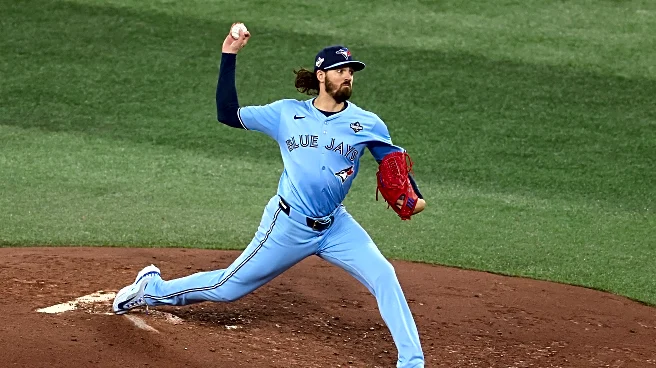
Enter the “kick change”. I have yet to hear widely about the kick change but I have a feeling we’re about to. The Toronto Blue Jays have cornered the market so far on much of the conversation, with Kevin Gausman and now KBO returnee Cody Ponce identifying the pitch as a key part of their arsenal. Reportedly, Clay Holmes, Andres Muñoz, and Jack Leiter are among other pitchers currently utilizing the pitch.
The “kick change” is a type of changeup. How does it differ from the ‘mom and pop’ changeup prominently showcased by many pitchers including the A’s own Jeffrey Springs? Here is our leading expert, Mr. Google AI, to explain:
What Is A “Kick Change”?
A kick change in baseball is a modified changeup with a grip that allows the pitcher to “kick” the ball’s axis at release, creating a pitch that has the velocity of a hard slider but the movement of a splitter, with significant downward depth. Unlike a traditional changeup, which often relies on armside fade, a kick change focuses on creating more vertical break. The unique movement is achieved by spiking one finger up on the seam, which alters the spin axis as the ball is released.
If you’re interested in learning more about the nuances of the kick change, Mr. AI is happy to oblige:
Key characteristics of the kick change
- Grip: Involves a spiked middle finger that presses into the seam, unlike a traditional changeup where fingers are typically flat on the ball.
- Movement: Generates less armside run than a traditional changeup, but with more downward depth, similar to a splitter.
- Velocity: Thrown with higher velocity than a traditional changeup, often maintaining a speed difference of only 8-10 mph from the fastball.
- Purpose: Creates a unique movement profile for pitchers who may have difficulty getting a changeup to break effectively, especially for those with a more supinated or “cut” release style.
How it works
- The middle finger “kicks” the ball’s spin axis forward and down upon release, creating the downward movement.
- The ring finger still works around the ball to cut down spin efficiency, producing the desired tumble and depth.
- The result is a pitch that can have both horizontal and vertical movement, making it difficult for hitters to square up.
Blogfather’s Summary
The tl;dr version is that with its unique “spiked middle finger” grip, the kick change is designed to have the velocity of a slider and the downward break of a splitter. This is reminiscent of the actual sliders thrown by two very good A’s relievers in the past, Michael Wuertz and Liam Hendriks, whose high velo sliders had a lot of “splitter” dive.
The Future Of The Pitch?
The question, as with any new addition, is whether we are looking at a new trend or a passing fancy. Certainly there are umpteen pitchers, many of them in the A’s organization, whose careers could be transformed if they took their current arsenal and were able to incorporate an effective “kick change” — but adding any new pitch, or even a new grip on an existing pitch, is far easier said than done.
When I go down to spring training mid-March, I intend to try to connect with A’s pitching coach Scott Emerson to talk about many topics including learning more about the “kick change” and to what extent it is in the A’s minds right now. I have a feeling we will be hearing more and more about it in the coming months.
Your thoughts?