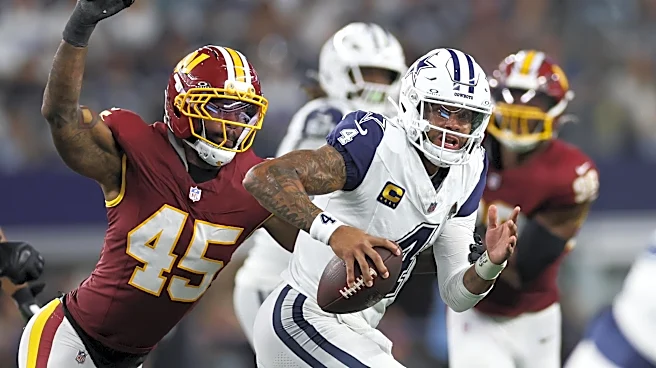


The Commanders were always going to go as far as Jayden Daniels took them this season. On the final play of the first half, Daniels re-aggravated the elbow dislocation he suffered last season. At the time of this writing, the prognosis is unknown. He could miss anywhere from three weeks to the rest of the season.
The speed of Daniels’ recovery and return to play will likely set the limit on the Commanders’ season outlook. That is all up in the air right now.
While Daniels’ injury was a disaster, and
the play on both sides of the ball left plenty of room for improvement, it wasn’t all bad.
On the positive side, Washington’s offense ranked second in the league in rushing average in Week 2, at 5.7 yards/attempt; while the run defense held the Cowboys to just 3.1 yards/attempt, tied for 8th lowest in the league.
The Commanders’ rushing attack made 4 explosive runs (>10 yds), putting them in a 4-way tie for 4th in the league. While the defense held Dallas to just 1 explosive run, putting them in a 5-way tie for last place.
On the not so positive side, the Commanders averaged just 5.9 net yards per pass attempt on offense (rank 20th); while the defense allowed Dak Prescott to average 8.1 net yards per attempt (rank 5th).
Washington’s pass defense conceded 4 explosive plays (completions > 20 yds), which put them in a 7 way tie for 9th most in Week 2. Meanwhile, the offense made 3 of their own, which put them in a 4 way tie for 16th place.
As of Week 3, the Commanders are hovering at league average in offensive efficiency (weighted EPA/play) and have sunk to a little below average in defensive efficiency:

Graphic courtesy of RBSDM.com
Can Daronte Jones make the adjustments needed on defense to keep the team competitive, while Marcus Mariota buys them time at QB?
It will be a challenge. But there were some glimmers of hope in Week 2, including solid play from Mariota, and standout performances by RB Rachaad White, RT Josh Conerly Jr, OLB K’Lavon Chaisson, and DT Javon Kinlaw, as well as flashes from a few others, including rookie WR Antonio Williams, veteran WR Dyami Brown, LT Brandon Coleman and CB Amik Robertson.
Now, let’s take a look at how the Commanders’ individual players fared in the Week 2 road loss to the Dallas Cowboys.
Technicalities: Last season I began listing advanced stats from both Pro Football Focus (PFF) and Pro Football Reference (PFR) to give readers alternative perspectives and to raise awareness of the variability of advanced stats between observers. This has resulted in some cluttering of the narrative and left readers wondering what to believe when the two stats services give varying accounts. Starting this week, I will make an effort to reduce the clutter by emphasizing consensus of stats which can differ as a result of judgement calls (e.g coverage yardage, broken tackles) and by picking a preferred source in cases where advanced stats from different sources are scored differently, making them not comparable (e.g. pressure counts, yards before contact). As always, official NFL stats trump those from PFF and PFR, right or wrong.
OFFENSE

Prior to his game ending injury, on the last play of the first half, Jayden Daniels played an efficient game at QB, completing 11/17 (64.7%, ADOT 11.1 yds ) passes for 96 yds and 1 TD, with 1 throw-away and 1 dropped by the receiver.
He also ran 7 times (6 scrambles) for 79 yds (9.9 Y/A) with a long of 20.
Jayden’s 70.7 total QBR ranked 14th among starting QBs in Week 2.
Marcus Mariota’s passing game in the second half was even more efficient than the injured starter he replaced. The Commander’s backup QB completed 11/16 passes (68.8%, ADOT 12.4 yds) for 111 yds and 1 TD, with no throw aways or drops.
Mariota was less of a threat on the ground, with just 1 carry for 3 yds.
His effort earned an impressive 84.0 total QBR.

Yardage before contact and broken tackle figures were sourced from Pro Football Reference.
After a tenuous start in Week 1, Rachaad White stepped it up against Dallas, leading Commanders’ backs in with 43 yards and 4 first downs on 7 carries (6.1 Y/A), with 2 broken tackles. White’s 85.7% rushing success rate was the second highest among RBs in Week 2, after Derrick Henry (87.5%, min 5 att.).
White averaged 3.4 yards before contact/attempt, which is better than the 90th percentile based on 2025 season stats.
White also led the team with 6 receptions (100% rec rate), and was third in receiving total at 40 yds. He was the Commanders’ second most productive receiver at a respectable 1.74 Y/RR.
Jacory Croskey-Merritt had the same total yardage as White, but it took him 12 carries to get there. His rushing average (3.6 Y/A) was the lowest among the RBs. Running behind the same blockers as White, Bill averaged just 2.0 YBC/att, a little below the 2025 NFL average.
Bill caught his only passing target for a 5 yard reception.
Kaytron Allen had 5 rushing attempts for 24 yards (4.8 Y/A).

Terry McLaurin caught 2 of 9 targets (22.2%) for 50 yds at an ADOT of 13.7 yds, with 1 drop. He was the Commanders’ third most productive receiver at 1.47 Y/RR. However, he had the lowest receiving success rate at just 22.2%. Terry was also flagged for a questionable 9 yard offensive pass interference penalty in the first quarter.
Stefon Diggs picked up where he left off in the fourth quarter in Philadelphia. Playing primarily in the slot, he caught 5/6 targets (83.3%) for 47 yds at an ADOT of 12.0 yds, and was 2/2 on contested targets. He was the Commanders’ most productive receiver at 2.04 Y/RR. His 83.3% receiving success rate might lead the team in many games, but was only fifth best on Sunday.
Antonio Williams played a nearly equal mix of snaps in the slot and wide out. He caught 3/3 targets for 24 yds at an ADOT of 5.3 yds. Through his first 2 NFL games, he is 7/7 for 88 yds and a TD, with a 100% receiving success rate. Williams also attempted 1 pass for an incompletion.
Dyami Brown caught 4/6 targets (66.6%) for 21 yds at an ADOT of 3.2 yds, with 1 drop. He seemed to be robbed of a 35 yd TD reception by a bad call by the officials:
https://x.com/CorneliusDGNTV/status/2101798491764744367?ref_src=twsrc%5Etfw%7Ctwcamp%5Etweetembed%7Ctwterm%5E2101798491764744367%7Ctwgr%5Ec41fe98bf5d1519e49b9f151c1961d44b641fa04%7Ctwcon%5Es1_&ref_url=https%3A%2F%2Fcommanderswire.usatoday.com%2Fstory%2Fsports%2Fnfl%2Fcommanders%2F2026%2F09%2F21%2Fcommanders-cowboys-twitter-reacts-to-terrible-call%2F91868167007%2F
Had that TD been credited to him, he would have been the Commanders’ leading receiver.
Brown lost a fumble, forced by Jaishawn Barham, in the 3rd quarter. He also completed 1 pass for 0 yds.
Treylon Burks did not catch his lone target. Jaylin Lane was not targeted.

Despite getting the fewest snaps, Colson Yankoff led the tight end group in receiving yardage for the first time in his pro career, as the result of catching his lone target for a 14 yard reception.
Ben Sinnott was not far behind at 1/1 for 6 yards. Sinnott also led the team in snaps at fullback.
None of the tight ends earned a PFF run blocking grade above 60, which is a little unusual (Yankoff 59.7, Bates 58.0, Sinnott 54.0).

Pressure counts and run blocking grades were sourced from Pro Football Focus.
Brandon Coleman left the game early with a finger injury. In 37 pressure opportunities (pass reps minus spikes and no-plays) he allowed 3 QB hurries. His 8.1% pressure rate in pass protection is a bottom quartile figure for starting OTs based on 2025 season stats. His 95.8 run blocking grade, on the other hand, led all NFL offensive linemen in Week 2 (min 20 blocking snaps).
Coleman was penalized 5 yards for being ineligible downfield.
Chris Paul allowed 0 pressures in 42 opportunities. His 48.2 run blocking grade was the second lowest on the team at any position.
Nick Allegretti allowed 1 hurry and 1 QB hit in pass protection. His 4.8% pressure rate is a bottom quartile figure for starting centers. His 46.7 run blocking grade was the lowest on the team.
Sam Cosmi left the game in the fourth quarter after suffering a concussion in a collision with Kaytron Allen. He allowed 0 pressures in pass protection. His 57.7 run blocking grade is low by his standards.
Josh Conerly allowed just 1 QB hurry in pass protection (2.8% pressure rate). His 81.1 run block grade was second highest on the team and ranked 10th among NFL offensive linemen in Week 2.
Andrew Wylie took over at LT when Coleman was injured and allowed 1 pressure in 6 blocking reps (16.7% pressure rate, 4.6 pass blocking grade).
Matt Gulbin filled took 3 snaps at RG and 1 at TE without incident when Sam Cosmi was injured.
DEFENSE

Pressure and stop counts were sourced from PFF. Missed tackles and coverage stats are by consensus of PFF and PFR. Other stats, including QB hits and sacks, are from the NFL gamebook.
K’Lavon Chaisson led the charge in the pass rush, recording 1 sack, 1 QB hit and 2 hurries. His 19% pressure rate is a top 10% figure based on 2025 stats. Chaisson also recorded 2 tackles, 1 assist, with 1 TFL (2 total stops) and 1 missed tackle.
He dropped into coverage 6 times (22.2% of pass plays). There was no consensus on his coverage stats.
Odafe Oweh registered 2 tackles with 1 run stop. In the pass rush he recorded 1 QB hit and 1 hurry (9.1% pressure rate). He dropped into coverage 3 times (12% of pass plays) without being targeted.
Dorance Armstrong made 3 tackles and 2 assists, with 2 run stops (22% run stop rate). In the pass rush, he recorded 1 QB hit (11.1% pressure rate). Armstrong dropped into coverage 6 times (40% of pass plays), but there was no consensus on his coverage stats.
Javontae Jean-Baptiste made 1 tackle and 1 assist, including 1 run stop. He did not generate pressure in just 5 pass rush snaps. He dropped into coverage twice (28.6%) and was targeted once, allowing a 7 yd reception.
Joshua Josephs kept a clean stat sheet in just 7 defensive snaps.

Javon Kinlaw was the most disruptive interior defender with 2 tackles, including 1 TFL/run stop, and 1 sack plus 1 QB hit in the pass rush. His 11.8% pressure rate is at the 90th percentile for iDL bases on 2025 season stats. Kinlaw had 1 missed tackle.
Daron Payne made 1 tackle and 1 assist, with 1 run stop. In the pass rush, he registered 1 QB hit and 1 hurry (9.1% pressure rate).
Charles Omenihu recorded 1 QB hit and 1 hurry in the pass rush (10.5% pressure rate). He also drew a 5 yard offside penalty in the first quarter.
Tim Settle recorded 2 tackles and 1 QB hurry. Shy Tuttle kept a clean stat sheet.

Sonny Styles made 3 tackle assists. He generated 1 hurry in 12 blitzes. His coverage stats varied between stats services. Accepting the worst numbers (PFF), he allowed 3 targets and receptions for 21 yds in 25 coverage snaps (0.84 Y/Cov Snp), which is not bad for a LB.
Leo Chenal led the team in most tackling categories with 6 tackles, 6 assists and 3 stops. He did not generate pressure in 5 blitzes. There was some disagreement in his coverage stats. The worst figures from PFF were 5/5 for 26 yds (1.04 Y/Cov Snp) and 1 TD reception by Jake Ferguson. PFR did not blame Chenal for the TD.

Amik Robertson continues to fly under the radar, which is generally a good thing in a CB. There was wide variance in his coverage stats this week, with PFF rating him in the shutdown range (0.59 Y/Cov Snp) and PFR rating him as leaky (1.32 Y/Cov Snp). There was consensus that he was responsible for Washington’s only two pass breakups in Week 2.
Robertson was second on the team with 5 tackles, and led the team with 3 stops, including 1 run stop. PFF credited him with 1 missed tackle, while PFR counted 2.
Mike Sainristil continued his poor start to the season. The stats services disagreed on his coverage stats, but the range was from bad (PFF 1.64 Y/Cov Snp) to atrocious (PFR 3.07 Y/Cov Snp). There was consensus that he gave up a 24 yd TD reception to CeeDee Lamb.
Sainristil made 3 tackles and 1 assist with no stops.
The stats services agreed that Rasul Douglas had a bad day in coverage, allowing 5 targets and 4 receptions for 52 yds in 18 coverage snaps (2.89 Y/Cov Snp).
Douglas made 1 tackle and 2 assists, contributing to 2 stops on passing plays.

Nick Cross moved around the secondary, and was the team’s primary slot defender. He made 3 tackles with 1 TFL. There was near consensus on his coverage stats, with PFF seeing 2 rec/2 tgt for 15 yds (0.48 Y/Cov Snp) and PFR seeing 1 rec/1 tgt for 10 yds. Both sets of figures are good, except for the consensus 3 yd TD reception conceded to CeeDee Lamb.
Jeremy Reaves was the primary free safety, which is an interesting choice for a player with a 1.4 RAS. Reaves made 3 tackles and 2 assists with 1 stop on a pass play. The stats services rated his coverage somewhat similarly, with PFF seeing 1 rec/1 tgt for 12 yds (0.37 Y/Cov Snp) and 1 TD, and PFR seeing 3 rec/3 tgt for 24 yds (0.75 Y/Cov Snp) and 2 TDs.
Reaves drew a 9 yard unnecessary roughness penalty in the second quarter for a helmet to helmet hit.
Quan Martin played predominantly at FS. He made 1 tackle and 1 assist. The stats services rated his coverage from average (PFR 1 rec/1 tgt for 23 yds, 1.0 Y/Cov Snp) to terrible (PFF 2 rec/2 tgt for 58 yds, 2.52 Y/Cov Snp).
SPECIAL TEAMS

Drew Stevens was 2/2 on extra points and 2/2 on field goal attempts below 50 yds. He missed 1 from 51 yds.
Jaylin Lane averaged 20 YPA on 6 kickoff returns with 0 fair catches. He returned 1 punt for 14 yds. His 13.4 Y/A punt return average is currently second in the league among players with 5 or more returns. Layne had a fumble forced by Caleb Downs on kickoff return, but was able to recover the ball.
Tress Way punted once for 47 yds, with a 9 yd return.

Ale Kaho led the team with 2 tackles in coverage, but also missed a tackle. Fabian Moreau made 1 tackle. Colson Yankoff made 1 tackle and missed one. Quan Martin chipped in 1 tackle assist. And Kain Medrano had 1 missed tackle.
For the second week in a row, there were no penalties on special teams.