


Art Fletcher had a long and distinguished major league career that spanned 14 years, racking up over 47 bWAR at shortstop in the process. But that is not enough to get Fletcher a feature in our Yankee Birthday series, considering none of those games involved him in pinstripes. It’s his post-playing days that get him that honor.
After hanging up his cleats in 1922, Fletcher moved from the infield to the dugout and began a coaching and managing career that lasted more than two decades. And he had the excellent
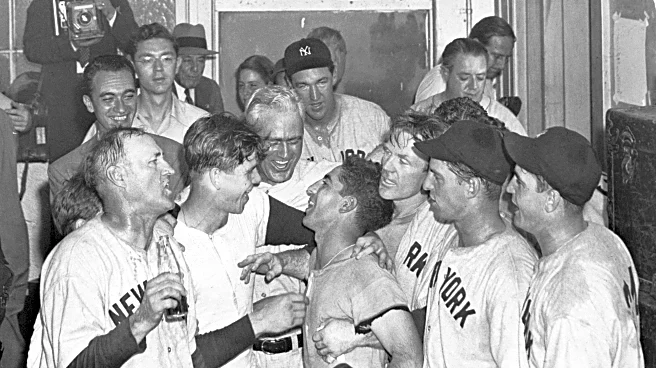
fortune to join the Yankees coaching staff just in time for the 1927 season. Fletcher, who made a brief cameo as the Yankees manager in 1929, remained with the club into 1945, when health issues forced him to retire. Though he never won a World Series as a player, he racked them up in the dugout, winning nine Fall Classics as a Yankee coach (he’s on the left in the photo above).
Name: Arthur “Art” Fletcher
Born: January 5, 1885 (Collinsville, IL)
Died: February 6, 1950 (Los Angeles, CA)
Yankees Tenure: 1927-1945
Fletcher broke into the major leagues in 1909 as a 24-year-old, playing shortstop for the New York baseball Giants. He was a mainstay for the Giants infield through the 1910s, excelling at the plate and in the field. Fletcher even led the Senior Circuit in bWAR in 1916, the finest offensive full season of his career. In 1920, the G-Men dealt Fletcher to Philadelphia for cash and he played the final two years of his career, the remainder of 1920, and 1922, for the Phillies.
After his playing days ended, he transitioned to the dugout. Unfortunately for Fletcher, he was not nearly as successful managing a baseball club as he had been as a player at shortstop. In his four seasons running the Phils, his high-water mark was a 68-85 record in 1925. He and Philadelphia failed to crack the 60-win mark in any of his other three seasons. Beaten down by the constant losing, Fletcher decided to resign.
Then, serendipity intervened. Fletcher and Yankees manager Miller Huggins knew each other from their days in the National League in the 1910s. Huggins persuaded Fletcher to join his coaching staff in New York, making Fletcher his “First Lieutenant,” as the New York Times later described.
What a time to board that particular train. The ’27 Yankees, featuring the famed “Murderer’s Row,” won 110 regular season games en route to their first of back-to-back World Series championships. As the Fall Classic approached that season, Fletcher took umbrage with the perception that the Yankees had trouble with the curve.
Calling any talk that Yankee batsmen struggled with the hook “bunk,” Fletcher opined: “The only real curveball pitcher on the Pirates squad is Aldridge, and his curve is not as sharp as that of Flint Rehm of the Cardinals. And what did the Yankees do to Rehm last year? Forced him out of the box in four innings.” The Yanks swept Pittsburgh in four games, outscoring them 23-10. If the Pirates were throwing curveballs, Fletcher was apparently dead on with his self-scouting.
When Huggins was hospitalized in September 1929, Fletcher got a second chance to manage a major league team, albeit briefly. The Yanks went 6-5 with Fletcher in the dugout and finished second in the American League. Tragically, Huggins died not long after entering the hospital, leaving the Yanks bereft of their leader.
After the 1929 season, the Yankees offered the managing job to Fletcher, who declined, knowing that the pressure of the job, along with his “high-strung temperament, flaming aggressiveness, and worrisome nature” would have been a poor match that may well have killed Fletcher. Fletcher knew what he was giving up though, telling his wife “I just turned down the best job in baseball.” Throughout his time with the Yankees, Fletcher also turned down managerial offers from the Indians, Browns, White Sox, and Tigers.
The Yankees ultimately chose Bob Shawkey to succeed Huggins for the 1930 season before hiring Joe McCarthy beginning in 1931. Upon McCarthy’s hire, reporters immediately speculated the new manager would fire Fletcher, with whom he had feuded when both were managing in the National League. McCarthy, however, saw Fletcher’s value, and kept him on staff. Fletcher continued to coach for New York into the 1945 season, when heart problems put him in hospital and forced him to give up coaching in September.

Fletcher, renowned as a master strategist as a coach, earned a reputation for his ability to steal opposing clubs’ signs. The New York Times reported that it was widely believed Fletcher was the highest paid coach in baseball, earning more than $10,ooo per year from the Yankees. Moreover, during his long coaching career, Fletcher collected more than $75,000 in World Series and first-place checks. That enabled Fletcher and his wife to live a comfortable life in California. At the time of Fletcher’s death in 1950, the story was that he’d cashed more World Series checks than anyone in history.
Fletcher died on February 6, 1950, while driving his car. At the time of his death, he was survived by his wife Irene, two daughters, and his sister.
Art Fletcher never donned the pinstripes as a player, though he did ply his trade for another New York club. But he was an indispensable part of nine World Series championship teams, coaching an utter plethora of legends, from The Babe and the Iron Horse, to Joltin’ Joe, to a 42-year-old Paul Waner, who appeared in one game in April 1945. Happy birthday, Art Fletcher.
References:
Art Fletcher. Baseball-Reference.
“Art Fletcher, 65, was a Giants Star.” New York Times. February 7, 1950.
Daley, Arthur. “Sports of the Times.” New York Times. February 8, 1950.
Gordon, Peter M. “Art Fletcher.” SABR.
Green, Howard. “George Schepps Remembers Art Fletcher and Others.” SABR.
“Yanks Can Hit Curves.” New York Times. October 4, 1927.
See more of the “Yankees Birthday of the Day” series here.