




Virginia fans came into this season with every reason to be optimistic, off the back of the best year in program history: a record 11 wins, an ACC Championship Game appearance and a Gator Bowl victory.
The Cavaliers came into this game ranked 25th, a 10.5-point favorite, and riding the best two-game start for the program since 1930 after dominant wins over NC State, 34-8, and Norfolk State, 59-3.
The early signs were positive. Virginia marched down the field on a methodical opening drive to take the lead,
and the Cavaliers led 14-7 eight minutes in. Then West Virginia scored on four of its next five possessions, in what can only be described as a deflating performance.
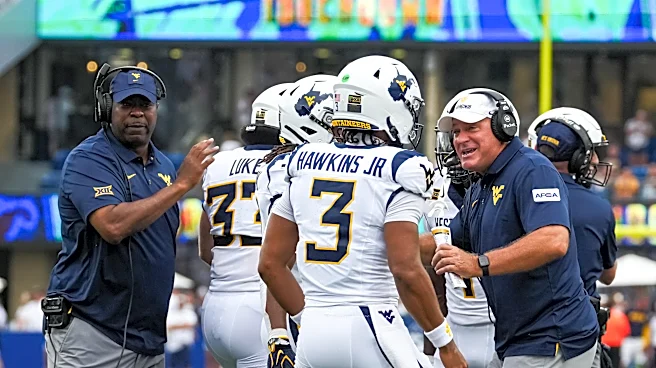
The 38-27 final moved the Mountaineers to 3-0 in Rich Rodriguez’s second season back in Morgantown. For Virginia, it was the first real adversity of the season, and it raised questions.
A year ago, the “Cardiac Cavs” built their reputation on late-game answers and hard-fought wins. Saturday, the answers were not encouraging.
Here are five takeaways from the loss.
The questions about Virginia’s interior defensive line got answered
Despite the success against the run in UVA’s first two games, I had flagged the defensive line as the room with the most left to prove. The news of Jason Hammond’s season-ending elbow surgery midweek only sharpened the concern. Factoring in the opponent, I thought it was the most important question on the board, which is why I spent midweek writing a deep dive on the front.
West Virginia entered Saturday ninth nationally in rushing offense, running the ball on roughly 81 percent of its snaps. Virginia entered without its starting three technique.
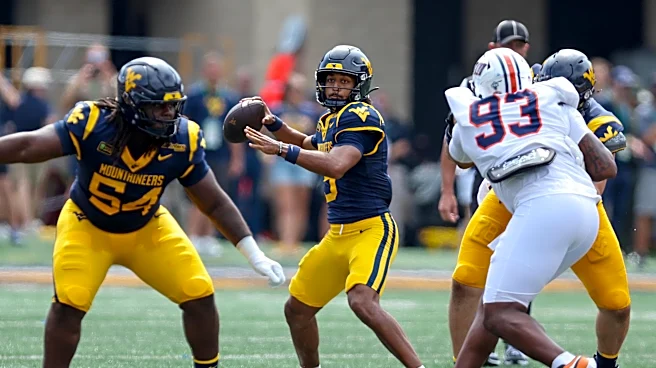
The problem turned out to be worse than even I had imagined. The Mountaineers ran it 51 times for 247 yards, 4.8 a carry, and three rushing touchdowns from their quarterback.
Whereas Virginia relies on a stable of backs, West Virginia rode two men: Cam Cook and Michael Hawkins Jr. combined for 246 of the Mountaineers’ 247 rushing yards. Cook got 30 carries, and Virginia was rarely able to bring him down on first contact, which turned three- and four-yard gains into six and seven all night.
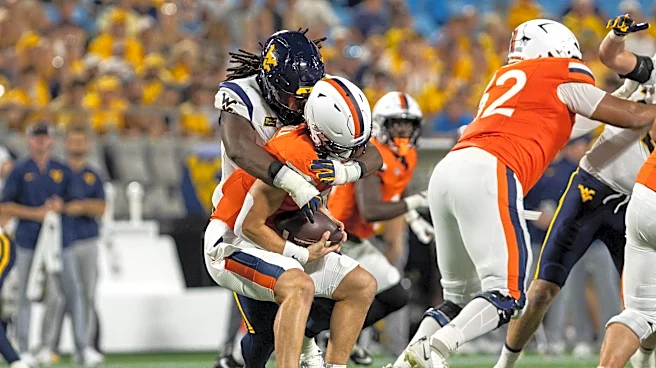
Virginia finished with five tackles for loss and one sack, and Nnanna Anyanwu’s second sack in as many games was one of the few times all night that the Cavaliers got to Hawkins at all.
The offensive play calling is once again a problem
After Virginia bullied both NC State and Norfolk State at the line of scrimmage, many fans had hoped the rudimentary play calling was a matter of not wanting to open up the playbook in games that were already decided.
Once Virginia fell behind, it became apparent there was nothing in the back pocket.
The Cavaliers ran the ball up the middle, threw it short, and had no third gear. They went 6-for-16 on third down, which is particularly notable given that Virginia converted nearly 50 percent of its third downs a year ago under quarterback Chandler Morris.
The most jarring example came late in the fourth quarter. Facing second-and-5 with about five minutes left, Virginia threw a contested go route on two straight plays, this from a team without a bona fide No. 1 receiver. Tony Elliott then went for it on fourth down, and a sack essentially ended the game. On a night when the offense had struggled in every obvious passing situation, something higher percentage that at least kept a run on the table seemed like the obvious call.
That was in stark contrast to the West Virginia offense, which seemed to dial up an open target down the field whenever Hawkins needed one, to the tune of 19 yards per completion.
There were two calls that worked, and both stood out precisely because they were unusual: a fake reverse and throw to Dakota Twitty, and the shot down the middle to Twitty that was the first genuine downfield attempt in what felt like a quarter and a half. The rest was a lot of the same thing. This is criticism that has been levied at offensive coordinator Des Kitchings before, and it appears less has changed than some had hoped.
Virginia does not have a downfield passing game and the QB run game disappeared
This is an extension of the play calling takeaway, but I want to narrow it to quarterback Beau Pribula. Against NC State, the two things that worked best for Virginia were using Pribula as an extension of the running game and leveraging that pressure through play action to take the top off the defense.
Against West Virginia, both of those facets seemed nonexistent.
Pribula was 21-of-33 for 197 yards and two touchdowns with no interceptions. That line looks fine in a box score. It did not look fine live, where his difficulty pushing the ball down the field was readily apparent.
His longest completion went 35 yards to Xay Davis on a catch and run in garbage time. Rico Flores Jr., the UCLA transfer and projected WR1 making his Virginia debut after missing the first two games, was invisible until a fantastic 26-yard catch on fourth-and-10, a play that led to Virginia tying the game and one of the few moments in the second half when it felt like the Cavaliers had momentum.
Pribula’s limitations as a pure downfield passer have been well documented, which is exactly why his excellent use of play action against NC State mattered so much. Abandoning his single biggest attribute is all the more surprising for it.
Against NC State, Pribula looked a lot like Hawkins looked Saturday, running downhill and eluding would-be tacklers with ease. Saturday, the quarterback run game was almost nonexistent after an 11-yard run on Virginia’s first drive.
Pribula has already proven he can be an elite running quarterback. But when we refuse to use him as a runner while trying to mount a comeback, and he struggles as a drop-back passer, I wonder whether Pitt transfer Eli Holstein, who looked good in his albeit limited snaps against Norfolk State, would have been the better choice.
The secondary had multiple large lapses, and Virginia’s defensive playmakers didn’t show up
Hawkins threw 17 passes and completed 10 of them for 190 yards, 19.0 yards per completion and 11.2 per attempt. That is what happens when the safeties rotate down to handle the run and the left seam opens behind them. D.J. Epps caught three balls for 92 yards and two scores; Jaden Bray caught two for 67.
That included some outright ugly coverage breakdowns. On multiple occasions, Virginia defenders ran into each other. A third-down pass interference on Omillio Agard on West Virginia’s second drive extended the possession that produced the tying touchdown and flipped the game’s momentum for good.
The names Virginia relies on to decide games did not decide this one. Brandyn Hillman, who had four of Virginia’s five takeaways coming in, finished with two tackles, neither of them solo, and a bad personal foul. Elliott said afterward that Hillman had been dealing with a tooth problem that limited him in practice much of the week. Even so, a subpar game from Hillman in a game that demanded excellent safety play was not ideal.
Fisher Camac led the team with 11 tackles, half a tackle for loss and no sacks. Kam Robinson, in his second game back, had eight tackles and a team-high two tackles for loss, including an early third-quarter stop behind the line and a genuinely violent hit on Hawkins.
But Virginia failed to force a single turnover after averaging 2.5 per game coming in, and struggled once again to get home on the quarterback.
The second-half push never came
Over the last two years, Virginia has prided itself on its high-rotation style and its second-half identity. It is part of why the Cavaliers pulled off so many close wins a season ago, and something I wrote about midweek.
Saturday, the story was different. From the moment Xavier Brown’s 47-yard touchdown put Virginia up 14-7, West Virginia outscored the Cavaliers 31-7 until John Rogers caught a touchdown with 21 seconds left that changed nothing. Virginia’s one real fourth-quarter possession reached the West Virginia 13, gave up a sack, and ended with Will Bettridge’s 41-yard field goal sailing wide right with 9:13 to play.
Virginia won 11 games last season by being the fresher, tougher team after halftime. Saturday, the Cavaliers faded down the stretch and West Virginia looked like the more physically imposing team. More concerning, there seemed to be a surprising lack of fight from the Virginia players once the game got out of reach.
Bonus: Charlotte remains a house of horrors. Many Virginia fans had hoped this game would serve as a get-right spot and a measure of redemption after the gut-wrenching loss to Duke in last season’s ACC Championship Game. It was not to be. Bank of America Stadium is now the site of Virginia’s last two losses of consequence, something I will be keeping an eye on given that the road back to Charlotte in December is the primary goal of the season.
Bonus: This never felt like a neutral site. I do not enjoy writing this one, but it needs to be said. This was supposed to be a Virginia home game. Instead it was moved to Charlotte, and the broadcast made clear which fan base had traveled better. Of the fans in the stadium, West Virginia’s outnumbered the Virginia faithful at least four to one, and the Mountaineers clearly fed off that energy. I suspect many Virginia fans assumed this was just another game and that the team could coast to a win. Unfortunately, it seems the players played with that same mindset, which is disappointing when you consider the atmosphere that could have been had this game been at Scott Stadium.
What’s next
Virginia hosts Delaware on Sept. 26 in a much-needed get-right spot at Scott Stadium before heading to Florida State on Oct. 3. The Delaware game is the last soft landing on the schedule, and Virginia needs to use it to iron out the kinks.
This was Virginia’s lone Power Four non-conference opponent, and Saturday’s performance likely kills any chance of an at-large playoff berth. But as Elliott said afterward, this team still has all of its goals in front of it and controls its own destiny in the ACC.