


Injuries are an unfortunate part of football, and losing players at a particular position can force a team to dig deep into its depth chart in search of answers. But what Syracuse has endured at quarterback over the past two years is an entirely different level of adversity.
Since September 20, 2025, the Orange have cycled through an astonishing eight players taking snaps under center. Steve Angeli, Rickie Collins, Joseph Filardi, Luke Carney, Amari Odom, Malachi Nelson, Danny Lauter and even tight
end Dan Villari, on multiple occasions, have all stepped in to lead the offense.
It is hard to overstate the challenges Fran Brown has faced, and it’s difficult to fault the head coach for a string of unfortunate circumstances which have pretty much been entirely outside his control. Still, Brown has been dealt an incredibly difficult hand as he tries to keep the program moving forward in the midst of what feels like a never ending QB carousel.

However, at the end of the day, football is a results-based sport, and the results have been difficult to ignore. Over the past two seasons, Syracuse has managed just one win over a Power Four opponent while now becoming nationally recognized as a team that might just belong in the basement of the ACC standings.
Through all of this, one thing has remained constant: Fran Brown’s desire to win. As he continues searching for answers, one potential solution is to get Steve Angeli, who has been out the past two games, back under center, especially with both Amari Odom and Malachi Nelson currently dealing with upper-body injuries.
At first glance, this seems like a positive development: Angeli is back practicing and is close to returning to a team that desperately needs him. But that word, “desperately,” is key here. In its search for answers, Syracuse could be making a decision that ultimately hurts both the Orange and Angeli moving forward.
When taking another look at Syracuse.com’s Chris Carlson’s tweet, one detail that caught my attention was that Angeli had received a PRP injection in an effort to expedite his return to the field. But what exactly is a PRP injection?
PRP stands for platelet-rich plasma, a treatment that involves taking a sample of a patient’s own blood, concentrating the platelets, and injecting the resulting plasma into the area that is injured in hopes of promoting the body’s natural healing process. Now the question is what is the area that needs the PRP shot.
Back to Chris Carlson we go:
A tweet from two days earlier confirmed that Angeli received the PRP injection in the same Achilles tendon he tore against Clemson last year and subsequently underwent what was described as “successful” surgery to repair.
(Editor Note- according to reports, the injection was at the recommendation of Martin O’Malley, the doctor who performed Angeli’s surgery)
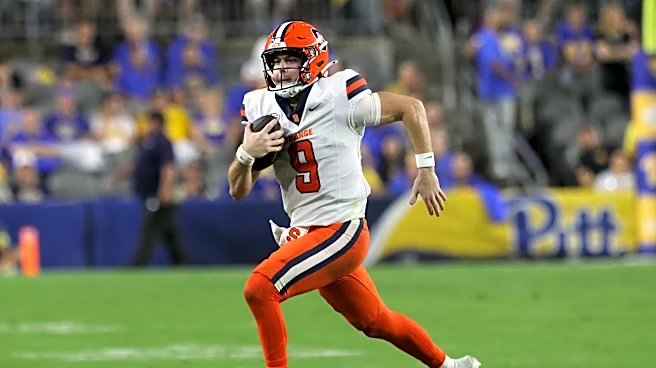
There are a few things worth noting here. First, there was a DRASTIC difference between the version of Angeli we saw against Clemson last year and the one who took the field against California and Pittsburgh this season. The velocity on his throws simply wasn’t the same, and his struggles appeared to coincide with limitations in his lower-body strength and mobility.
At the same time, it’s important to recognize just how remarkable Angeli’s “recovery” from his Achilles tear was. He returned to the practice field roughly six months after surgery, an incredibly impressive timeline for such a significant injury. While that speaks to his hard work and commitment to rehab, it also raises another fair question: Had his body fully returned to Division I FBS form by the time he took the field this season?
Finally, I’d like to offer a personal perspective. I was a collegiate baseball pitcher at the College of the Holy Cross in Worcester, Massachusetts. Although I never received PRP injections myself, I had teammates who were referred for the treatment to address shoulder and elbow discomfort. I watched them go through months of ups and downs, with some days when their arms felt great and others when they could barely move or rotate them without discomfort.
Based on what I witnessed and heard from those teammates, I came away wondering whether PRP injections were sometimes providing temporary relief for more significant underlying issues rather than addressing the root of the problem. In some cases, it seemed as though the short-term improvement came at the expense of a longer recovery process.
Every injury and recovery is different, of course, and my experience is purely anecdotal. Still, it makes me wonder whether Angeli’s return to the field tells the full story of where he is physically and whether he’s truly ready to perform at his previous level.
And the more and more I think about it, the more I believe that this Achilles injury is much more significant that it is being treated as and the PRP shot may not be enough of a solution.
When I watched Steve Angeli in Death Valley last year, carving up the defense and making every throw look effortless before suffering his injury, I felt like I was watching a future NFL quarterback.

But watching him take the field on a Thursday night against Pittsburgh just a few weeks ago, I found myself asking a question I never thought I’d have: Should Steve Angeli still be Syracuse’s starting quarterback?
From the outside looking in, it feels like the chaos surrounding this program could lead to questionable decision-making on issues surrounding the health of the quarterbacks, and my biggest concern is that those decisions have already created and will continue to create even bigger problems down the road.
What are your thoughts on how the Orange should handle the health of their quarterbacks?