
In the modern era, you can probably recall the exact prospects the Yankees have had that excited you but didn’t pan out. However, thinks like prospect rankings and outlets that cover up-and-coming players are all things that have come about in most of our lifetimes. If you were to open up the history books, you may find a random player who played in just 10 career games and never made it after that. To us, they’re just a name, but at the time, they may very well have been a potential superstar.
Slim
Love was one such player.
Edward Haughton “Slim” Love
Born: August 1, 1890 (Love, MS)
Died: November 30, 1942 (Memphis, TN)
Yankees Tenure: 1916-18
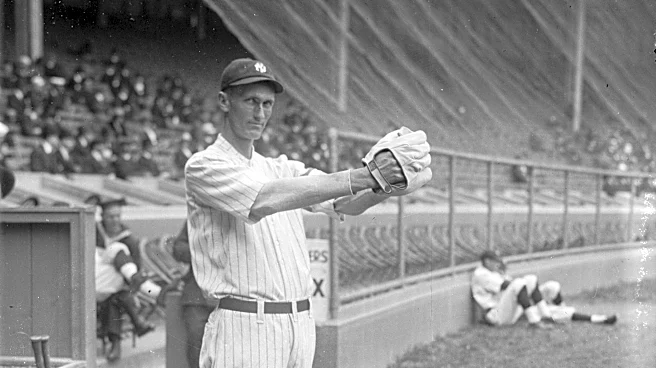
Edward Love was born in the aptly-named Love, Mississippi in 1890. The future big leaguer would say that wasn’t a coincidence and the town was named after his grandfather, but that’s a disputed claim. He grew up working on his family’s farm, but played baseball on some local amateur and semi-pro teams, and showed an aptitude for the sport. Helpful to that pursuit was that Love shot up in height, eventually growing to be 6-foot-7. (He was the tallest pitcher in the majors during his career.) His tall, lanky build got him his nickname of “Slim,” but also added a dimension to his pitching prowess.
Love rose pretty quickly from semi-pro player to getting a deal with the minor league Memphis Chickasaws. While his pitching ability impressed Memphis — he even struck out future Hall of Famer Nap Lajoie in an exhibition — he was a bit too raw and didn’t have a great grasp of other fundamentals, such as fielding. He was sent to some lower minor league levels. A good run with the Selma Centralites in 1913 got him noticed by the Southern Association’s Class-A Atlanta Crackers, which at that time was the second-highest level of the minors. His raw talent shone through there and after just a handful of starts, he was signed by the major-league Washington Senators.
Debuting in September 1913, Love made five appearances for the Senators, including one start. He was pretty decent, posting a 1.62 ERA, but was still considered very raw. That plus an injury led to him going back down to the minors and joining the old Los Angeles Angels of the Pacific Coast League. He spent two years there, and — especially in 1915 — was excellent, having refined some of his offspeed stuff. That got him back on the major league radar and the Yankees swooped in and acquired him ahead of the 1916 season.
Love’s first season in New York was a bit of a weird one. He missed time during spring training after injuring himself tripping over railroad tracks, and then contracted malaria in June. Those issues wouldn’t have helped, but he also wasn’t particularly great on the mound. Love posted a 4.91 ERA (60 ERA+), and walked more batters than he struck out.
However, Love’s potential was too much for the Yankees to ignore. Ahead of the next season, manager Bill Donovan said, “If that big fellow ever acquires control he will be as difficult to hit as Rube Waddell was in his best days. No left-hander since Rube’s time had such a good fast ball. His curve breaks fast and his great height will add to his effectiveness.” In 1917, he showed signs of that being true.
Working mostly in a swingman role for the 1917 Yankees, Love was very solid. He posted a 2.35 ERA (115 ERA+) in 130.1 innings, including nine starts. He also put up one of the more impressive pitching performances you’ll see throwing 14 scoreless innings in a game against the Athletics on May 30th. Besides that, Love also lowered his walk rate a bit, giving some hope for the future.
For 1918, Love became a mainstay in the Yankees’ rotation. However, he couldn’t maintain his improvements from the prior season. In 228.2 innings, Love issued a league-high 116 walks, and also put up a 3.07 ERA, which doesn’t sound bad, but equated to a 91 ERA+ in that Deadball Era season. That ended up being the Yankees’ limit, and that winter they traded him to the Red Sox.
Love wasn’t with Boston for long, as the Red Sox traded him to the Tigers just a month after acquiring him. After initially having a salary dispute with Detroit, he eventually joined them and had a pretty solid 1919. However after one bad game and reported rule violations, the Tigers released him in April 1920. While he continued on in the minor leagues though 1930, he never made it back to the majors. He just never managed to get his control under, well, control.
Following his baseball career, Love returned to the Memphis area, where he lived with his wife and worked as a pipefitter. He was killed in 1942 after being struck by a car while attempting to cross a road.
With all the technology at hand today, Slim Love is the type of player that teams today would love to acquire and try and work through his issues. However in the 1910s, there wasn’t a ton you could do besides just asking him nicely to stop walking people.
See more of the “Yankees Birthday of the Day” series here.